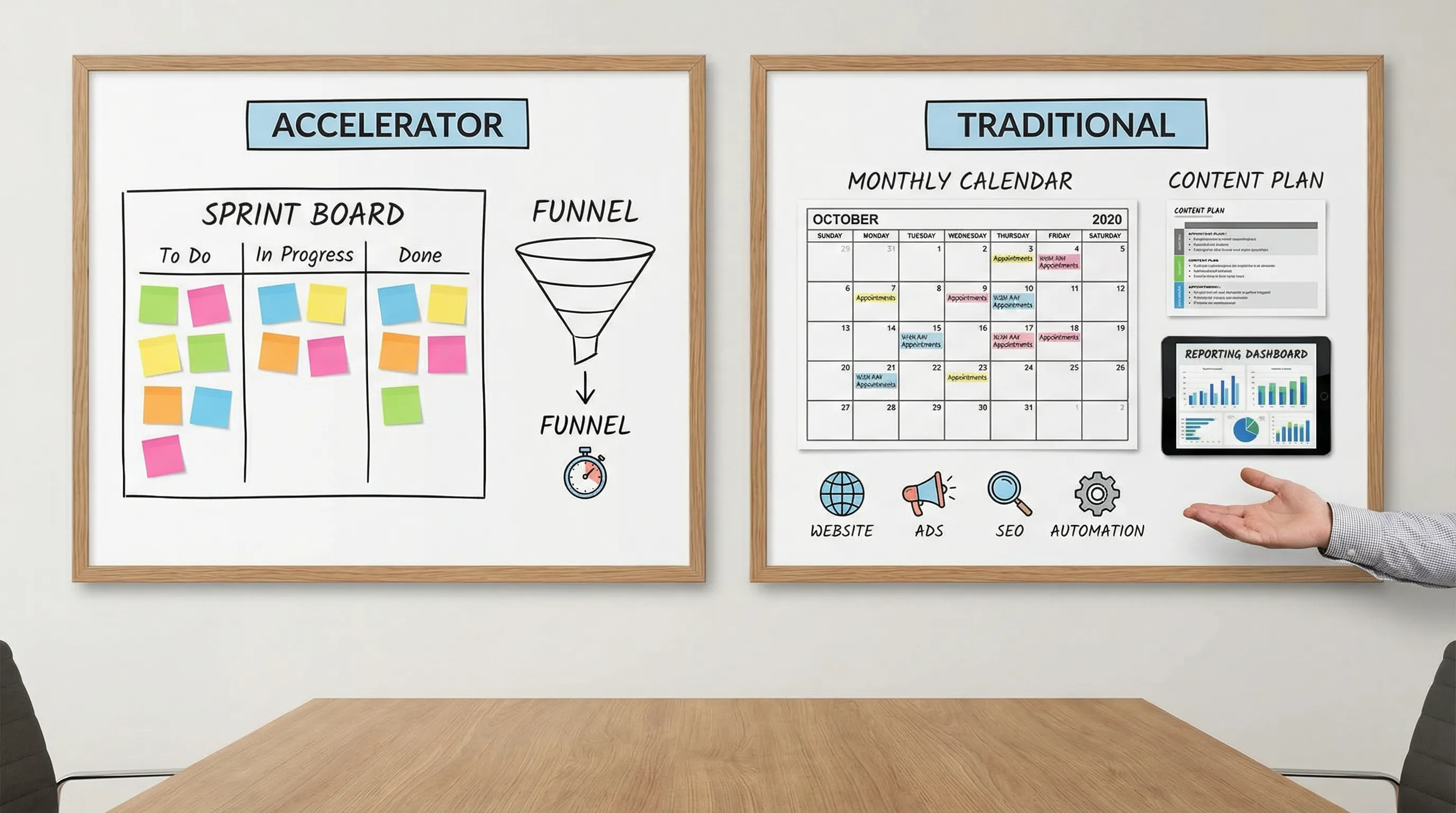
Accelerator Agency vs Traditional Agency: Key Differences

Most local businesses don’t fail because they “need more marketing.” They fail because they pick the wrong type of partner for the stage they’re in.
A traditional agency can be a great fit when you want steady brand presence, ongoing management, and someone to run a broad mix of channels over time. An accelerator agency is typically built for speed, focused experiments, and shipping a working growth system quickly (tracking, landing pages, ads, follow-up automation), then iterating hard until the numbers make sense.
If you’re comparing an accelerator agency vs a traditional agency, this guide breaks down the key differences, what to expect contractually, and how to choose based on your goals as a local business in Norway or the US.
What is an accelerator agency?
An accelerator agency is a growth partner designed around rapid implementation and compounding improvements. Instead of starting with long discovery phases and broad brand work, an accelerator model typically:
- Focuses on a narrow set of revenue-driving outcomes (qualified leads, booked calls, quote requests, pipeline)
- Works in short sprints (often weekly or biweekly)
- Prioritizes measurement, conversion rate improvements, and speed to market
- Uses repeatable frameworks and automation to reduce manual work and time-to-results
In practice, many accelerator agencies behave more like “operators” than “vendors.” They want to build or fix the engine (website, offer positioning, tracking, ads, follow-up) so the business can scale with less guesswork.
What is a traditional agency?
A traditional agency is usually structured around ongoing service delivery across one or more channels (SEO, paid ads, social, creative, email, web). The engagement is often retainer-based and includes recurring tasks like:
- Monthly reporting
- Campaign management and optimizations
- Content production
- Creative iterations
- Platform management (Google Ads, Meta Ads, etc.)
This model can be excellent when you want stable execution, consistent production output, and a long-term partner that plugs into your operations.
Accelerator agency vs traditional agency: the key differences
Below is the practical comparison most business owners actually care about: speed, incentives, scope, and what you receive at the end.
| Category | Accelerator agency | Traditional agency |
|---|---|---|
| Primary goal | Build and optimize a growth system fast | Provide ongoing marketing services |
| Timeline | Sprint-based, front-loaded execution | Continuous, often slower ramp |
| Scope | Narrow, outcome-oriented | Broad, channel-oriented |
| Measurement | Aggressive tracking and conversion focus | Varies, often channel KPIs |
| Deliverables | Landing pages, funnels, tracking, automations, testing roadmap | Campaign management, content, creative, reporting |
| Incentives | Often tied to outcomes or milestones | Often tied to time and deliverables |
| Best for | Businesses needing traction quickly | Businesses needing ongoing support across many areas |
1) Speed: shipping beats planning (most of the time)
A major difference is how quickly you get from “we signed” to “we’re live.”
- Accelerator agencies tend to launch a minimum viable version of the funnel quickly, then iterate.
- Traditional agencies often spend more time on discovery, brand alignment, approvals, and longer campaign cycles.
For local businesses, speed matters because demand is seasonal, competition is local, and cash flow is real. A plumber, clinic, roofer, or B2B service firm often benefits more from getting to a working lead system fast than from polishing a perfect plan for months.
2) Scope: channel-first vs outcome-first
Traditional agencies commonly start with channels:
- “You need SEO.”
- “You need Meta ads.”
- “You need content.”
Accelerator agencies usually start with the outcome:
- “We need 25 qualified quote requests per month at a sustainable cost.”
- “We need to turn your site traffic into booked calls.”
Then they pick the minimum set of moves required to reach that outcome.
This is not about one approach being “better,” it’s about matching your situation. If you already have demand and need long-term brand and content production, traditional can be perfect. If you need traction and clear numbers, outcome-first tends to feel more direct.
3) Incentives and risk: what are you paying for?
The most common frustration with traditional retainers is misalignment: a business pays monthly, but results may be slow or unclear.
Accelerator models often introduce some form of risk reversal or milestone-based delivery. That might look like:
- Fixed-scope “build and launch” packages
- Performance incentives (with careful definitions)
- Shorter commitments, or a clear phase structure (build, then scale)
A good example of risk reversal in the local-business world is when a partner builds the asset first, then you decide if it’s worth paying for.
At Kvitberg Marketing, for instance, the offer includes pre-built, SEO-optimized websites for local businesses completely free upfront, followed by a short walkthrough meeting. You only decide to buy after you’ve seen the finished site, and optional growth add-ons (like SEO campaigns or Google Search Ads management) can be layered on if it makes sense.
That is a very different risk profile than paying for months of work before you see a tangible asset.
4) What you “own” at the end of the engagement
Ask this blunt question before you sign anything:
“If we stop working together in 90 days, what do we own?”
With an accelerator agency, you should typically expect more durable assets:
- A finished website or landing pages designed around conversion
- A tracking setup that makes decisions easier (not just reports)
- A test backlog and documented learnings
- Basic automations (lead routing, follow-up sequences, qualification)
With a traditional agency, you may receive some assets (creative, content, ad account structure), but in many cases the main value is the ongoing management itself.
Neither is wrong, but your preference matters. Some owners want a long-term operator. Others want a system they can keep.
5) Team structure: specialists and operators vs account layers
Many traditional agencies are organized around account management, with work distributed to channel teams. That can be efficient and consistent, especially for multi-channel brands.
Accelerator agencies often have smaller teams with more “full-stack” execution capability. The upside is speed and fewer handoffs. The downside is that you must verify depth in the areas that matter most to you (for example, technical SEO, Google Ads lead quality, or conversion rate optimization).
What this looks like for local businesses (realistic examples)
Local business marketing has unique constraints: service radius, trust, reviews, call-heavy lead flow, and high-intent searches.
A traditional agency might propose a longer roadmap: brand refresh, content calendar, social management, SEO over quarters.
An accelerator agency is more likely to start with:
- A fast, high-clarity website experience (service pages, location relevance, strong calls to action)
- A lead capture flow that matches the business (calls, forms, booking)
- Google Search campaigns aimed at bottom-of-funnel terms
- Basic follow-up automation so leads do not leak
If you want a concrete reference for how a local home-service company structures its service and location relevance, look at how TapTech’s Kingston plumbing and drain cleaning services are presented. It’s a useful example of aligning offerings, service areas, and trust signals in a way that supports both conversions and local visibility.
When an accelerator agency is usually the better fit
Choose an accelerator-style partner when:
- You need results fast because cash flow or seasonality matters
- Your website is outdated, unclear, or not converting
- You are unsure which channel will work, and you need rapid testing
- Lead follow-up is inconsistent, and you suspect you’re leaking revenue
- You have a strong service, but your positioning is muddy
This is especially common for local services, clinics, and B2B teams that need a predictable pipeline rather than “more awareness.”
When a traditional agency is usually the better fit
A traditional agency tends to fit better when:
- You already have a working funnel and need scale across multiple channels
- You need ongoing content and creative production every month
- You have internal marketing leadership and want a stable execution partner
- Brand consistency and long-term positioning are top priorities
For established companies with steady inbound and clear product-market fit, the traditional model can be extremely effective.
How to evaluate any agency model (the questions that reveal the truth)
Instead of getting stuck on labels, evaluate the operating system behind the pitch.
Ask about measurement (not just reporting)
Good agencies can explain:
- What counts as a qualified lead for your business
- How they will track it end-to-end (from click to call to booked job, if possible)
- What they will change if results stall
If the conversation is mostly about impressions, clicks, or “brand awareness” for a business that needs leads, you may be looking at a mismatch.
Ask how they handle lead quality
Local businesses often discover too late that “more leads” can mean more spam.
A strong answer includes lead filtering, conversion-focused landing pages, negative keywords (for Google Ads), and feedback loops (marking leads as qualified, not qualified, won, lost).
Ask what happens in the first 14 days
The first two weeks tell you what type of partner you’re hiring.
An accelerator-style plan often includes concrete launches (pages, tracking, campaign build). A traditional plan may include more research and foundation work. Either can be valid, but it should match your urgency.
Ask what you own
You want clarity on:
- Website and landing page ownership
- Access to ad accounts and analytics
- Creative files
- Documentation of what was tested and learned
The hybrid approach (often the smartest answer)
Many local businesses do best with a hybrid:
- Start with an accelerator phase to fix the fundamentals (offer clarity, website, tracking, initial campaigns).
- Then move into a more traditional cadence for steady optimization, content, SEO growth, and expansion.
This avoids the most common failure mode: paying for long-term marketing activities before the funnel is capable of converting demand.
Bottom line: pick the model that matches your stage
“Accelerator agency vs traditional agency” is really a question of stage and urgency.
If you need a working lead system quickly, and you value rapid iteration and clear measurement, an accelerator agency is often the better fit.
If you already have momentum and want consistent multi-channel execution over time, a traditional agency is often the better fit.
If you’re a local business that wants to see a finished, SEO-optimized website before committing, you can explore the risk-reversal approach at Kvitberg Marketing, then decide whether to add ongoing growth services like SEO campaigns or Google Search Ads management.