Acquisition Marketing: The System Behind Predictable Growth

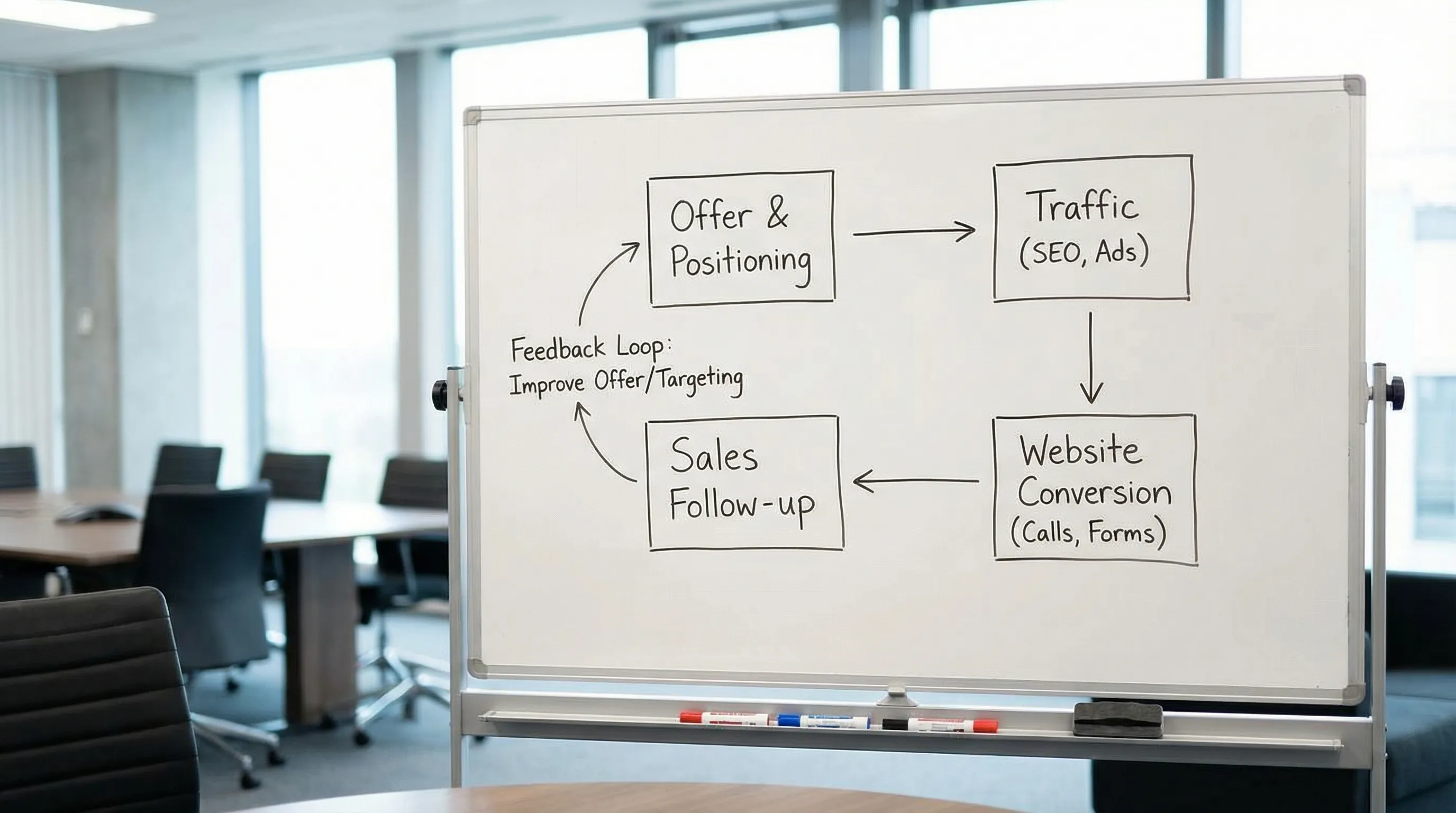
Predictable growth rarely comes from “trying a bit of everything.” It comes from a repeatable acquisition marketing system: a clear offer, a high-converting web asset, reliable tracking, a channel plan that matches your market, and a feedback loop that steadily improves results.
For local businesses in Norway or the US, this matters even more. Your demand is often seasonal, your service area is limited, and your budget has to create leads, not just “awareness.” The good news is that acquisition marketing is not magic, it is a set of controllable inputs.
What acquisition marketing is (and what it is not)
Acquisition marketing is the discipline of generating new customers (or qualified leads) through measurable activities, then optimizing those activities based on performance data.
In practice, that means building a system where you can answer, with confidence:
- Where leads come from (channel, campaign, keyword, creative)
- What they cost (cost per lead, cost per booked call, cost per customer)
- Whether they turn into revenue (close rate, average order value, payback period)
It is not the same as “running ads.” Ads can be part of it, but acquisition marketing also includes SEO, conversion rate optimization, landing pages, lead handling, and the operational pieces that stop good leads from leaking.
The system behind predictable growth: 6 building blocks
Most businesses that feel “marketing is random” are missing one or more of these blocks.
1) A focused offer and positioning
Acquisition gets dramatically easier when you are specific. “Plumber in Oslo” is a category. “Emergency plumber, 24/7, arrival in 60 minutes in Oslo West” is a reason to choose you.
Your offer does not need to be complicated, it needs to be:
- Clear (what you do, for whom)
- Differentiated (why you, not the business two streets away)
- Easy to act on (call, book, request quote)
A practical test: if a stranger lands on your site, can they understand your value in 5 seconds?
2) A conversion asset (website or landing page) built to win the click
Acquisition marketing converts on the page, not in the ad account.
For local service businesses, the highest-impact website elements are usually:
- One primary call to action (call, booking, quote)
- Proof (reviews, before/after, certifications, local references)
- Service-area clarity (cities, neighborhoods, travel radius)
- Fast load time on mobile
- Simple forms (collect only what you truly need)
If you are investing in SEO or Google Search Ads, this step is non-negotiable because search traffic has intent. Visitors are looking for an answer now, not a brand story.
3) Tracking that connects marketing to revenue (not just clicks)
Predictability comes from measurement quality.
At minimum, you want to track:
- Phone calls (including call duration or qualified calls)
- Form submissions (with spam filtering)
- Booked appointments (if relevant)
- Lead source and campaign attribution
If you only look at clicks and impressions, you will optimize for the wrong outcome. The goal is not traffic, it is qualified demand.
4) A channel mix that matches your buying intent
Channels are tools. Predictable acquisition comes from matching the tool to the moment.
- Google Search (SEO and Search Ads) captures existing demand (“best dentist near me,” “roof repair price”).
- Meta Ads (Facebook/Instagram) can create demand and retarget, but it usually needs a strong offer and good creative to work consistently.
- Local listings and reviews (Google Business Profile) are often the deciding factor for local buyers, even when they found you through ads.
A simple rule: if your service solves an urgent or high-intent problem, prioritize search and local visibility first.
5) A steady experimentation cadence
Acquisition marketing becomes predictable when your improvements are predictable.
Instead of constantly changing everything, you rotate through controlled tests:
- One offer test (for example, “free inspection” vs “fixed-price service”)
- One audience or keyword test
- One landing page test (headline, proof section, form friction)
- One creative angle test (pain-point vs outcome, seasonal angle)
Even small improvements compound when your tracking is clean.
6) Sales handoff and lead handling
Many local businesses unknowingly buy leads they never convert.
If you want predictable growth, you need an equally predictable follow-up process:
- Fast response time (often within minutes, not hours)
- A script for qualifying and booking
- A clear definition of a “qualified lead”
- A way to feed outcomes back into marketing (which leads closed, which did not)
For B2B teams, this is where CRM hygiene and pipeline discipline determine whether marketing shows ROI.
Which channels create predictable leads for local businesses?
The “best channel” depends on intent, margins, and how quickly you need results. Here is a practical comparison.
| Channel | Best for | Strengths | Watch-outs |
|---|---|---|---|
| SEO (local + service pages) | Sustainable inbound leads | Compounds over time, high trust, strong intent | Slower ramp, requires consistent quality |
| Google Search Ads | Immediate high-intent leads | Fast testing, precise intent targeting | Costs can rise, landing page quality matters |
| Meta Ads | Demand creation and retargeting | Scales reach, strong creative leverage | Intent is lower, needs tighter offer and proof |
| Google Business Profile + reviews | Local conversion lift | Influences almost every local purchase | Requires ongoing review generation and upkeep |
A common winning sequence for local businesses is:
- Fix the website and tracking.
- Turn on Google Search Ads for bottom-of-funnel queries.
- Build SEO in parallel so you reduce paid dependency over time.
- Add Meta retargeting once you have enough traffic and strong proof.
The metrics that keep acquisition marketing honest
“More leads” is not a strategy. You want profitable customer acquisition.
Use a small set of metrics that ties activities to outcomes:
| Metric | What it tells you | Simple formula | Why it matters |
|---|---|---|---|
| Cost per lead (CPL) | Efficiency of lead generation | Spend / leads | Helps compare channels fairly |
| Lead-to-customer rate | Lead quality + sales follow-up | Customers / leads | Shows if leads are actually viable |
| Customer acquisition cost (CAC) | Cost to win a customer | Spend / customers | The core profitability guardrail |
| Payback period | How fast you recoup CAC | CAC / monthly gross profit per customer | Protects cash flow |
| Conversion rate (site) | Website effectiveness | Conversions / sessions | Often the fastest lever to pull |
For local businesses, also track “qualified calls” or “booked jobs” when possible. A 30-second call is not a lead.
Common failure points (and how to fix them)
Treating the website like a brochure
If your site is mostly “about us” and vague service descriptions, you will pay more for every lead. Fix by making the page answer buyer questions directly: price ranges, process, timing, service area, proof.
Running too many channels too early
More channels create more noise. Start with the channel closest to purchase intent (often Google Search), then expand.
Measuring what is easy instead of what is true
Clicks and impressions are easy. Revenue is true. Move tracking closer to closed deals with call tracking, CRM notes, and consistent lead outcome labeling.
Weak operational follow-up
If you respond slowly, no channel will save you. Speed and consistency are multipliers on every marketing dollar.
A practical 30-day acquisition marketing setup (local business edition)
Week 1: Offer clarity + conversion foundations
Align on one primary offer and one primary call to action. Then rebuild or refine your key pages so they are designed for conversion, not just aesthetics.
If you do nothing else, make sure your home page and core service page each have:
- A clear headline (service + location + outcome)
- Prominent click-to-call on mobile
- Social proof (reviews, ratings, testimonials)
- A frictionless form
Week 2: Tracking + lead quality definitions
Implement measurement for calls and forms, then define what “qualified” means. For example, qualified might mean “within service area + budget range + service we provide.”
This is also the week to decide how you will record lead outcomes. A simple spreadsheet works if a CRM is not in place yet.
Week 3: Launch one high-intent channel
For most local businesses, that is Google Search Ads targeting service + location keywords with clear intent.
Keep it simple:
- A tight keyword set
- One landing page per service category
- Ad copy that matches the offer and sets expectations
Week 4: Optimize, then start compounding with SEO
Review what happened in the first 2 to 3 weeks of traffic:
- Which keywords or ads drove qualified leads?
- Which pages converted best?
- What questions did leads ask on the phone?
Then use that data to improve your pages and begin building SEO content that targets the exact terms that produced results.
Where AI and automation fit (without overcomplicating it)
AI is most useful in acquisition marketing when it removes manual work or improves speed-to-lead, for example:
- Automatically routing leads to the right person
- Enriching lead data (location, service requested)
- Summarizing call notes into your CRM
- Generating structured testing ideas from performance data
If your growth plan requires deeper integrations across CRM, ERP, CMS, or custom software, it can be worth involving a specialist partner like Syneo’s IT and AI solutions team to support implementation and information security considerations.
How Kvitberg Marketing supports predictable acquisition
If you are a local business that wants growth but does not want to gamble on a big upfront website project, Kvitberg Marketing offers a different starting point: a professionally built, SEO-optimized website delivered for free, followed by a short walkthrough to review the finished site. You only decide to buy after you have seen the completed result.
From there, you can add growth services based on what your market needs, including SEO campaigns and Google Search Ads management.
If you want acquisition marketing to feel predictable, start by getting the system right: a strong offer, a conversion-first website, clean tracking, and one channel that reliably captures intent. Then improve it every week.
You can learn more about Kvitberg Marketing’s approach at Kvitberg Marketing.