Agency Marketing Strategy: A Simple 90-Day Plan

Most agencies don’t lack tactics, they lack a plan that connects positioning, pipeline, and proof into a repeatable system. A simple 90-day agency marketing strategy fixes that by focusing on a few high-leverage moves, executed in the right order, with clear “done” criteria.
This 90-day plan is built for small to mid-sized agencies (and service businesses that sell like agencies) that want predictable, qualified meetings without burning weeks on random campaigns.
What a “good” agency marketing strategy must do in 2026
A strategy is only useful if it produces measurable pipeline. In practice, your agency marketing strategy should answer five questions:
- Who exactly do we serve? (ICP, niche, deal size, geography)
- What outcome do we sell? (clear offer, clear promise, clear proof)
- Where do qualified leads come from? (outbound, search, partnerships, referrals)
- How do leads become booked meetings and clients? (qualification, calendar routing, follow-up)
- How do we measure and improve performance weekly? (tracking, KPIs, iteration)
The 90-day plan below is organized around those five questions, so you build a system instead of a pile of disconnected “marketing activities.”
Before Day 1: pick your constraints (so you don’t overbuild)
Before you touch tools, decide on constraints. Constraints prevent scope creep.
Decide your target math:
- Monthly revenue goal (e.g., $30k)
- Average project size or retainer (e.g., $5k/mo)
- Close rate from qualified meetings (be honest, start with 20% to 30% if you have a decent sales process)
- Meetings needed per month to hit goal
If you want 6 new retainers at $5k/mo, and you close 25% of qualified meetings, you need ~24 qualified meetings. That becomes your operating target for marketing and outbound.
Decide your channel focus: choose one primary acquisition channel for the first 90 days (typically outbound or high-intent search), and one supporting channel (usually retargeting or partnerships). Trying to “do everything” is the fastest path to doing nothing.
The 90-day agency marketing strategy plan (simple, but complete)
Days 1 to 30: Nail positioning, proof, and the conversion path
Your job in the first 30 days is to make it easy for the right buyers to understand:
- what you do,
- who it’s for,
- why you’re credible,
- what happens next.
If you skip this, you will waste money on ads and burn leads in outbound.
Week 1: Define ICP + offer in one page
Start with a one-page “strategy snapshot.” It should include:
- ICP: industry, geography (Norway, US, or specific cities), team size, typical pain, buying trigger
- Offer: a clear packaged outcome (not “marketing services”)
- Proof: 2 to 5 specific results, case studies, or process credibility (even if anonymized)
- Disqualifiers: who you do not work with
A strong offer is specific enough that a prospect can self-select.
Example (simple, not perfect): “We help local service businesses book qualified estimates through Google Ads + conversion-focused landing pages, with call tracking and weekly optimization.”
Week 2: Build a landing page that sells the next step
Your website does not need to be huge. It needs to convert.
Minimum requirements for a high-performing agency landing page:
- Single primary CTA (book a call, request a quote, apply)
- Outcome-led headline (who + outcome + timeframe, when appropriate)
- Proof blocks (case studies, testimonials, before/after metrics, recognizable partners)
- Process section (what happens after they book)
- Qualification (3 to 6 questions on the form, or clear “who it’s for” copy)
If you run outbound, this page becomes your credibility layer. If you run ads, it becomes your conversion engine.
Week 3: Install tracking and define your weekly KPIs
If you can’t measure it, you can’t improve it. Set up your tracking so you can answer:
- Which channel produced this lead?
- Which message or keyword triggered it?
- Did it become a qualified meeting?
- Did it become pipeline and revenue?
At a minimum, ensure you have:
- Form and call conversion tracking
- CRM or spreadsheet pipeline tracking (lead source, status, value)
- Calendar booking attribution (even manual tagging is fine)
Here’s a practical KPI set that works for most agencies:
| KPI | What it tells you | Review cadence |
|---|---|---|
| Qualified meetings booked | Volume of real opportunities | Weekly |
| Show rate | Whether your scheduling + reminders work | Weekly |
| SQL to close rate | Sales effectiveness and lead quality | Monthly |
| Cost per qualified meeting (if paid) | Efficiency of acquisition | Weekly |
| Reply rate (if outbound) | Message-market fit | Weekly |
| Pipeline created | Whether activity turns into revenue | Weekly |
Week 4: Prepare your outreach and follow-up system
This is where most agencies accidentally “spam.” The fix is simple: improve targeting, relevance, and follow-up structure.
Build:
- A clean lead list process (ICP filters and exclusions)
- Deliverability basics (domains, inbox setup, sending limits)
- A reply handling workflow (fast responses, qualification, booking)
- A no-stress follow-up cadence (polite persistence)
If you have a small team, investing in skills pays off quickly here. A short, structured training sprint for your sales or outreach owner can dramatically improve reply handling and qualification quality. If you need formal learning paths, look at one-to-one upskilling programs that build practical skills with mentoring and certifications.
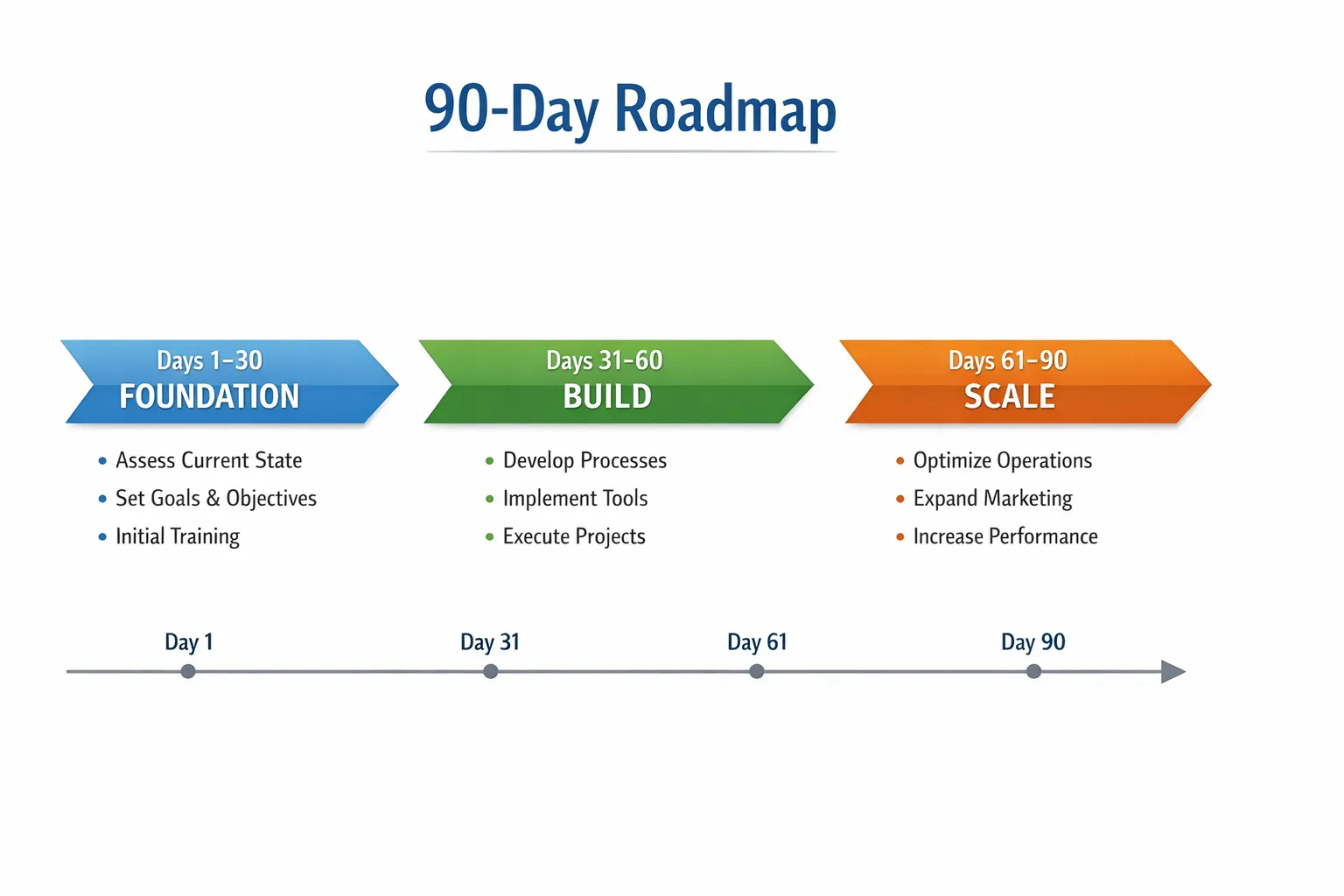
Days 31 to 60: Launch your primary channel and get to consistent meetings
Days 31 to 60 are about execution and feedback loops. You are trying to reach “baseline consistency” where you can roughly predict meetings per week.
Choose your primary channel below (outbound or search). You can do both eventually, but if you’re early-stage, pick one.
Option A: Outbound as your primary channel (common for agencies)
Your goal: book qualified meetings without volume blasting.
Focus areas:
1) Messaging that earns attention
Good outbound messaging is not clever, it is specific and relevant.
- Lead with a situation the ICP recognizes
- Name a common friction (leads, show rate, poor quality, slow follow-up)
- Offer a clear next step (short audit, quick teardown, 10-minute fit check)
2) Reply and follow-up workflows (where most revenue is made)
A lot of booked meetings come from follow-ups, not the first message. Build a simple workflow:
- Response rules (how fast you reply, how you qualify)
- A clear booking link and calendar routing
- A short pre-call confirmation (to increase show rate)
3) Weekly optimization
Every week, review:
- Which ICP segment replied most?
- Which opener got the best replies?
- Which objection shows up repeatedly?
Then adjust one variable at a time.
Option B: High-intent search as your primary channel (common for local and B2B)
Your goal: capture demand that already exists, then convert it.
1) Start with bottom-of-funnel keywords and pages
For agencies, this often means:
- “Google Ads agency for [industry]”
- “B2B lead generation agency”
- “SEO agency for [location/industry]”
For local businesses building an internal pipeline, it might be:
- “service + city” keywords
- competitor comparisons
- “near me” intent
Create or refine landing pages that match the intent and include proof.
2) Add retargeting as your supporting channel
Retargeting is a support layer that increases conversion rates when prospects need multiple touches.
Keep it simple:
- One offer-focused retargeting campaign
- One proof-focused retargeting campaign (case study/result)
3) Track leads through to meetings and revenue
Search can look great on CPC while quietly failing on lead quality. Track SQLs and closed-won, not just form fills.
Days 61 to 90: Systemize, scale, and remove bottlenecks
If you did the first 60 days correctly, you now have early traction and real data. The last 30 days are about making it stable and scalable.
1) Identify your constraint (it’s usually one of these)
Most agencies hit one of four constraints:
- Not enough leads (top-of-funnel problem)
- Leads aren’t qualified (ICP or messaging problem)
- Meetings don’t show (process problem)
- Deals don’t close (sales process problem)
Pick the biggest constraint and focus on it for two weeks.
2) Build simple SOPs so performance doesn’t depend on one person
Systemizing is what turns “a good month” into predictable growth.
Document:
- Lead sourcing rules (filters, exclusions, where to pull lists)
- Messaging guidelines (what to personalize, what to avoid)
- Qualification checklist (must-have criteria)
- Follow-up schedule (how many touches, what to send)
- Weekly review template (what metrics to check, what decisions to make)
3) Run focused A/B tests (one variable at a time)
Good 90-day strategies don’t run 20 experiments. They run 4 to 6 meaningful ones.
Examples:
- Two versions of the landing page headline
- Two outbound openers aimed at the same ICP
- Two lead magnets (audit vs teardown) for the same offer
- Two qualification forms (short vs slightly longer)
Track the outcome that matters (qualified meetings), not vanity metrics.
4) Add a second acquisition lever only after baseline consistency
Once your primary channel reliably books meetings, then add the next lever:
- Partnerships (web agencies, IT providers, local associations)
- Referral engine (simple ask, simple incentive, easy intro process)
- Content that supports sales calls (case studies, comparisons, “how we do it” pages)
This sequencing is what keeps your agency marketing strategy simple.
A practical 90-day deliverables checklist (what “done” looks like)
Use this table as your finish line for each phase.
| Phase | Primary goal | Core deliverables | Success signal |
|---|---|---|---|
| Days 1-30 | Conversion-ready foundation | ICP + offer snapshot, landing page, tracking, outreach workflow | You can clearly explain who you help, how you help, and measure meetings |
| Days 31-60 | Consistent meeting flow | Live campaigns (outbound or search), weekly optimization cadence, qualification + booking flow | Qualified meetings happen every week, not “randomly” |
| Days 61-90 | Stability and scale | SOPs, focused A/B tests, bottleneck fixes, secondary channel plan | You can predict pipeline within a reasonable range |

Common mistakes that kill a 90-day plan
Most failures come from a few predictable errors:
Building assets without distribution. A great website that no one sees is not a strategy.
Running distribution without conversion. Traffic and outreach won’t help if the landing page and offer are unclear.
Optimizing for the wrong metric. If you optimize for clicks or raw leads, you can end up with low-quality pipeline.
Changing too many variables at once. You won’t learn what’s working, and you’ll churn your team.
Skipping follow-up. A polite, structured follow-up process is often the difference between “no one is interested” and “we’re fully booked.”
When to bring in help (and what to ask for)
If you want to execute this 90-day agency marketing strategy faster, you typically need help in one of three areas:
- Outbound systems: lead sourcing, deliverability, messaging, reply handling, meeting booking, routing
- Performance marketing: Google Ads, Meta retargeting, landing page conversion improvements
- Measurement: tracking, pipeline reporting, weekly optimization
Kvitberg Marketing builds outbound client acquisition systems designed to book qualified meetings without spam, and supports the conversion side (landing pages, qualification, routing, tracking, and iterative optimization). If you want a system rather than scattered tactics, start by reviewing your current pipeline and identifying which constraint (leads, qualification, show rate, close rate) is holding you back, then map the next 90 days around that.
If you want to explore that approach with an expert, visit Kvitberg Marketing and use this plan as the agenda for your first conversation.