AI for Marketing: Real Workflows You Can Deploy This Quarter

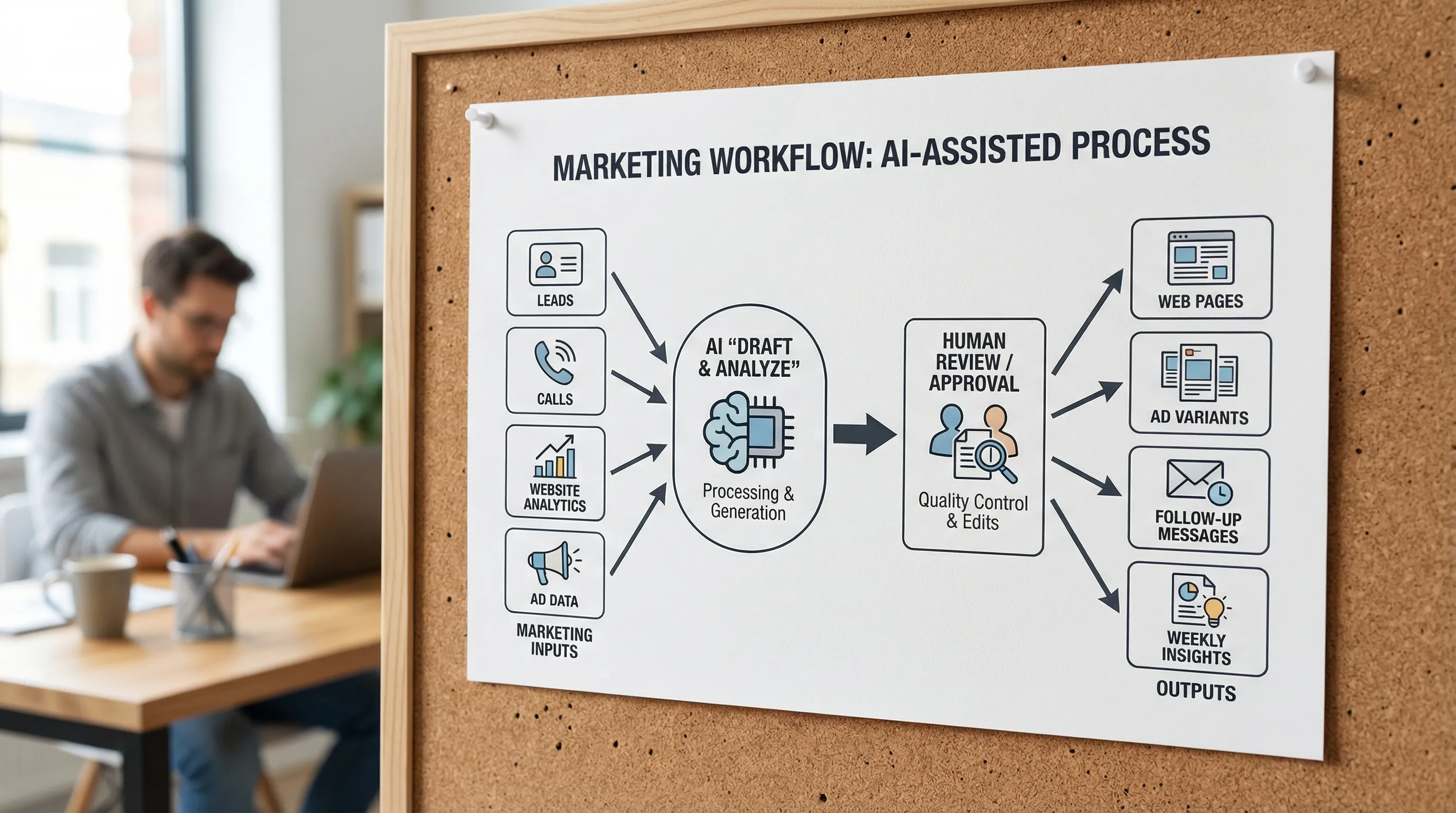
Most teams don’t need “more AI ideas”. They need repeatable workflows that reduce cycle time (from brief to publish, from lead to booked call, from spend to insights) without breaking trust or brand.
This guide focuses on AI for marketing workflows you can deploy this quarter (roughly 4 to 12 weeks), with clear inputs, tools, handoff points, and guardrails. It’s written for local businesses and lean B2B teams in Norway and the US that want practical wins in SEO, ads, and lead generation.
What “deployable this quarter” actually means
A deployable workflow has four characteristics:
- Known input: a form submission, a call recording, a weekly export, a set of landing pages.
- Constrained output: a draft page, five ad variants, a weekly insights email.
- Human review step: someone can approve, edit, or reject quickly.
- Measurable KPI: conversion rate, CPL, booked calls, indexed pages, time saved.
If your AI project needs a 6 month data lake rebuild, it’s not a “this quarter” workflow.
The 7 AI for marketing workflows that pay off fastest
The table below summarizes what most small teams can implement quickly.
| Workflow | Best for | Typical tools | Time to first version | Primary outcome |
|---|---|---|---|---|
| 1) Offer and messaging kit | Confusing positioning, low landing page conversion | ChatGPT/Claude, Google Docs | 1 to 2 weeks | Clear value props and objections handled |
| 2) Local SEO page pipeline | Service businesses, multiple locations or services | LLM + content brief template, Search Console | 2 to 4 weeks | More indexable pages that match intent |
| 3) Lead follow-up autopilot | Slow response times, missed leads | CRM + email/SMS, Zapier/Make | 1 to 3 weeks | Faster speed-to-lead, higher booking rate |
| 4) Google Ads build assistant | Search campaigns, limited time for testing | Google Ads, Sheets, LLM | 2 to 4 weeks | Faster iteration on keywords and ads |
| 5) Meta creative factory | Paid social testing, offer discovery | Meta Ads, LLM, simple video scripts | 3 to 6 weeks | More creative angles tested per month |
| 6) Reporting and insights digest | Owners want answers, not dashboards | GA4 exports, Sheets, LLM | 2 to 4 weeks | Weekly “what changed and what to do” |
| 7) Founder or exec content system | B2B credibility, trust-building | LLM, LinkedIn workflow | 2 to 6 weeks | Consistent posting with less effort |
Next, we’ll break down each workflow with concrete steps.
Workflow 1: The “Offer and Messaging Kit” (the foundation)
If your website, ads, and sales calls all describe your business differently, AI will only help you produce inconsistent content faster. Start by standardizing your message.
Inputs
Use what you already have:
- Top 20 customer questions (from calls, emails, DMs)
- Recent reviews (Google, industry platforms)
- Your current homepage and top landing page
- 3 competitor homepages (for differentiation, not copying)
Steps (lightweight, but powerful)
- Extract customer language: paste call notes and reviews into an LLM and ask for recurring phrases, “jobs to be done”, and fears.
- Build an objection map: list the 8 to 12 objections that stop people from buying (price, timing, trust, complexity).
- Create a one-page kit: write one primary value proposition, 3 supporting proofs, and 5 “if you are X, this is for you” segments.
- Turn it into reusable blocks: headline options, short paragraphs, and a few CTAs you can reuse in ads.
Guardrail
Require a human to approve any claim that involves:
- Results (“we guarantee…”, “double your…”)
- Compliance areas (health, finance, legal)
- Competitor comparisons
Workflow 2: Local SEO page pipeline (publish more, without publishing fluff)
Local SEO is not about flooding your site with thin pages. It’s about matching real intent: services, locations, problems, pricing expectations, and trust signals.
What to build this quarter
Pick one of these page sets:
- Service pages: one per core service, written for conversion and local intent
- Location pages: only if you truly serve those areas and can add real proof
- Problem pages: “{problem} help in {city}” style, where the problem is common and search intent is high
A reliable page workflow
- Create a brief template (once): target query, who it’s for, what the visitor wants to decide, proof to include, local signals to include.
- Use AI for first draft only: structure, headings, suggested sections, and internal link ideas.
- Add human proof: photos of your work, certifications, guarantees, process, and local testimonials.
- Ship and measure: indexation in Search Console, impressions, and conversions.
Critical note for Norway and the US
If you serve bilingual audiences (for example, English and Norwegian), treat translation as localization, not direct translation. AI can help draft, but you still need a local review for tone, terminology, and compliance.
Workflow 3: Lead follow-up autopilot (speed-to-lead without sounding robotic)
For many local businesses, the easiest revenue lift is simply responding faster and more consistently. AI helps by drafting, routing, and summarizing, not by “closing” on its own.
The simplest version to deploy
- When a form is submitted, create a lead in your CRM.
- Send an immediate confirmation message.
- Draft a personalized follow-up using the lead’s service interest and location.
- Assign the lead to the right person and create a task.
What the AI should write (and what it should not)
A good AI follow-up message:
- Confirms what the lead asked for
- Offers 2 to 3 scheduling options or a booking link
- Asks one clarifying question to route correctly
Avoid:
- Overly long messages
- Fake familiarity (“I loved your message…”)
- Claims you cannot verify
Guardrails (GDPR and privacy)
If you are operating in Norway or handling EU residents’ data, be careful with what you send to an LLM. Prefer:
- Redacting sensitive data
- Using enterprise settings where available
- Keeping only necessary fields in automations
(For legal certainty, consult your counsel, this is operational guidance, not legal advice.)
Workflow 4: Google Ads build assistant (faster testing, better structure)
Google Ads performance still comes down to fundamentals: intent, structure, landing page relevance, and continuous testing. AI can speed up the parts that normally take hours.
Use AI for these tasks
- Keyword clustering: group a raw keyword list into themes that should share ads and landing pages.
- Ad variant generation: create multiple headline and description options that stay on-message.
- Negative keyword ideas: suggest likely irrelevant searches based on your offer and exclusions.
- Landing page alignment checks: identify missing sections on a landing page based on the query intent.
A practical quarterly plan
- Week 1 to 2: rebuild or clean up campaign structure around your top 1 to 3 services.
- Week 3 to 6: run disciplined ad tests (message match, offers, extensions).
- Week 7 to 12: scale what works, pause what doesn’t, and expand only into adjacent intent.
Guardrail
AI should not be the final decision-maker for budgeting or bid strategy. Use it to propose and summarize, then decide based on your data.
Workflow 5: Meta creative factory (turn one offer into 20 testable angles)
If you rely on Meta Ads, your bottleneck is often creative volume and angle variety. AI helps you generate angles and scripts quickly, then you validate with real performance.
A simple “creative brief” the AI can follow
Give the model constraints:
- Audience: who it’s for
- Offer: what they get
- Proof: testimonials, years in business, guarantees
- Tone: practical, premium, friendly, direct
- Banned words: anything you never want in ads
Then ask for:
- 10 hooks (first 2 seconds)
- 10 pain-to-solution angles
- 5 testimonial style scripts
- 5 “process explained” scripts
Guardrail (policy and trust)
Meta policies are strict in some verticals. Always review for:
- Personal attribute statements
- Overpromises
- Before/after claims where restricted
Workflow 6: Weekly reporting and insights digest (answer “what do we do next?”)
Dashboards are useful, but many owners just want a short weekly email:
- What changed?
- Why did it change?
- What should we do next week?
What to automate
- Export or pull weekly data (leads, spend, CPL, conversion rate, top pages, top queries).
- Use AI to create a one-page narrative.
- Include a short action list that a human approves.
Suggested structure for the digest
- Wins (what improved)
- Risks (what dropped)
- Insights (likely reasons)
- Next actions (3 to 5 tasks)
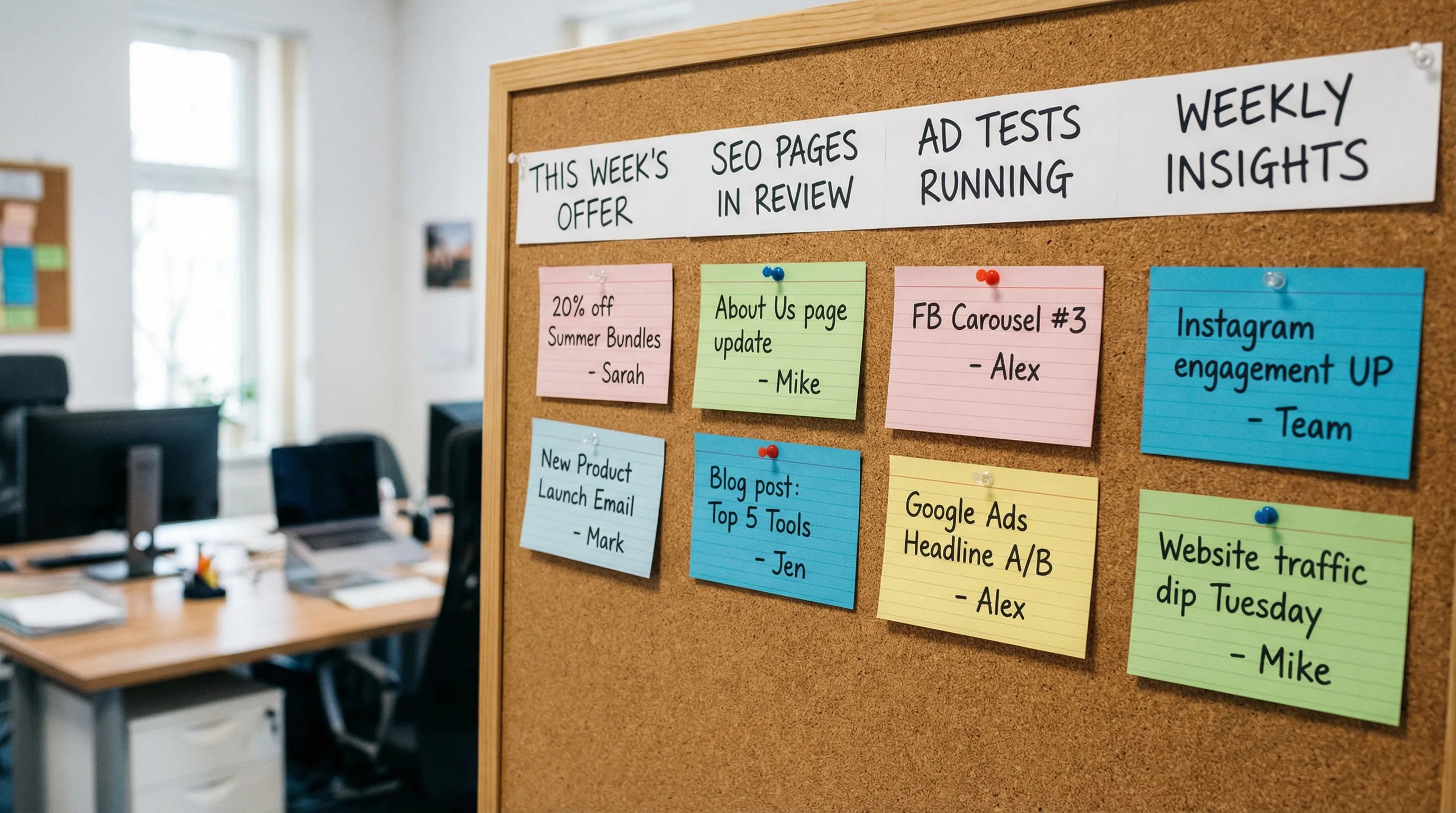
This workflow is where AI often feels the most “magical”, because it replaces hours of manual summary work, while still leaving final judgment to you.
Workflow 7: Founder or exec content system (B2B trust at scale)
For B2B, consistent thought leadership can become a compounding asset. AI helps you turn expertise into posts, but you still need authentic points of view.
The simplest system
-
Record 10 to 15 minutes of voice notes each week: what you learned, what you’re seeing in the market, common client mistakes.
-
Transcribe.
-
Use AI to draft:
- 2 short posts
- 1 deeper “lesson” post
- 1 case-study style post (anonymized)
If you want a more structured, LinkedIn-first approach for founders and executives, a specialized service like Windmill Growth for LinkedIn brand building can be a better fit than trying to duct-tape a content process together internally.
Guardrail
Do not let AI invent case studies, numbers, or client names. If you cannot prove it, don’t publish it.
How to choose the right workflow (so you don’t overbuild)
If you only pick one workflow to start, choose based on your bottleneck:
- You need leads now: start with Lead follow-up autopilot, then Google Ads build assistant.
- You get traffic but not enough inquiries: start with Offer and messaging kit, then landing page improvements.
- You rely on referrals and want more predictable demand: start with Local SEO page pipeline.
- You spend on ads but feel blind: start with Weekly reporting and insights digest.
Implementation guardrails that protect quality (and your reputation)
AI for marketing fails when teams skip governance. Keep it simple:
1) Define “AI is allowed to do” vs “humans must do”
AI is great at drafts, variations, summaries, and pattern detection. Humans should own:
- Final claims and guarantees
- Pricing and legal language
- Brand tone and sensitive topics
- Budget and strategic tradeoffs
2) Create a single source of truth
Store your approved messaging, offers, and proof points in one place (a doc is enough). Your AI outputs improve dramatically when you give it consistent inputs.
3) Measure something every 2 weeks
Pick 1 primary metric per workflow (booked calls, lead response time, CPL, indexed pages, conversion rate) and review it on a schedule.
Where Kvitberg Marketing fits (if you want speed without upfront commitment)
If your biggest bottleneck is simply getting a modern, SEO-ready site live, Kvitberg Marketing builds pre-built, high-quality, SEO-optimized websites for local businesses, completely free with no upfront commitment. You review the finished website in a short walkthrough meeting, and only decide to buy after you’ve seen the result.
That model pairs well with the workflows above because it gets you to a “real” foundation faster, so you can spend this quarter improving visibility, running ads, and tightening follow-up instead of debating templates.
A practical “this quarter” rollout plan
To keep momentum, aim for one workflow per month:
- Month 1: Offer and messaging kit (plus one landing page refresh)
- Month 2: Lead follow-up autopilot
- Month 3: Local SEO page pipeline or weekly reporting digest
The goal is not to “use AI everywhere”. The goal is to make marketing execution faster, more consistent, and easier to measure.