Automation Marketing: Where to Start for Fast Wins

Marketing automation gets pitched like a shopping list of tools. For most local businesses, that approach backfires: you end up paying for software, still chasing leads manually, and wondering why nothing “talks” to anything else.
Automation marketing is simply this: turning your highest-value, most repeatable marketing and sales steps into a reliable system, so leads get captured, followed up with, qualified, and booked without constant manual effort.
If your goal is fast wins, start where automation shortens time-to-revenue: lead capture, speed-to-lead follow-up, booking, and measurement.
What “automation marketing” means in practice (for local businesses)
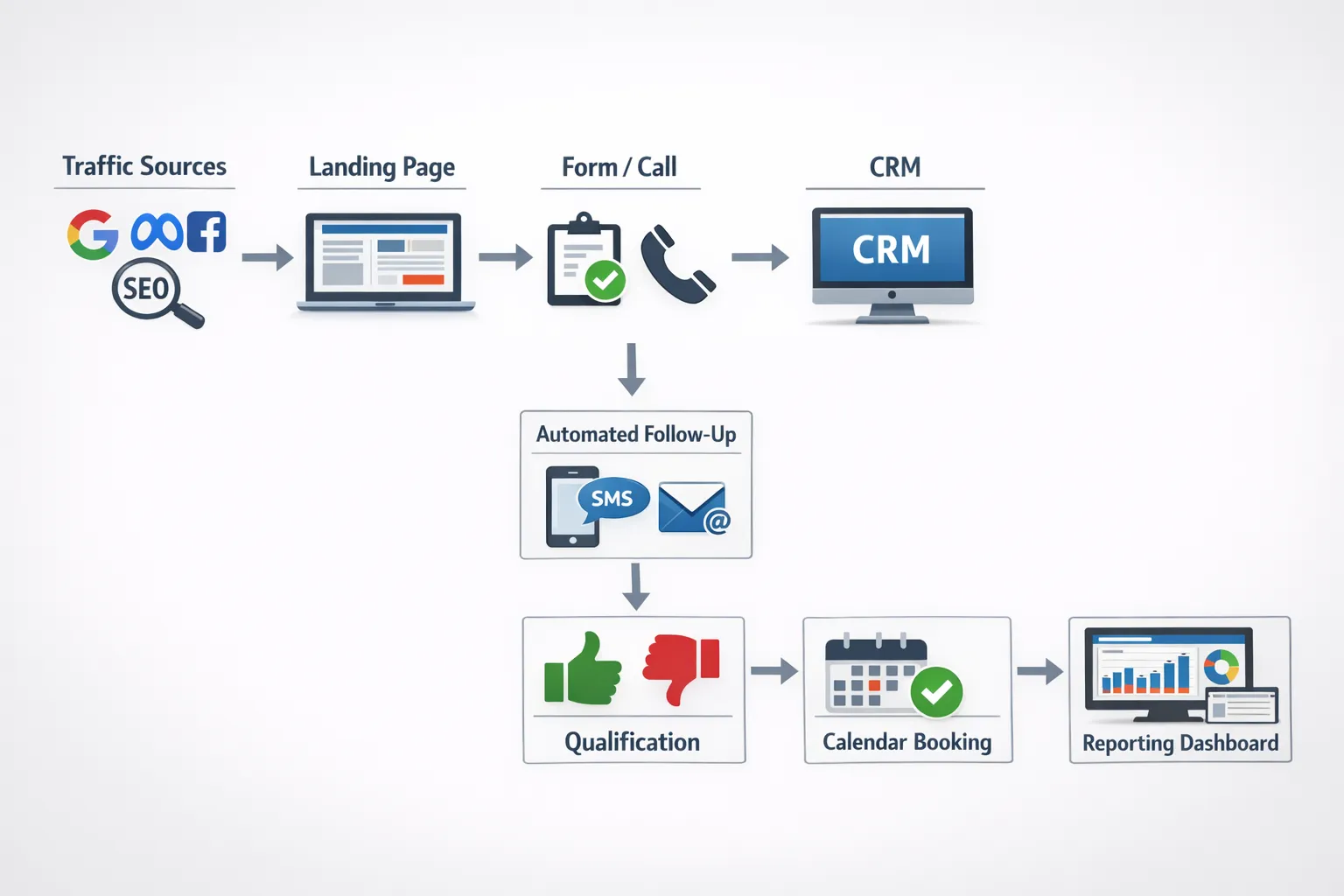
For a clinic, contractor, law firm, or B2B service business, marketing automation is not about complex “AI journeys.” It is about removing friction from the path between:
- Someone showing intent (searching, clicking an ad, visiting your site)
- You responding quickly (text, email, call)
- A qualified conversation happening (booked meeting, estimate, consult)
- The right next step being tracked (show-up, close, reschedule)
The best automations are boring, measurable, and directly tied to revenue.
Before you automate anything: 3 prerequisites that unlock fast wins
Most “automation” failures are actually positioning, tracking, or process failures. Get these three right first.
1) A single, clear conversion goal
Pick one primary conversion for the next 30 days:
- Booked call/consultation
- Quote request
- In-store visit appointment
- Demo request (for B2B)
If you try to automate everything at once (leads, nurture, upsell, referrals), you will ship half-finished workflows that are hard to debug.
2) A tight ICP and one message that matches intent
Automation amplifies what you already say. If the message is vague, you will just scale vague.
A strong starting point:
- Who: the ideal customer profile (industry, location, budget range, urgency)
- Problem: the “right now” pain they want solved
- Proof: one credibility signal (reviews, outcomes, years in business)
- Next step: one clear action (book, request, call)
If you serve both Norway and the US, make sure the offer and language match how people buy locally. For example, many US home-services buyers expect fast SMS follow-up, while Norway prospects may prefer email clarity and a straightforward booking flow.
3) Measurement you trust (or you will automate blind)
At minimum, confirm you can answer:
- Which channel produced the lead (Google Ads, Meta, SEO, outbound)
- What the lead did (form submit, call, booked)
- Whether they showed up and converted
If you cannot connect lead source to booked meetings and closed deals, automation will feel “busy” but not profitable.
Fast wins: the 5 automations to implement first
These are the quickest-to-ship workflows that typically create immediate lift, especially for local businesses running ads or getting steady inbound.
1) Speed-to-lead follow-up (the highest ROI “automation marketing” move)
If you do nothing else, do this.
When a lead submits a form, they are most likely to book when you respond quickly. Waiting hours (or days) turns warm intent into “just browsing.”
What to automate:
- Instant confirmation (email or SMS) that sets expectations
- Immediate internal alert so someone responds (Slack, email, app notification)
- A short, polite follow-up sequence if they do not reply
Keep it simple: one confirmation message plus two follow-ups over 48 hours is enough to start.
2) Lead-to-calendar booking (with qualification, not chaos)
Booking links are great until your calendar fills with low-quality meetings.
A better approach is:
- A short qualification form (budget range, location, timeline, service needed)
- Routing to the right calendar (sales, technician, specialist)
- Automated reminders (reduce no-shows)
This is where local businesses often see “fast wins” because it turns marketing activity into scheduled revenue conversations.
3) Abandoned lead capture rescue (forms that did not finish)
People often start a form and bounce. If you capture partial details (ethically and compliantly), you can recover value.
Practical options:
- A shorter form with fewer fields
- A two-step form (step 1: name + contact, step 2: details)
- A polite “Did you still want help with X?” follow-up if they provided contact info
Important: If you operate in Norway (EEA), make sure this aligns with GDPR and your consent model.
4) Retargeting audiences built automatically (no manual “busy work”)
Retargeting is not a “nice to have” when you pay for clicks.
Fast-win automation here is mostly setup:
- Ensure your ad platforms can build audiences based on key actions (visited service page, started form, booked)
- Split audiences by intent level (visited vs started vs submitted)
- Send the right message (proof and next step), not generic branding
Once configured, this runs in the background and makes your initial traffic more profitable.
5) Weekly performance reporting that ties to bookings
Local business teams do not need a 40-chart dashboard. They need a weekly snapshot they can act on.
Automate a simple report that shows:
- Leads by channel
- Cost per lead (if running ads)
- Booked meetings
- Show rate
- Close rate (even if estimated at first)
The “win” is not the report itself. The win is making decisions faster (pause what is not working, scale what is working).
A practical “fast wins” automation checklist (impact vs effort)
Use this to decide what to ship first.
| Automation | Time to implement (typical) | Effort | Why it creates fast wins |
|---|---|---|---|
| Instant lead confirmation + internal alerts | Same day to 2 days | Low | Prevents lead decay and speeds up response |
| 48-hour follow-up sequence | 1 to 3 days | Low | Recovers leads you would otherwise lose |
| Qualification + calendar routing | 3 to 7 days | Medium | Improves meeting quality and reduces wasted calls |
| Retargeting audiences by intent | 1 to 5 days | Medium | Increases ROI from the traffic you already paid for |
| Weekly lead-to-booking reporting | 2 to 7 days | Medium | Helps you scale winners and stop losers quickly |
(These time ranges assume you already have a website, a lead form, and access to your ad accounts and inbox/CRM.)
A simple 14-day rollout plan (no overengineering)
Days 1 to 2: Map the revenue path
Write down your current steps from lead to booked meeting:
- Where leads come from
- Where they land (page, form, call)
- Who responds
- How booking happens
- How you track outcomes
You are looking for bottlenecks: slow response, missed leads, no reminders, no attribution.
Days 3 to 5: Ship speed-to-lead + basic follow-up
Implement:
- Instant confirmation message
- Internal alerts to the owner or salesperson
- Two short follow-ups
Keep the tone human. The goal is not “automated marketing voice,” it is a helpful response that gets a reply.
Days 6 to 10: Add qualification and booking routing
Add a short form that filters obvious misfits (wrong area, wrong service, unrealistic timeline). Then route qualified leads to the correct calendar.
This is where many teams feel immediate relief because scheduling becomes consistent.
Days 11 to 14: Add retargeting + weekly reporting
- Build retargeting audiences by intent level
- Launch one simple retargeting campaign (proof, reviews, offer clarity)
- Automate a weekly email or dashboard snapshot that includes leads, bookings, and show rate
From here, you optimize, not rebuild.
Tool choice: keep your stack small
A lean automation stack is easier to maintain than a “best-of-breed” stack with five integrations that break.
A common pattern that works well for local businesses:
- A landing page or website form
- A CRM (or at least a shared pipeline)
- A calendar tool
- An automation connector (to move data and trigger messages)
If you are in a highly regulated or specialized industry, you may need an industry platform that already includes key pieces (payments, compliance workflows, analytics) so you are not stitching everything together yourself. For example, iGaming operators often choose all-in-one platforms such as Spinlab’s modular iGaming platform to centralize onboarding, payments, compliance, and performance tracking.
The mistakes that waste the most money (and how to avoid them)
- Automating a broken process: If your offer is unclear or your landing page does not convert, automation just scales poor performance.
- Over-collecting data too early: Long forms reduce lead volume. Start short, qualify after the first reply.
- No human-in-the-loop: Automation should get you to a conversation faster, not remove people from the relationship.
- Ignoring deliverability (for outbound): If emails do not land in inboxes, your “automation” is just unseen messages.
- Tracking only leads, not bookings: Leads are activity, bookings and closes are outcomes.
What to track to prove automation is working
Automation marketing should show up in operational metrics before it shows up in revenue. Track both.
| Metric | What it tells you | What “good” often looks like |
|---|---|---|
| Speed-to-lead | How fast you respond after inquiry | Minutes, not hours |
| Contact rate | % of leads you actually reach | Increases after follow-up automation |
| Booking rate | % of leads that book a meeting | Should rise with clear routing and reminders |
| Show rate | % of booked meetings that happen | Improves with reminders and confirmations |
| Cost per booked meeting | Real efficiency of your spend | More stable than cost per lead |
You do not need perfect attribution on day one. You do need consistency: one definition for a “lead,” one for a “booking,” and a weekly review.
When it makes sense to get help
If you are a founder or growth lead, your highest leverage is rarely building Zap connections at midnight. Getting help is worth it when:
- You want outbound that books qualified meetings without spamming
- You need lead sourcing, deliverability setup, and messaging built around a tight ICP
- You want qualification, calendar routing, and follow-up workflows done cleanly
- You want performance tracking and ongoing optimization (A/B testing, landing page improvements)
Kvitberg Marketing builds outbound and conversion systems designed to generate predictable meetings and revenue for agencies and B2B teams, with a focus on automation that stays human and compliant. If you want to move quickly, start by tightening your conversion goal and speed-to-lead workflow, then layer in qualification, routing, and reporting.
The fastest way to get a win this week
If you want one action that typically produces results within days: set up instant lead response plus two follow-ups, and make sure every lead can book a time without friction.
That is automation marketing at its best: not complicated, just reliably turning intent into conversations.