B2B Ads That Work: Offers, Targeting, and Landing Pages

Most B2B ad campaigns don’t “fail” because the platform is broken. They fail because the offer is vague, the targeting is too broad (or too clever), and the landing page leaks intent.
If you fix those three pieces in order, B2B ads become predictable: you pay to capture demand, route it to the right promise, and convert it with a frictionless page and follow-up.
This guide breaks down exactly how to build B2B ads that work, with practical examples you can apply whether you’re running Google Ads, Meta Ads, or a mixed channel approach.
Start with the B2B ad equation
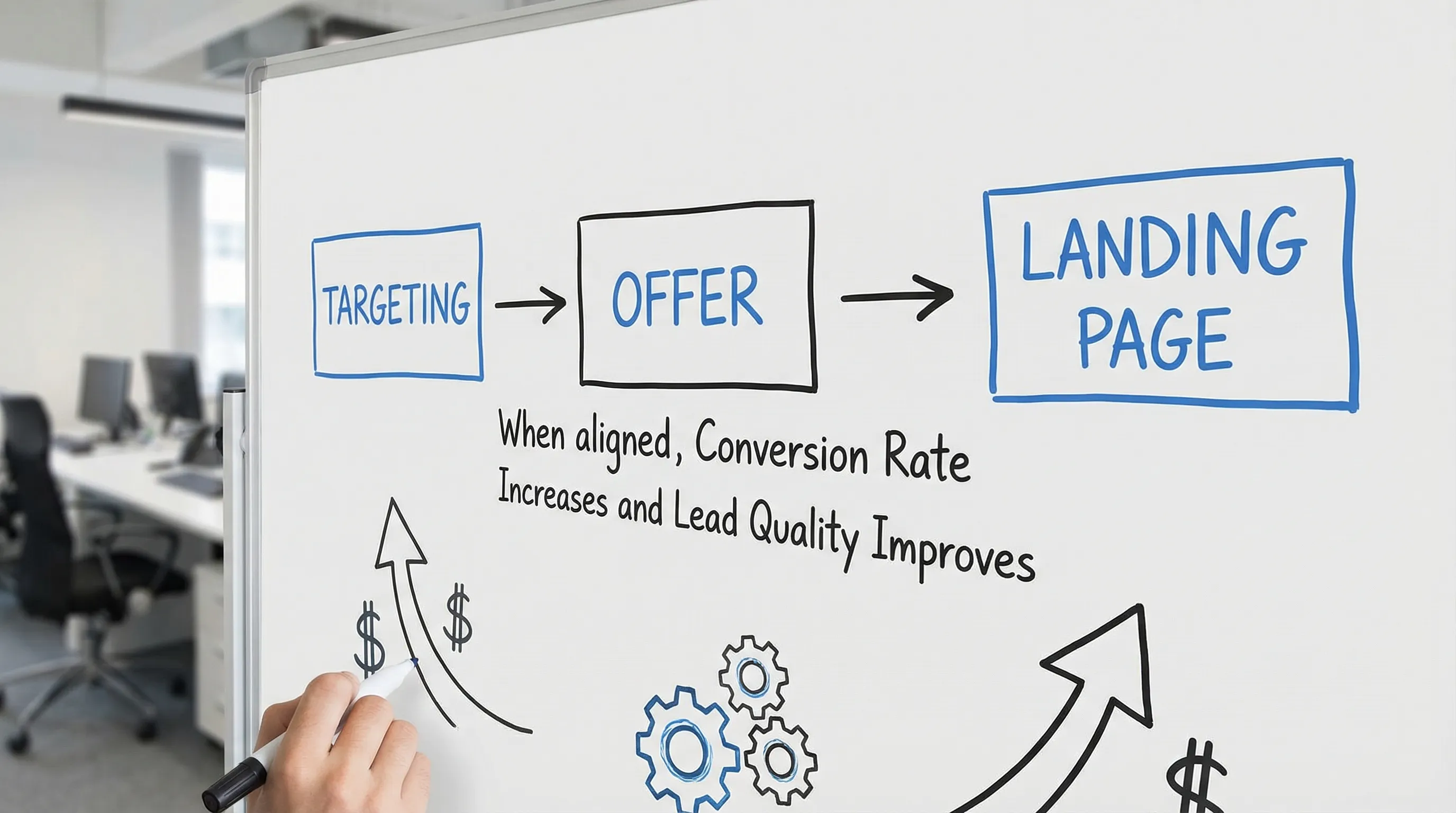
You can think of B2B ads as a simple chain:
Targeting (who sees it) + Offer (why they click) + Landing page (why they convert) = Results (leads, pipeline, revenue).
Most teams obsess over targeting first. In practice, offer and landing page usually create the biggest lift because they increase conversion rate and lead quality without increasing spend.
Offers that actually work in B2B (and why)
In B2B, people rarely click an ad and instantly buy. They click when they believe you can reduce risk, save time, or increase revenue, and when the “next step” feels safe.
The 5 offer types that tend to win
Here are the offers that typically perform best for B2B lead generation, especially for small and mid-sized teams.
| Offer type | Best for | The promise | Common mistake |
|---|---|---|---|
| Audit / assessment | Services, agencies, consultants | “We’ll find what’s holding growth back” | Too generic (no clear deliverable) |
| Demo / consultation | Software, retainers, complex solutions | “See how it works for your use case” | Asking for too much too soon (long forms) |
| Benchmark / report | Competitive markets | “See where you stand” | Hiding the methodology or making it fluffy |
| Calculator / estimator | Pricing-sensitive categories | “Get a real number in minutes” | Not capturing any contact info until the end |
| Case study / proof pack | When trust is the main barrier | “Here’s evidence from similar companies” | Choosing the wrong “similar” |
A quick rule: if you cannot summarize the offer as a specific output someone gets within 24 hours (or a clear scheduled next step), it is probably too weak for paid traffic.
Add specificity without adding risk
B2B buyers hate uncertainty. Your offer should reduce it.
Instead of:
- “Free marketing consultation”
Try:
- “15-minute account review, you’ll leave with 3 fixes to reduce wasted spend.”
Instead of:
- “Book a demo”
Try:
- “See a 10-minute walkthrough tailored to your industry and current stack.”
Specificity improves click quality. It also makes your landing page easier to write because you are promising one clear outcome.
Align the offer to intent (especially for Google Ads)
Intent differs by channel:
- Google Search Ads often capture high intent. The offer can be more direct (demo, quote, assessment).
- Meta Ads often capture problem-aware or solution-aware users. The offer usually needs more “bridge” (guide, proof pack, short assessment).
If you push a “Book a call” offer to a cold audience, you can still get leads, but they tend to be lower quality and harder to close.
Targeting that doesn’t sabotage your results
Once the offer is strong, targeting becomes a multiplier instead of a band-aid.
Step 1: Define one ICP you can actually buy traffic for
“Small businesses” or “B2B companies” is not an ICP. You need a profile you can target and message:
- Industry (examples: commercial cleaning, accounting firms, construction suppliers, B2B SaaS)
- Geography (Norway, a county/state, or metro areas)
- Company size proxy (employees, revenue, service area)
- Buyer role (owner, marketing manager, operations)
- Pain (lead flow, high CAC, churn, low conversion)
If you serve multiple ICPs, create separate campaigns. Mixing them usually forces vague copy and vague offers.
Step 2: Pick targeting methods that match the platform
Google Search: target intent first
In most B2B categories, the highest-quality leads come from search terms that imply evaluation:
- “best [service/software] for [industry]”
- “[service] agency for [industry]”
- “[software] pricing”
- “[competitor] alternative”
This is also where landing page “message match” matters most. If someone searches “B2B lead generation for HVAC suppliers” and lands on a generic page, your CPC stays high and your conversion rate drops.
A useful reference on structuring campaigns around intent and ad rank factors is Google’s documentation on ad auctions and ad rank.
Meta: target buyers, then let creatives do the sorting
Meta targeting for B2B is often misunderstood. Detailed targeting can help, but your creatives and offer do most of the qualification.
What tends to work:
- Target by broad industry interests and job functions where available
- Use strong “disqualifiers” in ad copy (for example, “For companies with 5+ employees” or “For B2B teams selling services over $2k/month”)
- Run multiple creative angles per ICP (pain, proof, process)
Meta is rarely the place to be subtle. The goal is to make the wrong person scroll past.
LinkedIn (if you use it): focus on role + seniority + industry
LinkedIn targeting can be powerful for mid-market and enterprise, but costs are typically higher. If you run it, the offer needs to justify the click. Proof packs, benchmarks, and short consults are often better than “download our ebook.”
Step 3: Use intent signals outside ads to improve lead quality
Two practical upgrades that help almost any B2B team:
- Add a qualifying question on the form (industry, budget range, or timeline). Keep it simple.
- Route leads instantly into your CRM and follow-up sequence so speed-to-lead is measured and improved.
If you need a lightweight CRM option for small and mid-sized businesses, a CRM dashboard like Dr. CRM is an example of the kind of system that can centralize deals, tasks, and basic automation so leads don’t disappear into inboxes.
Landing pages that convert B2B clicks into qualified leads
Your landing page is not a brochure. It is a conversion system.
The “message match” checklist
Within the first screen, your landing page should answer:
- What is this? (one sentence)
- Who is it for? (one sentence)
- What do I get next? (deliverable or booked outcome)
- Why believe you? (proof)
If your ad says “Get a 10-minute Google Ads waste audit,” your landing page headline should say exactly that, not “Performance marketing solutions.”
A landing page structure that works for most B2B offers
Use this as a starting blueprint:
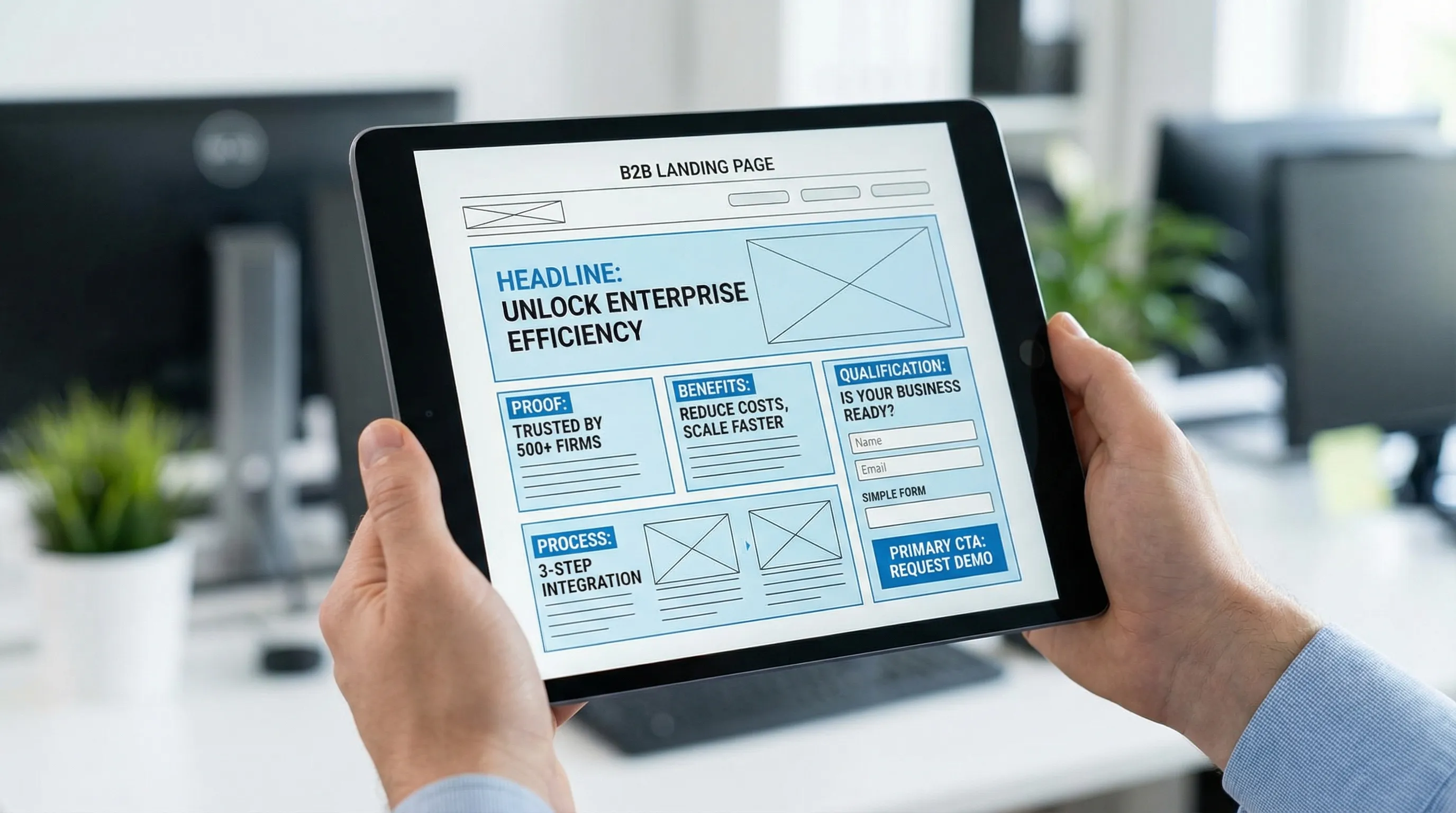
- Headline + subheadline with the offer and ICP
- Short proof block (logos, numbers, or a short testimonial)
- What’s included (3 to 6 bullets maximum)
- Who it’s for / not for (qualifies leads)
- How it works (3 steps)
- Form with a clear CTA
- Trust and risk reducers (privacy note, “no spam,” timeframe)
You do not need a long page for every offer. You need clarity and credibility.
Forms: the fastest way to improve lead quality without spending more
B2B forms are a tradeoff:
- Shorter forms increase conversion rate.
- Better qualification increases close rate.
A practical compromise is to keep contact fields minimal and add one qualifying field.
Good qualifiers:
- “What best describes your company?” (dropdown)
- “Monthly budget range” (ranges)
- “When do you want to start?” (this month, 1 to 3 months, later)
Avoid “Tell us about your project” as the only qualifier. It looks easy, but it often produces low-signal answers.
Speed and tracking: unglamorous, decisive
Landing page performance is heavily impacted by basics:
- Load speed (especially on mobile)
- Clean tracking (so you know which ads produce qualified leads)
- Thank-you page with the next step (calendar link, confirmation, what happens next)
If you cannot reliably answer “Which offer and landing page produces the most sales calls that show up,” you are optimizing blind.
How to connect offers, targeting, and landing pages (with examples)
Here are three example “aligned stacks” that tend to work well.
| Channel | Targeting approach | Offer | Landing page angle |
|---|---|---|---|
| Google Search | High-intent keywords (service + industry) | Audit / assessment | “Get X outcomes in 24 hours” + proof |
| Meta | Broader targeting + strong disqualifiers in copy | Proof pack or short assessment | “Here’s what works for companies like yours” |
| Role + seniority + industry | Benchmark / report | “See where you stand” + methodology |
The key is not the channel. It’s that each piece supports the next.
Where Kvitberg Marketing fits (if your landing pages are the bottleneck)
Many B2B teams can write decent ads. Where campaigns often break is the landing experience: generic pages, poor message match, slow sites, or pages that were never designed to convert.
Kvitberg Marketing builds pre-built, professional, SEO-optimized websites for local businesses, free with no upfront commitment. You submit an inquiry, review a finished site in a short walkthrough meeting, and decide whether to buy only after you’ve seen the result. If you want help turning paid traffic into leads, Kvitberg also offers optional growth services like SEO campaigns and Google Search Ads management.
If you already run ads and results are inconsistent, improving the offer and landing page is usually the fastest path to better CPL and better lead quality.
A simple optimization loop (what to test first)
If you want a practical order of operations, use this sequence:
1) Fix the offer
Strengthen the promise, make the deliverable concrete, and add a relevant proof point.
2) Build one landing page per offer
Stop sending multiple offers to the same generic page. Even small differences in ICP and intent justify separate pages.
3) Only then tighten targeting
When your offer and landing page are clear, targeting adjustments become more meaningful because you can interpret performance data.
4) Measure what matters
In B2B, optimize toward downstream quality, not just form fills:
- Lead-to-meeting rate
- Meeting show-up rate
- Sales-qualified lead rate
- Cost per qualified meeting
When those metrics improve, your ad budget becomes an investment instead of a gamble.