B2B Agency Checklist: How to Choose the Right Partner

Choosing a B2B agency is a high-stakes decision. The right partner can shorten your sales cycle, create a predictable lead pipeline, and make your marketing spend measurable. The wrong partner can burn budget for months while you get “activity” instead of outcomes.
This B2B agency checklist is built for decision-makers at local businesses in Norway and the US who want a practical way to evaluate agencies, compare proposals, and reduce risk before signing a contract.
Start with clarity: what outcome are you hiring for?
Most agency relationships fail because the business and the agency never agree on the actual job to be done. Before you evaluate vendors, define your “success definition” in plain language.
Examples of clear, measurable outcomes:
- Generate 30 qualified inbound leads per month for a specific service line
- Book 12 sales meetings per month with companies in a target region
- Increase organic traffic to high-intent service pages by 40% in 6 months
- Reduce cost per qualified lead by 20% while maintaining lead quality
Also decide what constraints matter:
- Time to value (do you need leads in 30 days, or can you wait 6 months?)
- Internal capacity (who will approve creatives, write content, or follow up leads?)
- Budget reality (media spend, agency fee, and tooling)
When your outcome and constraints are clear, it becomes much easier to spot agencies that are “a fit” versus agencies that are simply good at selling.
The B2B agency checklist (what to verify, not just what to hear)
A credible agency can explain what they will do, why it works, and how you will know it’s working. Use the checklist below to evaluate that credibility.
| Checklist area | What “good” looks like | Proof to ask for |
|---|---|---|
| ICP and positioning | They can restate your ideal customer profile, buying triggers, and objections in your words | Notes from discovery, example messaging map, sample landing page structure |
| Demand strategy | They recommend channels based on your sales motion (high ACV vs low ACV, long cycle vs short) | A simple 90-day plan with assumptions and milestones |
| Measurement plan | They define conversion events and quality signals, not just clicks and impressions | Example dashboard/report, tracking map (forms, calls, CRM handoff) |
| Lead quality system | They account for qualification, follow-up speed, and feedback loops | Process for lead scoring, call tracking, CRM integration plan |
| Creative and offer | They pressure-test your offer and propose improvements | Landing page examples, ad angles, form strategy, offer testing approach |
| Execution ownership | Clear division of responsibilities and approvals | RACI-style responsibility summary (even a simple one is fine) |
| Communication | Predictable cadence and decision points | Weekly or biweekly agenda template, sample QBR structure |
| Commercial terms | Transparent fees, realistic timelines, clear deliverables | Sample contract sections, statement of work outline |
Evaluate “fit” across four dimensions
Instead of asking “Are they a good agency?”, ask “Are they the right agency for our situation right now?”
1) Channel fit: SEO, paid ads, or both?
For many B2B local businesses, the right answer is not “all channels.” It’s the channel mix that matches your urgency and your buying journey.
- SEO tends to compound over time and works best when you have clear service pages, strong local relevance, and the ability to publish credible content.
- Google Search Ads can produce demand quickly when there is existing search intent, but it requires disciplined conversion tracking and landing page quality.
- Meta Ads can work for some B2B offers, especially retargeting and top-of-funnel education, but it often needs strong creative and a thoughtful funnel.
What to listen for: an agency that asks how prospects buy, how long deals take, and what a qualified lead means, before recommending channels.
2) Industry and sales-cycle fit
An agency does not need to be in your exact niche, but they should understand how B2B buying works in practice:
- Multiple stakeholders
- Longer consideration
- Trust requirements (proof, reviews, references, case studies)
- Lead qualification and follow-up process
Ask them to describe how they adapt when your sales cycle is 30 to 180 days. If the plan relies on immediate last-click conversions only, that’s a risk.
3) Geography and compliance fit (Norway and US considerations)
If you operate in Norway, you will often care about:
- Language and localization (English can work for some industries, but many local services convert best in Norwegian)
- Privacy expectations and consent practices (especially around tracking and remarketing)
- Local market knowledge (seasonality, competitor landscape, typical lead values)
In the US, you may care more about:
- Competitive ad auctions and rising CPCs
- Multi-location complexity (service areas, city pages, GBP management if relevant)
- Clear attribution when leads come through multiple touchpoints
A good agency will proactively ask about these factors rather than assume a one-size-fits-all playbook.
4) Execution fit: speed, quality, and accountability
Some agencies are excellent strategists but slow implementers. Others move fast but create messy systems you cannot audit. Choose based on what your business needs.
A practical question to ask is: “How long until we have a working version of the funnel live, with tracking verified?” The answer should include a sequence, not just a date.
The questions that reveal whether an agency is serious
Use these questions in discovery calls. You are listening for structured thinking, not perfect answers.
Questions about strategy
- “What would you do in the first 30 days, and what would you avoid doing?”
- “What assumptions does your plan depend on?”
- “If results are weak in month two, what do you change first?”
Questions about measurement and attribution
- “What conversions will we optimize for, and how do we define lead quality?”
- “How do you verify tracking is correct?”
- “How do you handle attribution when deals take weeks or months?”
Questions about creative and landing pages
- “Will you build or improve landing pages, or only run traffic?”
- “How do you test offers and messaging?”
- “What is your approach to form length, call tracking, and qualification?”
Questions about operations
- “Who is actually doing the work, and what is their seniority?”
- “What is your reporting cadence, and what decisions happen in each meeting?”
- “What do you need from us to succeed?”
A strong agency welcomes these questions because they reduce ambiguity.
Red flags that should slow you down
Not every red flag is a deal-breaker, but each one increases risk.
- They guarantee rankings or a specific number of leads. Marketing has too many variables for guarantees without heavy caveats.
- They focus on vanity metrics. If reporting is mostly impressions and clicks, you may not get business outcomes.
- They avoid showing how tracking works. If you cannot audit conversion setup, you cannot manage performance.
- They pitch a long contract before proving value. Longer commitments can make sense later, but early lock-in increases risk.
- They cannot explain how your offer affects performance. In B2B, offer and positioning are often the bottleneck.
Use a simple scorecard to compare agencies objectively
When you talk to multiple agencies, conversations blur together. A scorecard keeps decisions grounded.
| Category | Weight (example) | What you’re scoring |
|---|---|---|
| Strategy clarity | 25% | Do they understand your ICP, offer, and buying journey? |
| Measurement and tracking | 20% | Is the conversion plan auditable and tied to revenue outcomes? |
| Execution plan | 20% | Are deliverables and timelines specific and realistic? |
| Proof and credibility | 15% | Do they show relevant results, references, or work samples? |
| Communication and process | 10% | Do you trust the operating rhythm and responsiveness? |
| Commercial terms | 10% | Is pricing transparent and aligned with risk and value? |
Tip: require each agency to submit a one-page plan. If they cannot summarize clearly, execution usually will not be clear either.
Consider the “risk reversal” options available
For local businesses, the biggest fear is paying for a build or a campaign before seeing quality. If you are unsure, look for ways to reduce downside:
- A short pilot with clear success criteria
- A phased scope (measurement and landing pages first, scaling second)
- Performance checkpoints tied to expansion of work
Some providers also flip the model by delivering the asset first, then charging only if you choose to keep it. That approach can be especially useful when your immediate need is a modern, SEO-ready site foundation.
If you are evaluating agencies globally, you may also compare full-service partners in other markets (for example, a digital marketing company in Chennai can offer a broad mix of SEO, PPC, and development services). The key is still the same: verify fit, proof, and process.
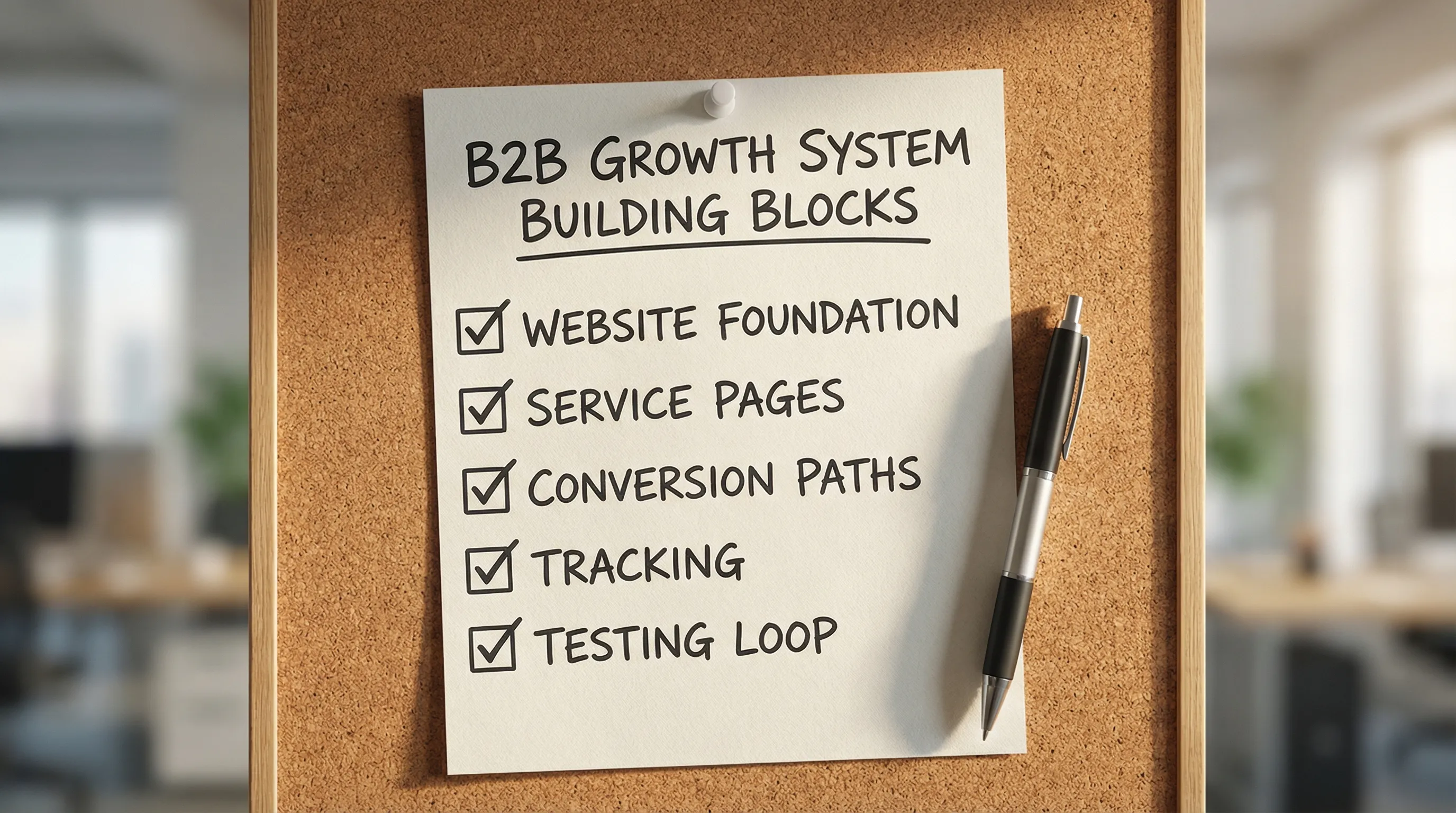
What “good” looks like for a local-business B2B growth system
Whether you hire an agency for SEO, ads, or both, you generally want a system that looks like this:
- A fast, credible website that communicates your offer and proof
- Dedicated service pages aligned to buyer intent
- Conversion paths that match your sales process (forms, calls, booking)
- Tracking you can trust (and that your sales team can feedback into)
- A testing loop for messaging, offers, and targeting
Even the best ad account will struggle if the landing page is weak, slow, or unclear. And even great SEO content will underperform if the site architecture makes it hard for buyers to find what they need.
If you need a safer way to start: see the finished website first
If your top priority is getting a professional, SEO-optimized website without taking upfront risk, Kvitberg Marketing offers a straightforward model: they build a complete website for local businesses for free, then walk you through it, and you decide whether to buy only after you’ve seen the finished result.
That can be a practical first step before committing to ongoing services like SEO campaigns or Google Search Ads management.
You can review the approach and submit an inquiry at Kvitberg Marketing.
Final pre-sign checklist (quick decision filter)
Before you sign, confirm you can answer “yes” to these:
- We agree on the definition of a qualified lead.
- We know what will be built in the first 30 to 45 days.
- We know what will be measured, and who owns tracking.
- We understand how decisions will be made when results are unclear.
- We are comfortable with the contract terms and exit conditions.
If any of those are fuzzy, slow down and ask for clarity. The best B2B agency relationships are built on shared expectations and a system both sides can measure.