Client Testimonials: How to Collect and Use Them

Trust is expensive to earn and easy to lose. In 2026, that is even more true as buyers sift through polished websites, AI-generated content, and competing offers that all sound similar. Client testimonials cut through the noise because they show outcomes in a customer’s words, not your marketing copy.
For local businesses and B2B service providers, testimonials are not “nice to have.” They are a core conversion asset that can lift lead quality, improve close rates, and make your ads and outbound messages feel credible.
What counts as a “testimonial” (and what does not)
A testimonial is any customer-provided statement that describes the experience or results of working with you. The key is that it is specific, attributable, and permissioned.
It helps to distinguish three common forms:
- Testimonials: Short statements you publish on your website, landing pages, proposals, and sales materials.
- Reviews: Ratings and comments posted on third-party platforms (Google Business Profile, Facebook, industry directories). You can quote them (with care), but you do not “own” the platform.
- Case studies: Structured, longer-form stories with context, process, and measurable outcomes.
If you want testimonials to reliably generate leads, treat them like a system, not a one-off request.
Step 1: Decide what you want testimonials to prove
Most businesses collect testimonials randomly, then wonder why they do not move conversions. Start by identifying the buying fears and questions your prospects have.
Examples for local businesses:
- “Will they show up on time?”
- “Will this be worth the money?”
- “Will I get upsold or surprised with hidden fees?”
Examples for B2B services (agencies, consultants, operators):
- “Can you actually generate pipeline, or only clicks?”
- “How fast do we see qualified meetings?”
- “Will this damage our brand (spammy outreach)?”
When you know the objections, you can collect testimonials that answer them directly.
Step 2: Collect testimonials at the right moment (timing beats persuasion)
The easiest way to collect testimonials is to ask when the customer has a fresh win, not when you remember three months later.
High-conversion “ask moments” include:
- Right after delivery, when the customer says “This is great.”
- After a measurable milestone (first booked week, first campaign lift, first month of consistent leads).
- After resolving a problem quickly (a support win is often more emotional than a smooth delivery).
For local businesses, you can operationalize this by setting a rule like: “Every completed job triggers a short ‘quick feedback’ message within 2 hours.” For B2B, attach the ask to a recurring review, for example monthly reporting or quarterly business reviews.
Step 3: Use a frictionless request (with prompts that create strong testimonials)
Most clients will not write a useful testimonial if you simply ask, “Can you leave a testimonial?” They need structure.
A strong testimonial usually contains:
- The customer’s situation before working with you
- What they chose and why
- The outcome (ideally tangible)
Instead of asking for “a testimonial,” ask for answers to 2 to 3 short prompts.
Here are prompts that consistently produce usable quotes:
- “What problem were you trying to solve?”
- “Why did you choose us over other options?”
- “What changed after working with us?”
If you serve both Norway and the US, offer to accept the reply in the customer’s preferred language, then request permission to translate it for publication.
Simple request templates you can copy
Email template (B2B or higher-ticket local services):
“Hey [Name], quick one. What was the main problem you wanted to solve before we started, and what changed after working together? Two to three sentences is perfect. If you’re okay with it, I’d love to publish your reply on our website with your name and company.”
SMS template (local businesses):
“Thanks again for choosing us, [Name]. If you have 20 seconds, what did you like most about the service today? If you’re okay with it, we may share your message as a customer testimonial.”
Video ask (great for service businesses and agencies):
“Would you be open to a 30-second video? Just: who you are, what you needed, what result you got. I can send 3 questions and you can record it on your phone.”
Step 4: Train your team to ask naturally (without sounding awkward)
The biggest blocker is rarely the customer. It is the person asking. If your staff or account managers feel uncomfortable, they will postpone the ask until it disappears.
Two practical fixes:
First, write down your exact “ask script” and make it part of your delivery checklist. Second, rehearse it.
If you want a structured way to practice objection handling and confident delivery, tools like AI roleplay training from Scenario IQ can help teams run realistic simulations before they try the request with real customers.
Step 5: Get consent and stay compliant (especially for ads)
Testimonials are marketing claims, so treat them with the same care as any ad copy.
Key best practices:
- Get explicit permission to publish the testimonial (especially if it includes a name, company, or photo).
- Do not edit the meaning of what the customer said. Light grammar cleanup is fine if you confirm.
- Be careful with incentives. Many platforms restrict or discourage incentivized reviews, and disclosure rules can apply.
For US marketing, the FTC’s Endorsement Guides are the baseline reference for endorsements and testimonials.
For Norway and the EU/EEA, consider privacy and consent requirements under GDPR when publishing identifiable personal data, especially if you store customer proof in shared tools.
Step 6: Choose the right testimonial format for the right job
Not all testimonials convert in the same way. Match format to channel and buyer intent.
| Testimonial type | Best for | Why it works | What to include |
|---|---|---|---|
| Short quote (1 to 2 sentences) | Landing pages, outbound emails, proposals | Fast credibility where attention is low | Specific result or specific reassurance |
| Before/after mini story (3 to 6 sentences) | Service pages, sales decks | Adds context and reduces skepticism | Situation, decision, outcome |
| Video testimonial | Ads, website hero sections, retargeting | High trust because it is hard to fake well | Face, voice, specificity |
| Screenshot of a written review (with permission) | Social posts, retargeting creatives | Feels native and authentic | Platform context and date (optional) |
| Full case study | SEO pages, high-ticket sales | Helps buyers justify the decision internally | Process, timeline, measurable impact |
Step 7: Place testimonials where they reduce friction (not just on a “testimonials” page)
A dedicated testimonials page is helpful, but it is rarely the main conversion driver. What moves the needle is placing the right proof next to the moment of doubt.
High-impact placements include:
- Homepage: 3 to 6 testimonials that cover different objections, not the same compliment repeated.
- Service pages: Testimonials specific to that service (a Meta Ads testimonial on the Meta Ads page, not a generic “great experience”).
- Landing pages: Place testimonials near pricing, near the form, and after the core promise.
- Outbound sequences: A single, relevant one-liner can increase reply rates because it signals legitimacy.
- Follow-up emails: Add proof right after you restate next steps, so the prospect stays confident.
A practical rule: every page or message that asks for action should include at least one piece of proof.
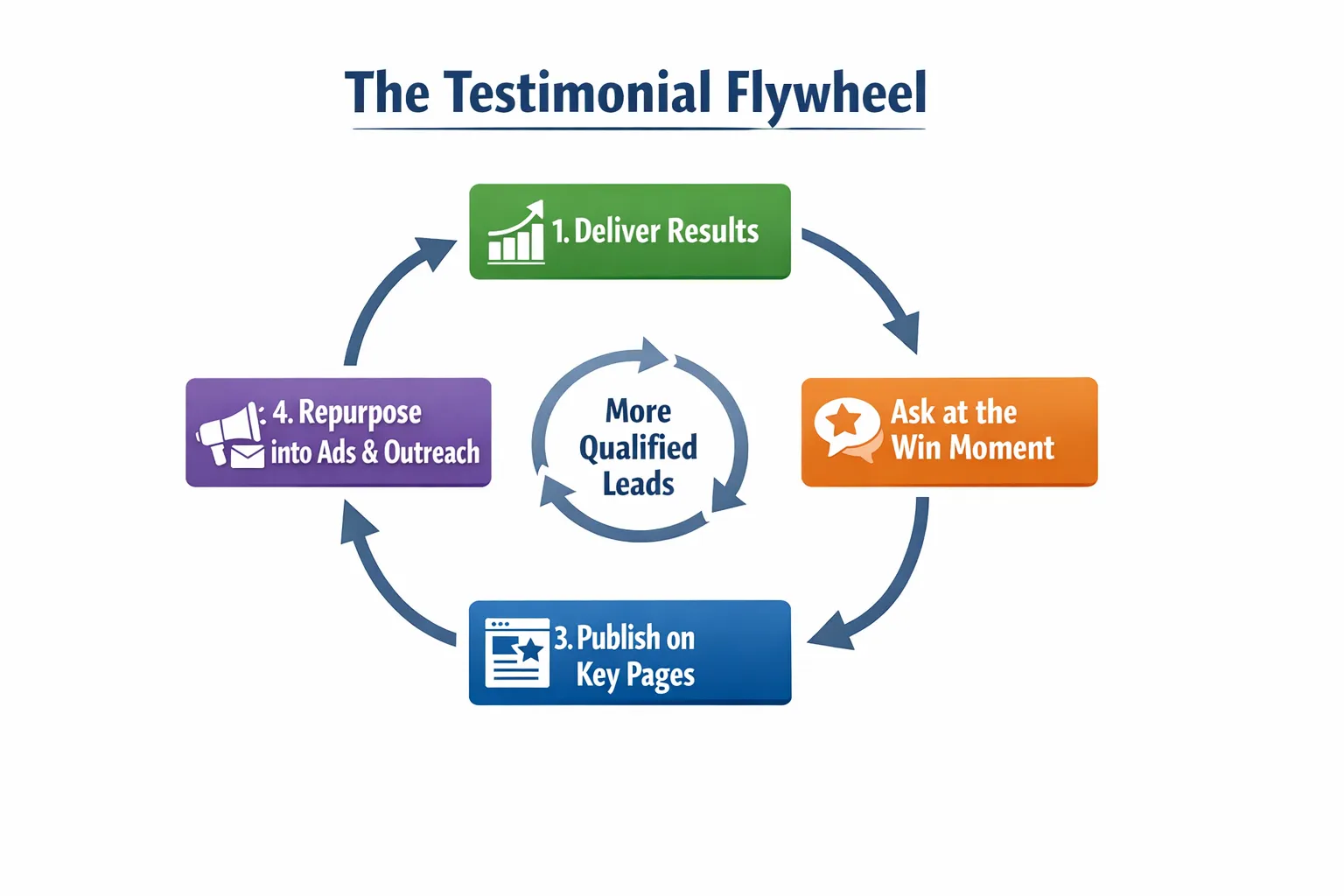
Step 8: Turn one testimonial into multiple assets (repurposing without dilution)
If you only paste testimonials onto your website, you are underusing them. One strong customer story can power several channels.
Here is a simple repurposing workflow:
- Pull 3 short “claim lines” from one testimonial (for ads and outbound).
- Write a slightly longer version (for landing pages).
- Turn it into a mini case study post (for social and email newsletters).
Keep the wording consistent with what the client meant. Your job is to distribute the proof, not rewrite it into marketing fiction.
Step 9: Build a testimonial pipeline you can actually maintain
The easiest way to make testimonials a habit is to treat them like a repeating operational process.
A lightweight approach that works for most local businesses and small B2B teams:
- Set a weekly reminder to identify “win moments” from the last 7 days.
- Ask within 24 hours of that win.
- Store testimonials in one place with tags (service, industry, objection answered, format).
- Refresh your landing pages quarterly so your proof stays current.
If you run outbound or lead generation, keep a separate shortlist of “outbound-friendly testimonials.” These are short, credible, and specific, for example “Booked 12 qualified meetings in the first 30 days” (only if it is true and permissioned).

Common mistakes that make testimonials feel fake
When testimonials do not work, it is often because they are too generic or too polished.
Watch out for:
- Empty praise: “Amazing service, highly recommend.” Useful as a review, weak as conversion proof.
- No identity: “John D.” can be necessary for privacy sometimes, but it lowers trust. When possible, add name, role, and location.
- Unverifiable extremes: Overblown claims create skepticism and can raise compliance issues.
- Wall-of-text sections: Many testimonials, no structure. Curate fewer, better ones.
Frequently Asked Questions
How many client testimonials do I need on my website? Three to six strong testimonials can be enough to improve conversions if they are specific and placed next to key decision points (service pages, landing pages, pricing, forms). Add more only when they cover new objections or industries.
Is it better to collect Google reviews or website testimonials? Collect both. Third-party reviews build platform trust and local visibility, while website testimonials let you control placement and match proof to each service or landing page.
Can I edit a testimonial for clarity? Yes, but do not change the meaning. If you make more than minor grammar edits, confirm the final version with the customer and keep a record of their approval.
Should I offer a discount or gift for a testimonial? Be careful. Incentives can create compliance and platform-policy issues, especially for public reviews. If you do incentivize, disclose it where relevant and focus on collecting honest feedback, not only positive statements.
How do I get video testimonials without making it awkward? Lower the bar. Ask for 30 seconds, provide 3 prompts, and let clients record on their phone when it suits them. Many people say yes when it feels simple and guided.
Want a predictable pipeline of leads (powered by proof, not hype)?
If you already deliver great results but struggle to turn them into consistent inquiries, the gap is usually system design: how you source leads, how you book meetings, how you follow up, and how you prove credibility at each step.
Kvitberg Marketing builds outbound client acquisition systems and conversion workflows that help agencies and local businesses book qualified meetings without spamming prospects. If you want help turning testimonials into a repeatable growth asset across outreach, landing pages, and follow-up, explore Kvitberg’s approach at Kvitberg Marketing.