Conversion Marketing: Increase Lead Quality, Not Just Volume

If your marketing is “working” but your sales calendar is full of no-shows, price shoppers, or leads who were never a fit, you do not have a traffic problem. You have a conversion marketing problem.
Conversion marketing is not just about raising conversion rate. It is about designing every step, from ad and SEO snippet to follow-up, to produce qualified actions (calls, form fills, quote requests) from the right people.
This guide breaks down how to increase lead quality, not just volume, with practical tactics you can apply whether you run a local service business in Norway or the US.
What conversion marketing actually means (and what it is not)
Most small businesses treat “conversion” as a single event: submit form, call, book. But conversion marketing is broader.
Conversion marketing is the practice of improving:
- Who converts (fit)
- Why they convert (intent)
- What happens next (speed, routing, follow-up)
It is not “make the button a different color” optimization. Those tweaks matter, but they rarely fix low lead quality.
A helpful way to think about it is this:
- Demand generation gets attention (SEO, Google Ads, Meta Ads).
- Conversion marketing makes sure that attention becomes the right pipeline.
Why “more leads” often makes revenue worse
Lead volume feels productive, but it can quietly damage performance:
- Your team responds slower because the inbox is flooded.
- Sales conversations skew toward low budget prospects.
- Close rate drops, so you raise ad spend to compensate.
- You start distrusting marketing altogether.
This is why many high-performing teams track down-funnel conversion, not just form fills.
Google’s own guidance on measuring campaign success emphasizes aligning measurement with real business outcomes (not vanity metrics) through conversion tracking and value-based measurement where possible. See Google’s overview of conversion measurement.
Lead quality: define it before you optimize it
“Quality lead” means different things for a plumber, a law firm, a B2B consultant, or a dental clinic. Before changing ads or landing pages, define quality in plain language.
Start with three questions:
1) What is a good-fit customer?
Examples:
- Within 30 km of your service area
- Has the right problem (emergency repair vs renovation planning)
- Meets a minimum budget or project size
- Needs your timeline (this week vs “someday”)
2) What intent signals matter?
Intent signals are behaviors that predict readiness:
- Searches like “price,” “near me,” “book,” “open now,” “quote,” “availability”
- Viewing case studies or service pages (not just the homepage)
- Asking specific questions (materials, turnaround time, warranties)
3) What is the “qualified conversion” event?
A form fill is not always a qualified conversion. Sometimes the qualified event is:
- A booked call
- A completed quote request with required details
- A phone call over 60 seconds
- A checkout or deposit paid
The metrics that reveal whether you are improving quality
Track quality by connecting marketing activity to outcomes your business actually cares about.
| Metric | What it tells you | Why it matters for lead quality |
|---|---|---|
| Lead-to-meeting rate | How many leads become real conversations | Filters out junk leads fast |
| Meeting show-up rate | Whether leads had real intent | Low show-up often means weak pre-qualification |
| Close rate | Fit and sales readiness | A strong quality signal across channels |
| Cost per qualified lead (CPQL) | What you pay for a lead that meets your criteria | More useful than cost per lead |
| Time to first response | How quickly you reply | Speed strongly affects conversion for high-intent leads |
| Refunds/cancellations (if relevant) | Downstream satisfaction | Often correlates with misaligned expectations |
If you cannot track revenue yet, start with lead-to-meeting rate and show-up rate. Those two alone usually expose what is broken.
The most common reasons lead quality is low
Low lead quality usually comes from one (or more) of these mismatches:
Your message attracts the wrong customer
If your ad says “Affordable” or “Best price,” you will get price-first leads. If you sell premium outcomes, your copy must signal premium.
Your landing page is too generic
A generic page converts, but it converts everyone. A page that is specific converts fewer people, but a higher percentage are qualified.
Your form or call flow has no friction
Removing friction can increase submissions, but it can also increase spam, tire-kickers, and people outside your area.
Your campaigns optimize for the wrong thing
If you optimize for cheap leads, the platforms will find cheap leads. In Google Ads, that can mean broad queries. In Meta, that can mean low-intent clickers.
Your follow-up system is slow or inconsistent
High-intent leads decay quickly. If you reply tomorrow, you often lose to the business that replied in five minutes.
Conversion marketing tactics that increase lead quality
Below are practical changes that typically improve lead quality without requiring massive budgets.
1) Match intent with the right offer
A common mistake is pushing the same offer to everyone.
High-intent offers (better quality, often lower volume):
- “Get a quote”
- “Book an inspection”
- “Talk to a specialist”
- “Check availability”
Mid-intent offers (more volume, lower immediate readiness):
- “Download a guide”
- “Get a checklist”
- “See pricing examples”
If you need better quality, shift budget toward high-intent offers and use mid-intent offers for nurturing.
2) Use “qualifying copy” to repel bad leads
This is one of the fastest ways to improve lead quality.
Add clarifying statements like:
- Service area boundaries (cities, regions)
- Minimum project size (if applicable)
- What you do and do not offer
- Typical timeline (“Most projects start within 2 to 4 weeks”)
This can reduce form fills while increasing booked meetings and close rate.
3) Build landing pages that answer the real buying questions
High-quality leads come from pages that reduce uncertainty.
Strong conversion marketing pages typically include:
- A clear promise (outcome, not just service name)
- Proof (reviews, before/after, case studies)
- Process (what happens after they contact you)
- Pricing guidance (ranges or “starting at” when possible)
- Local trust signals (service area, local projects, maps)
The key is specificity. A landing page for “roof repair in Bergen” should not look like a generic “roofing services” page.
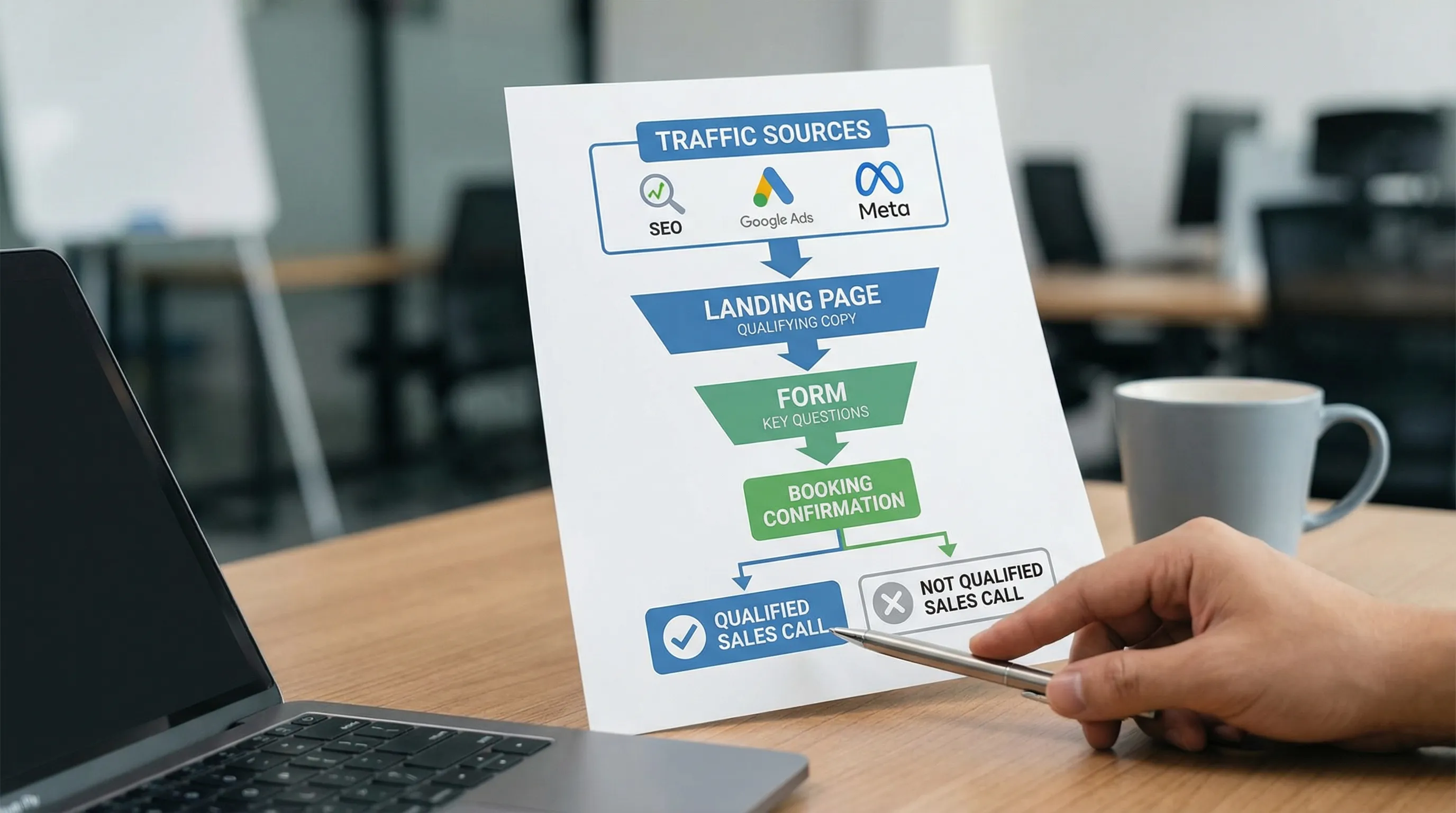
4) Add smart friction to your forms (without killing conversions)
Friction is not always bad. The goal is useful friction.
Examples that often improve lead quality:
- Required service area field (city/postcode)
- Budget range selector (especially for renovation, legal, B2B services)
- “What problem are you trying to solve?” short answer
- A checkbox like “I’m ready to start within: 0 to 2 weeks / 2 to 4 weeks / 1 to 3 months”
You are not making the form longer to annoy people. You are making it clearer who you can help.
5) Stop optimizing on “leads” and start optimizing on “qualified leads”
This is where many businesses plateau.
Practical steps:
- In Google Ads, import only meaningful conversions (for example, booked calls or calls over a threshold duration) if you can.
- Separate campaigns by intent (brand, high-intent non-brand, competitor, remarketing).
- Use negative keywords aggressively to block irrelevant searches.
If you are in a local niche, negative keywords are often the difference between “busy” and “profitable.”
6) Tighten geo-targeting and local relevance
For local businesses in Norway and the US, location mismatch is a major lead-quality killer.
Ways to improve:
- Ensure your ads target the right locations (and exclude areas you do not serve).
- Add service area language on the landing page.
- Strengthen local SEO signals through consistent NAP data and location-specific pages where it makes sense.
For local visibility fundamentals, Google’s guidance on how to improve your local ranking is a good reference.
7) Improve speed-to-lead with a simple follow-up system
Conversion marketing continues after the form submit.
A strong baseline system:
- Instant confirmation message that sets expectations (“We reply within X business hours”)
- Fast first reply (ideally minutes, not hours)
- A second follow-up if no response
- Clear next step (booking link, call window, required info)
If you use automation, the goal is not to spam. It is to reduce response time and ensure no qualified lead slips through.
8) Treat phone calls like a conversion asset
Many local businesses get their best leads by phone, but they do not measure or optimize it.
Basic improvements:
- Make the call-to-action visible above the fold on mobile
- Track call length and outcomes (qualified or not)
- Train your first-call script to quickly confirm fit (area, need, timeline)
Even without advanced tooling, simply logging call outcomes for 2 weeks can reveal patterns in lead quality by channel.
A practical 30-minute lead quality audit
Use this quick check to find the biggest leaks.
Check your last 20 leads
Look for patterns:
- How many were in the wrong location?
- How many had unrealistic budgets?
- How many were asking for something you do not provide?
Compare ad promise vs landing page reality
If the ad implies one thing but the page explains another, you will attract the wrong click.
Review your form fields
Ask: “Do these fields help us qualify, or are they just easy?”
Measure response time for 10 leads
If response time is slow, fix that before you rebuild campaigns. Speed is often the cheapest conversion lift available.
How this ties into your website (and why “free websites” can still be premium)
A high-converting website is not defined by fancy animations. It is defined by:
- Clear positioning that attracts your ideal customer
- Pages built around real search intent (SEO) and paid traffic intent (ads)
- Conversion paths that qualify and route leads properly
Kvitberg Marketing’s approach is built around that idea. If you are a local business, Kvitberg builds a complete, SEO-optimized website for free, then walks you through it. You only decide to buy after you have seen the finished result, with no upfront commitment. If you want to grow beyond the website, optional add-ons include SEO campaigns and Google Search Ads management.
If your current site generates the wrong leads, or too many low-intent inquiries, a conversion-focused rebuild is often the cleanest reset.
The bottom line: aim for fewer, better conversions
If you want better lead quality, stop treating conversions as a single metric and start treating them as a system.
The winning formula is consistent:
- Attract the right intent
- Qualify with clear messaging and smart friction
- Measure down-funnel outcomes
- Follow up fast
Do that well, and you will usually see a counterintuitive outcome: lead volume may drop, but revenue becomes more predictable.