Lead Marketing: Turn Clicks Into Qualified Meetings

Most businesses do not have a traffic problem, they have a click to meeting problem. You can run Google Ads, publish SEO pages, and post on social media for months, only to end up with a handful of low quality inquiries and a calendar that still looks empty.
Lead marketing fixes that by treating every click as the start of a system, not a hope. The goal is simple: turn the right visitors into qualified meetings (sales calls, consultations, demos, site visits) with people who can realistically buy.
What “lead marketing” actually means (and why it beats “lead generation”)
Lead generation is often framed as “get more form fills.” Lead marketing is broader and more measurable:
- You attract the right intent (not just any traffic)
- You convert that intent with a clear next step
- You qualify without creating friction
- You route leads into fast follow up
- You track what produces booked meetings, not just clicks
If you only optimize for cheap clicks or high CTR, you can accidentally optimize for curiosity seekers. Lead marketing forces you to optimize for outcomes that matter: meeting rate, show rate, sales qualified rate, and cost per booked meeting.
Define a “qualified meeting” before you spend another dollar
A qualified meeting is not “someone wants to talk.” It is someone who:
- Has a real need you solve
- Fits your service area (important for local businesses)
- Can afford a typical engagement (or matches your minimum)
- Has authority, or can bring the decision maker
- Is ready within a reasonable timeline
Once you define this, your website, ads, and follow up can be built around filtering for these signals.
The click to meeting system (the 7 parts you need)
A high performing lead marketing system usually has seven connected parts. If one is weak, the whole funnel leaks.
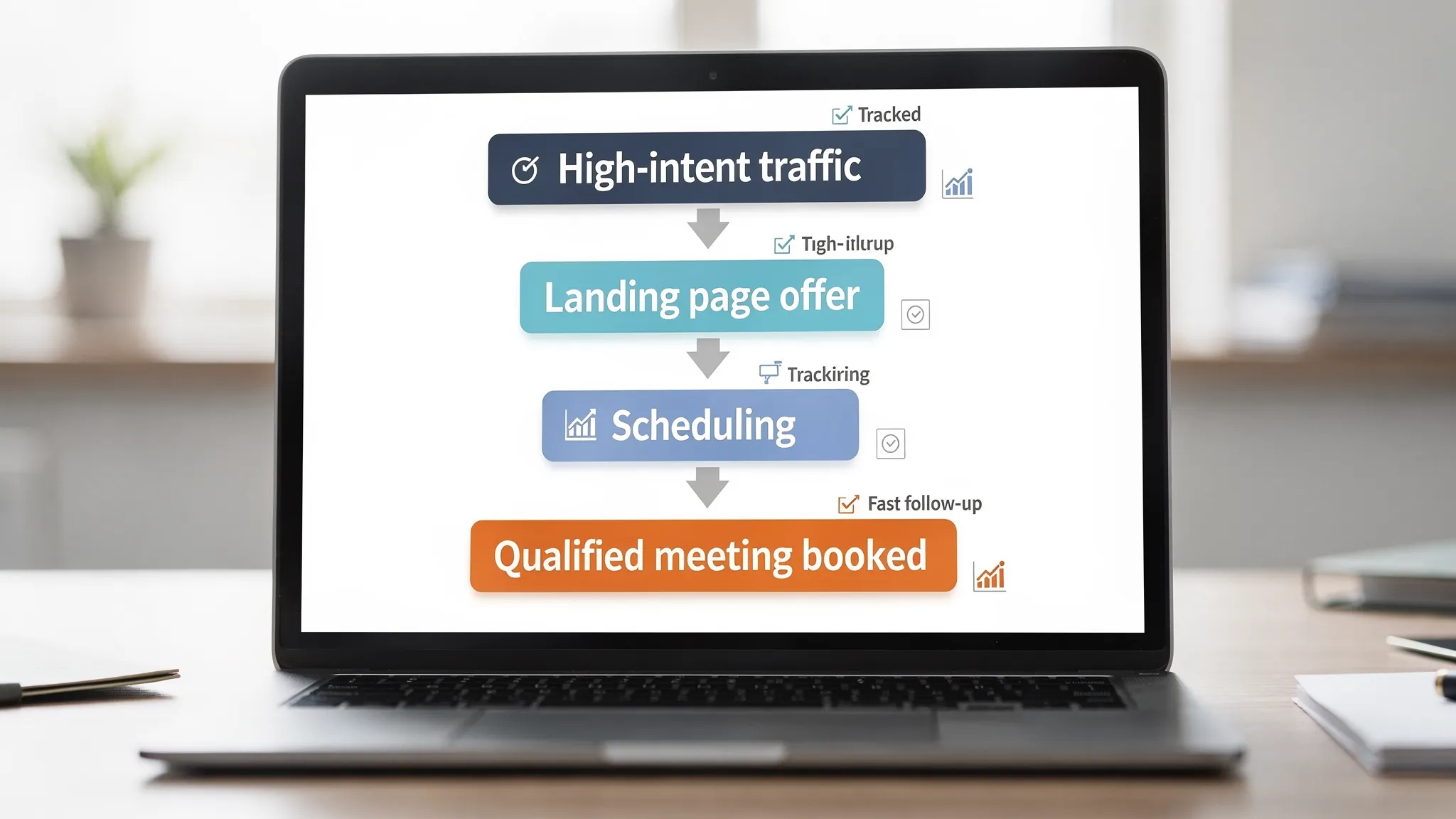
1) Match the channel to the intent
Not all clicks are equal.
- Google Search (high intent): Often best for local services because people search with urgency (example: “roof repair near me,” “dentist in Austin,” “accountant Oslo”).
- Meta (interest based): Can work well for demand creation, seasonal promos, and retargeting, but it usually needs stronger qualification to avoid low intent leads.
- SEO (compounding intent): Best when you publish pages that answer the exact questions buyers ask before they book.
For local businesses in Norway, also consider how people search in Norwegian vs English, and whether they use location modifiers (city, neighborhood) or service terms.
2) Send clicks to a dedicated landing page, not a generic homepage
If your ad promises “Book a free 15-minute estimate,” the click should land on a page that repeats that promise and removes distractions.
A good lead marketing landing page is not “pretty.” It is clear.
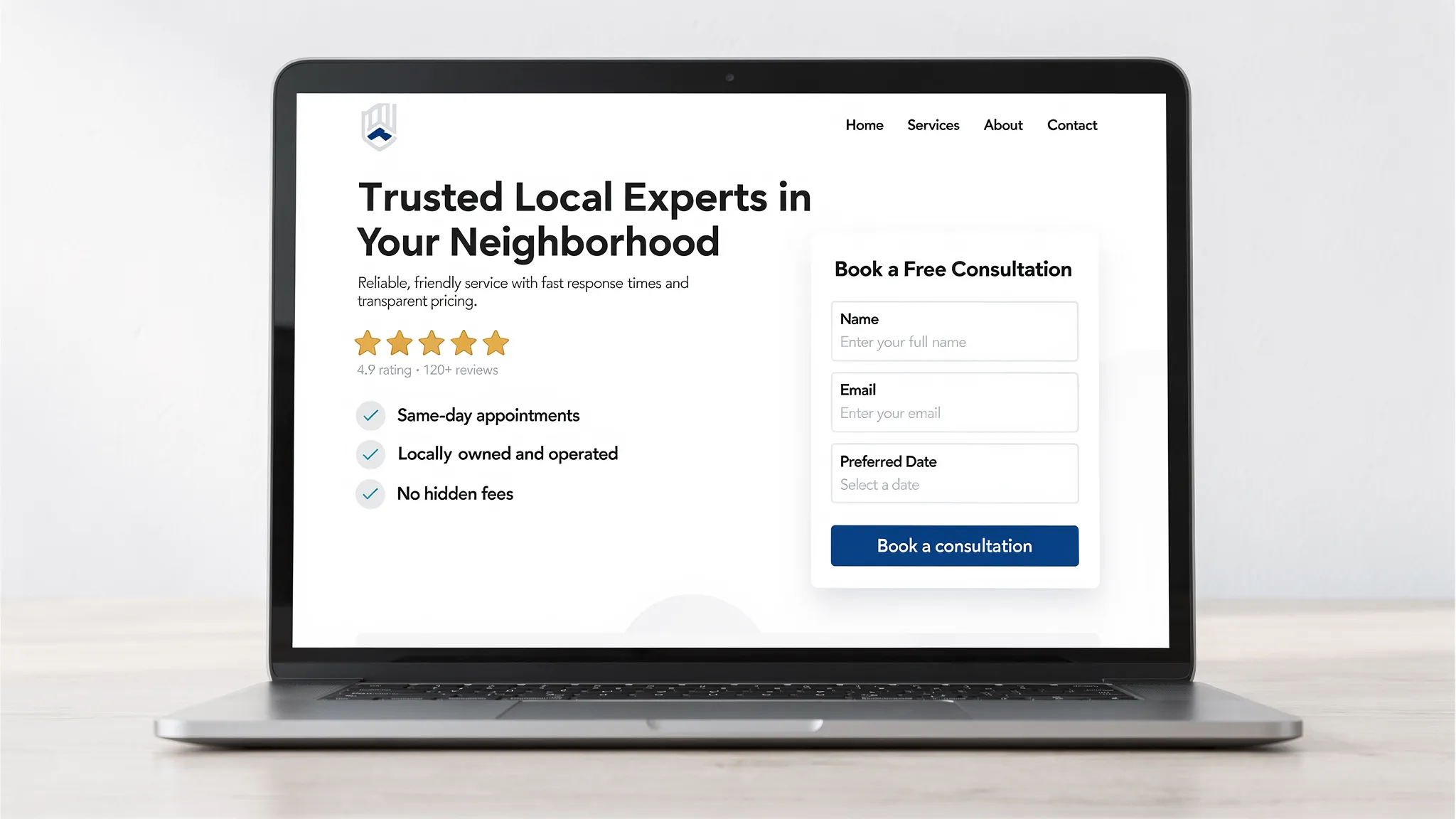
Here is a practical checklist of what typically moves visitors toward booking:
| Landing page element | What it does | Example for a local business |
|---|---|---|
| Strong headline that matches the ad/query | Confirms they are in the right place | “Same-week plumbing repairs in Bergen” |
| Proof above the fold | Reduces perceived risk fast | Reviews, certifications, before/after photos |
| Specific offer | Makes the next step obvious | “Free on-site quote” or “30-min strategy call” |
| Service area clarity | Filters out bad-fit leads | “Serving Oslo + 30 km” |
| Friction-reduced form | Improves conversion rate | Name, email, phone, one qualifying question |
| Short “how it works” section | Sets expectations | “Submit, we call within 10 minutes, book a time” |
| FAQ-style objections (embedded in copy, not a FAQ section) | Handles common doubts | Pricing ranges, timelines, guarantees |
3) Make the offer about the buyer’s risk, not your features
A click becomes a meeting when the visitor feels the next step is safe.
For local services, offers that often perform well include:
- A fixed-scope consultation (example: “20-minute kitchen remodel planning call”)
- A quote or estimate with clear boundaries
- A diagnostic (example: “Free Google Ads account audit”)
- A local assessment (example: “On-site energy efficiency walk-through”)
The best offers reduce two fears: “Will this waste my time?” and “Will I get pressured?”
4) Qualify without killing conversions
Qualification is a balancing act. Too little, and you fill your calendar with bad meetings. Too much, and you crush conversions.
A practical approach is:
- Keep the initial form short
- Add 1 to 3 qualifying questions that map to your definition of “qualified meeting”
- Do deeper qualification after the form (email/SMS automation or the first call)
A simple lead scoring model helps your team prioritize quickly:
| Signal | Example question or data point | Why it matters |
|---|---|---|
| Location fit | “What city are you in?” | Prevents out-of-area leads |
| Budget fit | “What range are you expecting?” | Filters price shoppers if you are premium |
| Timeline | “When do you need this done?” | Prioritizes urgent opportunities |
| Service match | Dropdown of services | Routes to the right person |
| Decision role | “Are you the decision maker?” | Improves close rate |
Use this to decide whether a lead should go straight to scheduling, get a quick screening call, or be nurtured.
5) Turn form fills into booked meetings with immediate scheduling
If your goal is qualified meetings, make “book a time” the default next step.
Common options:
- A scheduling link right after form submit
- A “thank you” page with available slots
- A call-back promise (with an actual process behind it)
Speed matters. A well-known analysis in Harvard Business Review highlights how quickly online leads go cold and why fast follow-up dramatically improves contact rates and outcomes (The Short Life of Online Sales Leads).
If you are a local business owner juggling operations, the solution is not “be online 24/7,” it is building a system that responds quickly even when you are busy.
6) Build follow-up that respects how people actually decide
Many qualified buyers do not book on the first visit. They compare options, ask a spouse or business partner, or wait for payday.
Your follow-up should match that reality:
- A short confirmation message that sets expectations
- A reminder before the meeting (reduce no-shows)
- A value-based follow-up if they do not book (case study, price guide, checklist)
This is where lead marketing becomes a compounding asset. Each follow-up sequence is a reusable system, not a one-time manual effort.
7) Track the right metrics (clicks are not the goal)
A lead marketing system should be measured by outcomes closest to revenue.
Here is a clean set of metrics that works for most local businesses and B2B teams:
| Funnel stage | Metric to track | What “good” usually means |
|---|---|---|
| Traffic quality | % of visitors from high-intent sources | Increasing over time |
| Page performance | Landing page conversion rate | Improves after testing |
| Lead quality | % that meet your qualification criteria | Stable or increasing |
| Scheduling | Lead-to-meeting booked rate | Improves when scheduling is simpler |
| Operations | Speed to first response | Faster is almost always better |
| Sales | Meeting show rate | Improves with reminders and clear expectations |
| Efficiency | Cost per qualified meeting | Decreases as funnel tightens |
Instead of obsessing over CTR, ask: Which keyword, ad, or page produces the most qualified meetings per 100 clicks? That question changes your decisions immediately.
Where most “clicks but no meetings” funnels break
If you are getting traffic but not bookings, the problem is usually one of these:
Message mismatch
The ad says one thing, the page says another. People bounce because they feel bait-and-switched.
Weak trust signals
Local buyers want proof: reviews, photos, credentials, clear service area, and real contact details.
Slow pages on mobile
Mobile visitors abandon slow pages quickly. Google’s guidance on user experience and page performance is a good reference point if you want to audit your site and prioritize improvements (Core Web Vitals).
Too many choices
Navigation menus, multiple CTAs, and “learn more” buttons compete with your booking flow.
No clear next step
If the visitor has to guess what happens after they submit a form, they hesitate.
Lead marketing examples by business type
Lead marketing looks slightly different depending on what you sell.
Local service businesses (plumbers, electricians, dentists, clinics)
What usually works best:
- Search intent pages for each core service + location
- A fast booking or call flow
- Proof and clarity above the fold
- Tight service area filtering
B2B services (agencies, consultants, IT providers)
What usually works best:
- A strong point of view (who you help, what you fix, what outcomes you drive)
- Case studies and specific results language
- A qualification step to protect your calendar
Hiring and recruiting driven growth teams
If your “lead” is a high-caliber candidate or an executive conversation, you still need the same click-to-meeting fundamentals: clear positioning, proof, and a frictionless path to a first call. For companies hiring senior GTM, sales, and marketing leaders across Europe and beyond, a specialist partner like Optima Search Europe shows how focused positioning and process can support business-critical outcomes.
How to improve meeting quality without reducing volume
Many businesses try to fix low-quality leads by narrowing targeting so much that volume collapses. A better approach is usually:
- Keep your targeting reasonably broad
- Improve qualification on the page and in the form
- Add “self-selection” copy (price guidance, service area, minimum project size)
- Route lower-fit leads into nurture instead of booking
This keeps the top of funnel healthy while protecting your calendar.
Where a better website fits into lead marketing
A lot of lead marketing wins come from unglamorous fundamentals:
- Having a website that loads fast and reads clearly on mobile
- Creating service pages built around real search intent
- Using conversion-focused layouts instead of generic templates
- Making tracking and follow-up possible
If your current site is old, slow, or not built to convert, it becomes the bottleneck even if your ads and SEO are strong.
How Kvitberg Marketing helps local businesses get from clicks to meetings
Kvitberg Marketing builds pre-built, professional, SEO-optimized websites for local businesses with no upfront commitment. You submit an inquiry, receive a finished website, then decide whether you want to buy after you see the result.
That model is especially helpful if you know your business needs more qualified meetings, but you do not want to gamble on a rebuild before seeing what you are getting.
If you want to go beyond the website, Kvitberg also offers optional growth services like SEO campaigns and Google Search Ads management, so your traffic generation and conversion system can work together.
If your current funnel is “clicks in, hope out,” start by tightening the path to one outcome: a qualified meeting. You can learn more or submit an inquiry at Kvitberg Marketing.