Local Business Marketing That Works in 2026 (Norway + US)
Local business marketing in 2026 is less about chasing every new channel and more about building a system that reliably turns “near me” intent into calls, bookings, and walk-ins. The businesses winning in both Norway and the US are doing three things well: they show up when people search locally, they convert that attention into leads fast, and they follow up automatically so opportunities do not leak.
This guide breaks down what’s working now, what’s changed (AI search, privacy, tracking), and how to build a practical marketing engine you can run without a huge team.
What changed in 2026 (and what stayed the same)
A few shifts are shaping local business marketing right now:
- Search is becoming “answer-first.” Google and AI-powered experiences are summarizing results more often, which means your website and business listings need to be structured, consistent, and easy for machines to understand.
- Tracking is harder, measurement is more important. Cookie restrictions, consent requirements, and platform changes mean you need cleaner first-party data (forms, calls, bookings) and better CRM hygiene.
- Speed wins. Many local categories are “first responder markets” (plumbers, dentists, towing, HVAC, legal, clinics). The business that replies first, with clarity and proof, often wins.
What stayed the same:
- Local intent is still the highest-intent intent. Someone searching “electrician in Bergen” or “roof repair near me” is often ready to buy.
- Trust signals matter more than clever ads. Reviews, before-and-after proof, clear pricing ranges, and location legitimacy still decide outcomes.
The 2026 local marketing system (simple, repeatable)
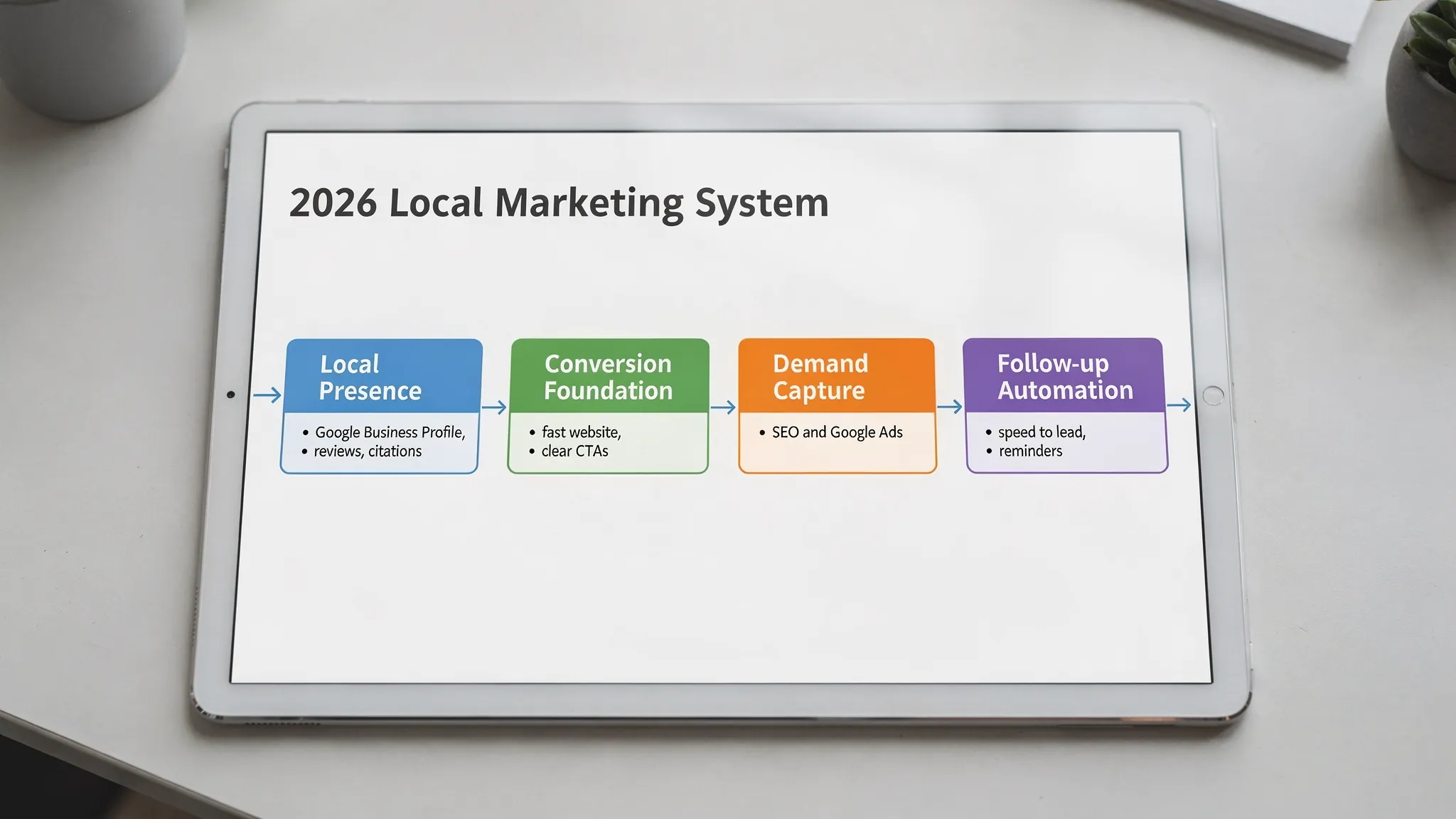
Think in four layers. If you build them in order, every channel performs better.
1) Local presence (be eligible to rank and be trusted)
If your business information is inconsistent or incomplete, every other tactic gets more expensive.
Focus on:
- Google Business Profile (GBP): Categories, services, opening hours, photos, service areas, and frequent posting.
- Consistent NAP: Name, address, phone number must match across your site, GBP, and key directories.
- Review velocity: A steady flow of recent, detailed reviews (not a one-time push).
Good starting references:
2) Conversion foundation (turn visits into leads)
In 2026, the conversion gap is a hidden tax. Many local businesses “get traffic” but lose revenue because the website and follow-up are weak.
Your baseline conversion foundation:
- One primary goal per page: Call, request quote, book appointment, get directions.
- Fast mobile performance: Most local intent is mobile.
- Trust blocks above the fold: Reviews, licenses, guarantees, local photos, and clear service area.
- Lead capture that matches urgency: Click-to-call, short forms, and frictionless booking.
If you want a reality check, open your site on your phone and ask: “Could a stranger decide to contact me in 15 seconds?” If not, fix this before buying more ads.
3) Demand capture (show up when people are already looking)
This is where local businesses get the fastest ROI.
The best capture channels for most local categories:
- Local SEO (maps + local organic)
- Google Search Ads (high-intent keywords + location-based ads)
- Retargeting (lightweight, only if you already have traffic)
4) Automation and follow-up (stop leaking leads)
Your marketing is only as strong as your response speed and persistence.
Minimum viable follow-up system:
- Auto-confirmation message within 1 minute
- A clear next step (availability, pricing range, what happens next)
- Reminder message (for bookings)
- Missed call workflow (text-back, voicemail, callback task)
This is where AI automation can help, not by being “fancy,” but by being consistent.
Local SEO that works now (Norway + US)
Local SEO is still one of the most compounding investments for local businesses because it reduces long-term dependence on ads.
The 2026 local SEO checklist (high impact)
| Area | What to do | Why it matters in 2026 |
|---|---|---|
| Google Business Profile | Fill every relevant field, add services, upload real photos monthly | Improves map visibility and trust |
| Reviews | Ask after delivery, guide customers to mention the service and location | AI summaries and users rely heavily on review content |
| Service pages | Create dedicated pages per core service (and sometimes per city/area) | Helps rank for specific intent searches |
| Location signals | Put address/service area, hours, and contact info in the site footer | Reinforces legitimacy and consistency |
| Schema markup | Add LocalBusiness schema (and service schema where relevant) | Helps machines interpret your business |
| Internal linking | Link from homepage to money pages, and between related services | Distributes authority and clarifies site structure |
Norway vs US: what differs in practice
The fundamentals are the same, but discovery paths can differ:
- Norway: Google is central, and many customers expect strong legitimacy signals (clear org number where relevant, local references, transparent terms). Local language nuance matters if you market in Norwegian, but even English sites can work in some niches if the trust and clarity are strong.
- US: Beyond Google, some categories feel stronger on ecosystem platforms (Apple Maps, Yelp, Nextdoor, industry-specific directories). You do not need to be everywhere, just where your customers actually check.
The rule is: pick a few high-quality citations and keep them correct, do not scatter your business across dozens of low-quality directories.
Reviews: stop asking for “a review,” ask for the right review
A 5-star rating helps. A 5-star rating that mentions the service and the city helps more.
Instead of: “Can you leave us a review?”
Try: “If you were happy with the [service] in [city/area], could you mention what we did and where we helped you? It really helps local customers find us.”
For a useful benchmark mindset, BrightLocal’s annual review research is a solid reference point for how consumers use reviews when choosing local businesses.
Google Ads in 2026: the local playbook that still prints money
Google Ads is still the fastest lever for local lead generation, but only if you run it like a lead quality system, not a “traffic” system.
What to run (most local businesses)
- Search campaigns focused on high-intent terms: “emergency plumber,” “dentist appointment,” “roof leak repair,” plus city and “near me” variants.
- Tight location targeting: Focus budget on the real service area, not an entire country or state.
- Conversion tracking that matches reality: Calls, form fills, booking confirmations. If you cannot measure it, you cannot optimize it.
What usually wastes budget
- Broad, vague keywords (for example, “plumbing” without modifiers)
- Sending clicks to a generic homepage
- Optimizing for leads without validating lead quality
The simplest “quality control” loop
| Step | What you check weekly | What you change |
|---|---|---|
| Lead review | Are leads real, local, and service-fit? | Add negatives, adjust locations, refine keywords |
| Speed to lead | How fast do you respond? | Add automation, missed call text-back |
| Close rate | Which campaign produces booked jobs? | Shift budget to high-close ad groups |
| Search terms | What did people actually type? | Build new exact keywords, exclude junk |
If you want Google’s current best practices straight from the source, start here:
Meta Ads in 2026: best for awareness and retargeting, risky for cold leads
Meta can work well for local businesses, but the role matters.
Meta tends to be strongest for:
- Retargeting people who visited your site (especially if you have a clear offer)
- Local brand awareness (new clinic, new restaurant, new gym)
- Promotions with a clear deadline (seasonal offers)
It can be weaker for:
- Emergency services (people do not browse Facebook when their basement is flooding)
- Highly technical services where trust requires deeper proof
A practical approach: capture demand on Google, then use Meta retargeting to stay top-of-mind and recover undecided buyers.
Reference:
- Meta Business help center
Your website in 2026: it needs to be a sales rep, not a brochure
A local website that converts in 2026 is usually:
- Fast on mobile
- Service-first navigation (not “About” first)
- Proof-heavy (reviews, case photos, credentials)
- Clear on geography (where you operate)
- Built for action (call, form, booking)
A common mistake is trying to make the website “impressive” instead of making it decisive.
The must-have pages for most local businesses
- Homepage (what you do, who you help, where you serve, primary CTA)
- Core service pages (one per main service)
- Contact page (phone, email, map if relevant, hours)
- About page (local story, credentials)
- Reviews or testimonials page (optional if well integrated elsewhere)
If you are unsure whether your site is holding you back, run a basic audit with Google’s tools:
AI and automation for local businesses: where it actually helps
In 2026, “AI marketing” is not about generating more content. It’s about reducing manual work and increasing consistency.
High-ROI automation ideas:
- Lead routing: Form submissions instantly go to the right person.
- Instant response: Auto-confirmation with next steps.
- Follow-up sequences: If someone requests a quote and goes silent, send a helpful reminder.
- Pipeline visibility: Track lead status (new, contacted, booked, won, lost).
Two guardrails:
- Keep messaging human and brand-safe.
- Never let automation replace real service when urgency is high (for example, emergency jobs).
Measurement in a privacy-first world (GDPR and US state privacy laws)
Whether you operate in Norway (GDPR) or the US (a patchwork of state laws, including California’s CCPA), the direction is the same: transparency and consent matter.
Practical measurement principles that hold up in 2026:
- Prioritize first-party conversions: Calls, form fills, bookings.
- Use clean attribution expectations: Do not obsess over perfect tracking, obsess over profitable tracking.
- Connect marketing to outcomes: Leads that become revenue, not clicks.
If you work with an agency or vendor, ask them how they handle consent, tracking configuration, and what they consider a “qualified lead.” The answer tells you a lot.
A 30-day plan you can actually execute
If you want traction fast without chaos, run this sequence.
Week 1: Fix your foundation
- Clean up Google Business Profile (categories, services, photos, hours)
- Confirm consistent name, address, phone across your site and key listings
- Add clear CTAs (call, quote, booking) across your top pages
Week 2: Build proof and relevance
- Create or improve your top 2 to 4 service pages
- Add a review request process (email or SMS after delivery)
- Publish 10 to 20 real photos (team, work, location, vehicles, before/after)
Week 3: Turn on demand capture
- Launch or rebuild Google Search Ads around high-intent keywords
- Add conversion tracking for calls and forms
- Tighten location targeting and add negative keywords
Week 4: Install follow-up automation
- Auto-reply to all inbound leads with next steps
- Add missed-call text-back
- Track lead status in a simple pipeline
If you do only this, you will usually outperform businesses that jump straight to “posting more on social.”
When it makes sense to get help (and what to look for)
Local business marketing can be DIY, but it often becomes expensive DIY when:
- You are spending on ads but do not know which campaigns produce booked jobs
- Your website is old, slow, or not built to convert
- You respond to leads late, inconsistently, or not at all
- You want growth, but you do not have time to manage SEO, ads, and follow-up
A good partner should be able to explain their system clearly, show how they measure qualified leads, and improve outcomes within weeks, not months.
If you need a new website, consider a “see it first” approach
For many local businesses, the website is the bottleneck. If you upgrade it, SEO and ads both get cheaper because conversion rates improve.
Kvitberg Marketing builds pre-built, professional, SEO-optimized websites for local businesses with a “see it first” model: you submit an inquiry, receive a fully finished website, review it in a short walkthrough meeting, and only decide to buy after you’ve seen the completed result. If you want additional growth, optional services like SEO campaigns and Google Search Ads management can be added, based on what your business actually needs.
If your current site is outdated or you are unsure what to fix first, start with the foundation. A fast, clear, trust-heavy website paired with local SEO and high-intent Google Ads is still the most reliable local business marketing combo in 2026.