Marketing AI: Practical Use Cases for Local and B2B Teams

AI has moved from “nice experiment” to “core workflow” in marketing. For local businesses, it can mean fewer missed calls, faster content, and better review management. For B2B teams, it often shows up as higher-quality leads, tighter alignment with sales, and faster iteration across ads and landing pages. The win is not just creative generation, it is automation + decision support, applied to the parts of marketing that are repetitive, data-heavy, or response-time sensitive.
This guide breaks down marketing AI practical use cases you can deploy today, with examples for both local and B2B teams, plus guardrails for quality, privacy, and brand consistency.
What “marketing AI” actually means (in plain terms)
In day-to-day marketing, “AI” usually refers to a stack of capabilities:
- Generative AI for text, images, and variants (ads, emails, landing page copy, FAQs).
- Predictive and scoring models (lead scoring, churn risk, propensity to buy).
- Automation and orchestration (routing leads, follow-ups, summarizing calls, pushing data to CRM).
- Optimization in ad platforms (bidding and budget allocation, creative rotation).
If you are a local business owner, you will likely feel the impact first in speed and responsiveness (answering leads, publishing content, managing reputation). If you are a B2B team, you will often see it first in pipeline efficiency (lead qualification, account prioritization, sales enablement).
For a useful baseline on what AI is good at (and what it is not), see NIST’s AI Risk Management Framework for governance concepts you can adapt to marketing operations.
Practical marketing AI use cases by function
1) Lead capture and conversion (local + B2B)
Use case: Instant lead response and qualification
Speed-to-lead matters in almost every industry. AI can:
- Classify inbound leads (high intent vs low intent) based on form fields, referral source, and message text.
- Ask 2 to 4 follow-up questions automatically (budget, timeline, service area, requirements).
- Route leads to the right person or calendar.
- Generate a personalized “next step” email in your tone.
For a local business (plumber, dentist, law office), this reduces missed opportunities after hours. For B2B, it prevents SDR teams from drowning in low-quality demos.
Implementation tip: Start with a single channel (your website form). Capture first-party data cleanly (name, email/phone, request type), then add enrichment only if it is compliant and necessary.
2) Local SEO content at scale (without turning spammy)
Use case: Location and service page creation with human review
Local SEO still depends on clear pages that match intent: “service + city,” FAQs, pricing guidance, trust signals, and internal links. AI helps you draft:
- Service pages (core services, process, timelines, what’s included).
- Location pages (service area specifics, travel fees, local proof).
- FAQ sections based on real customer questions.
- Schema markup drafts (to be validated).
The non-negotiable: AI drafts should be grounded in real details. If your business does not offer 24/7 support, do not let AI claim it. If your service area is limited, do not publish generic city lists.
Helpful references for quality and trust:
- Google’s guidance on helpful content and people-first content.
3) Review management and reputation growth (especially local)
Use case: Review response assistant and review request automation
AI can draft polite, on-brand responses to reviews (including negative ones) and help you respond faster and more consistently.
It can also automate review requests after a completed job or appointment, with light segmentation:
- “New customer” vs “repeat customer” message tone.
- Different templates for different services.
- A simple escalation path for unhappy customers before they leave a public review.
Implementation tip: Keep responses authentic. Always add one human detail (the service delivered, the date, the location) so you do not sound automated.
4) Google Ads and Meta Ads creative production (local + B2B)
Use case: Rapid ad variant generation and testing
AI is excellent for producing many plausible variations quickly:
- Headlines and descriptions for Google Search ads.
- Meta primary text variations.
- Offers and CTA variations.
- “Objection handling” angles (price, trust, speed, quality, warranties).
Then you let the platform and your performance data choose the winners.
What AI should not do alone: decide your positioning. Your strongest ads still come from a clear value proposition and proof.
If you want platform-specific best practices, start with:
- Google Ads best practices for core account hygiene and relevance.
5) Landing page personalization and CRO (mostly B2B, also high-ticket local)
Use case: Message matching by query and audience
In B2B, conversion rate often improves when the landing page mirrors the intent behind the click.
AI can help you generate and maintain:
- Industry-specific variants (construction, healthcare, SaaS, manufacturing).
- Use-case variants (reduce admin work, improve lead quality, increase booked calls).
- FAQ blocks targeted to objections seen in sales calls.
For local businesses with higher ticket services (legal, cosmetic dentistry, remodeling), the same concept applies: one page per core service, with FAQs and trust sections aligned to what prospects actually ask.
6) Sales enablement for B2B (turn marketing assets into pipeline)
Use case: Call summaries, objection libraries, and follow-up drafts
Marketing AI is not only for the marketing team. When integrated into revenue operations, it can:
- Summarize discovery calls into structured notes.
- Extract objections and “why us/why now” language.
- Suggest follow-up sequences based on what was discussed.
- Build a living FAQ and comparison page outline from real sales conversations.
This is one of the highest ROI applications because it compounds. Every call improves messaging, content, and targeting.
7) Reporting, insights, and “what changed?” explanations (local + B2B)
Use case: Automated performance narratives
Dashboards are not the same as understanding. AI can produce a weekly summary like:
- What moved (leads, CPL, conversion rate, ROAS, booked calls).
- What likely caused it (budget shifts, seasonality, creative fatigue, ranking changes).
- What to do next (test plan and priority list).
This is especially helpful for small teams that do not have an analyst.
8) Content refresh and pruning (SEO maintenance)
Use case: Updating existing pages instead of publishing endless new ones
In 2026, many sites have “content debt”: outdated pages, thin posts, duplicated topics, and missing internal links. AI helps you:
- Identify pages that are decaying in clicks or rankings.
- Suggest refreshed outlines that better match intent.
- Improve clarity, headings, and FAQs.
- Generate internal link suggestions.
This is a practical way to grow organic traffic without bloating your site.
Use case matrix: what to prioritize first
Below is a simple prioritization view. “Effort” assumes you already have a website and basic analytics.
| Use case | Best for | Typical impact | Effort | Main risk to manage |
|---|---|---|---|---|
| Speed-to-lead automation | Local + B2B | More qualified conversations | Medium | Wrong routing or robotic replies |
| Review response drafts | Local | Faster reputation recovery | Low | Generic, copy-paste tone |
| SEO service page drafting | Local + B2B | More relevant organic entry points | Medium | Inaccurate claims, thin content |
| Ad copy variant generation | Local + B2B | Faster testing and iteration | Low | Off-brand messaging |
| Landing page variants | B2B + high-ticket local | Higher conversion rate | Medium-High | Fragmented analytics, inconsistency |
| Call summaries and objection library | B2B | Better pipeline conversion | Medium | Privacy/compliance needs |
| Automated weekly performance insights | Local + B2B | Faster decisions | Medium | Misattribution without context |
A practical rollout plan (that does not overwhelm your team)
Step 1: Pick one KPI and one workflow
Good starting points:
- Local: “Booked calls per week” or “request-a-quote submissions.”
- B2B: “Qualified demos” or “SQLs.”
Then choose one workflow where AI removes a bottleneck (lead response, ad variants, page creation, reporting).
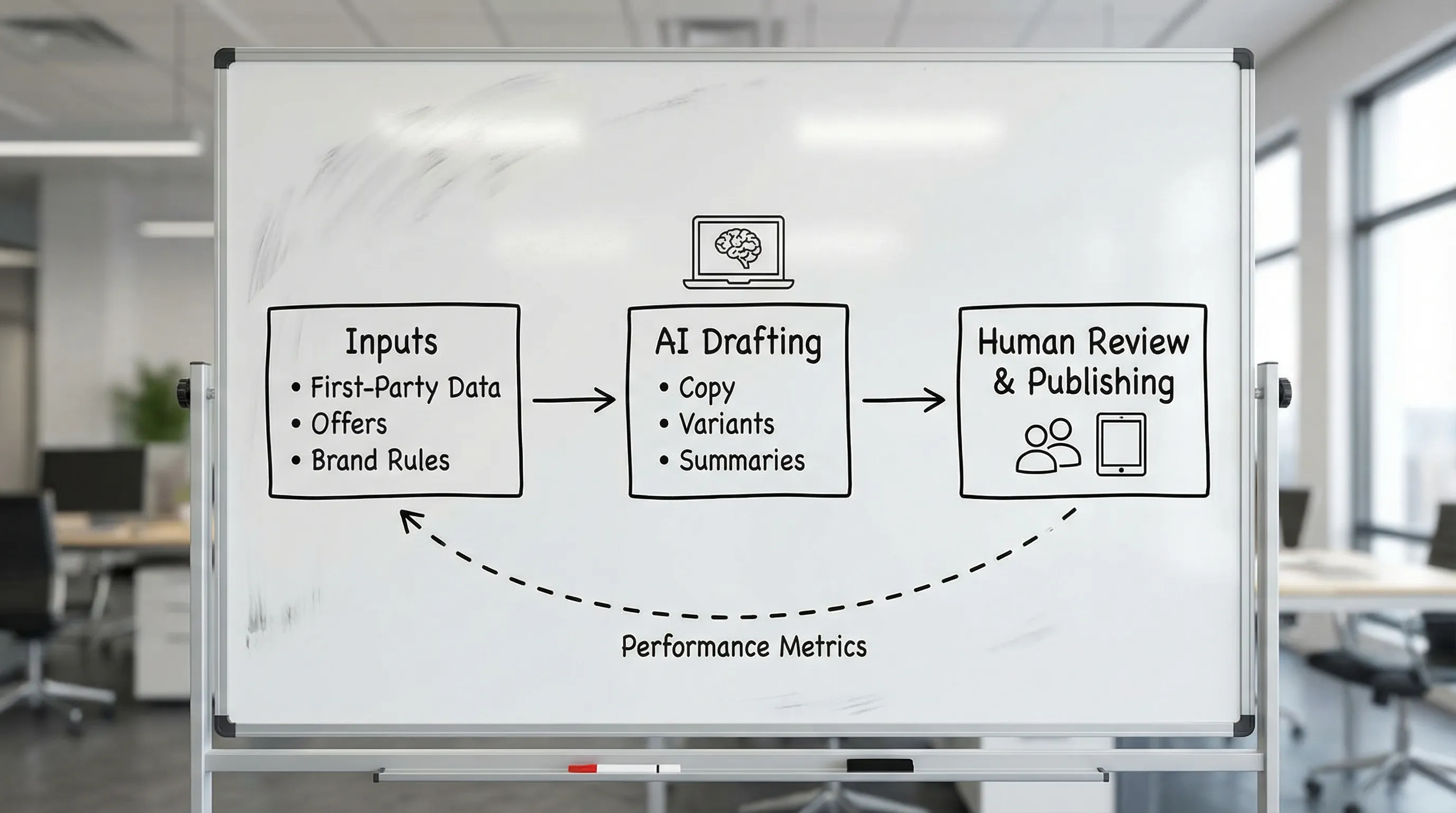
Step 2: Define your “brand and truth” rules
Write a simple one-page guideline that AI must follow:
- What you sell, who it is for, and who it is not for.
- Pricing rules (if you do not publish pricing, say so).
- Proof allowed (reviews, case studies, certifications).
- Restricted claims (guarantees, timeframes, regulated industries).
This single step prevents most low-quality AI output.
Step 3: Put humans back in the loop where it matters
AI works best when it drafts and your team approves.
A common split:
- AI drafts: outlines, variants, summaries, internal link suggestions.
- Human approves: final copy, compliance, offers, pricing, guarantees, medical/legal claims.
Step 4: Instrumentation (so you can prove ROI)
At minimum:
- Conversion tracking for forms and calls.
- UTM hygiene for paid campaigns.
- A CRM stage definition (lead, qualified, booked, closed).
If you are unsure where to start, Google’s Analytics documentation is a reliable reference for baseline setup.
Marketing AI pitfalls (and how to avoid them)
Hallucinated claims and “confident nonsense”
Generative models can produce plausible but incorrect statements. The fix is process:
- Use approved facts only (services, areas, pricing rules, guarantees).
- Require citations for claims in B2B thought leadership.
- Maintain a shared “truth doc” the model draws from.
Publishing pages that look mass-produced
If your site suddenly adds 50 near-duplicate city pages, you risk poor user experience and weak performance.
Better pattern:
- Build fewer pages, make each one demonstrably useful.
- Add real photos, real project examples, and FAQs from real customers.
- Refresh your best pages before creating new ones.
Privacy and consent issues
If you use AI to summarize calls or analyze customer messages, confirm your legal basis and retention policy, and be careful with sensitive data.
For teams building governance, the NIST AI RMF is a practical starting point.
A simple prompt framework your team can reuse
You will get more consistent output if you standardize prompts.
| Task | Prompt components that improve quality |
|---|---|
| Ad copy variants | Goal, audience, offer, proof, tone, banned claims, character limits |
| Service page draft | Service scope, service area, pricing guidance, process steps, FAQs, proof |
| Sales follow-up email | Call notes, next step, key objection, timeline, tone, CTA |
| Weekly performance summary | Date range, KPIs, changes, hypotheses, recommended tests |
This is not about “prompt engineering.” It is about giving AI the same inputs your best marketer would ask for.
Where this fits for local businesses vs B2B teams
Local businesses usually win fastest by applying marketing AI to:
- Lead response and scheduling
- Review workflows
- Service page creation and updates
- Simple Google Ads iteration
B2B teams usually win fastest by applying marketing AI to:
- Sales enablement (call summaries, objection libraries)
- Landing page variants and message matching
- Lead scoring and routing
- Reporting narratives tied to pipeline stages
If you are doing both (for example, a local services company with longer sales cycles), combine the local fundamentals with B2B-style qualification and follow-up.

Frequently Asked Questions
What are the best marketing AI use cases for a small local business? Start with speed-to-lead follow-ups (forms and missed calls), review response drafts, and AI-assisted service page updates. These tend to improve revenue quickly without heavy tooling.
Will AI replace my marketing team or agency? In most cases, AI replaces tasks, not accountability. You still need strategy, positioning, tracking, and human review for brand and compliance.
Is AI-generated content bad for SEO? AI content is not automatically “bad,” but low-value, inaccurate, or mass-produced pages typically perform poorly. Focus on helpful, specific content with real proof and clear intent matching.
How do I measure ROI from marketing AI? Tie AI-driven workflows to one KPI (booked calls, qualified demos, cost per lead, close rate). Measure baseline performance, then run controlled changes (one workflow at a time).
Can marketing AI help with Google Ads performance? Yes, especially for generating and testing ad variants, improving landing page relevance, and producing clearer performance summaries. You still need solid conversion tracking and account structure.
Want AI-driven growth without committing upfront?
If you are a local business and you need a website that is built to convert, not just “look nice,” Kvitberg Marketing offers free, professionally designed, SEO-optimized websites with no upfront commitment. You review the finished site in a short walkthrough, then decide whether to buy only if you like the result.
If you want to go further, we also offer optional growth services like SEO campaigns and Google Search Ads management.
Explore Kvitberg Marketing here: Kvitberg Marketing