Marketing and Conversion: Fix Your Funnel in 30 Days
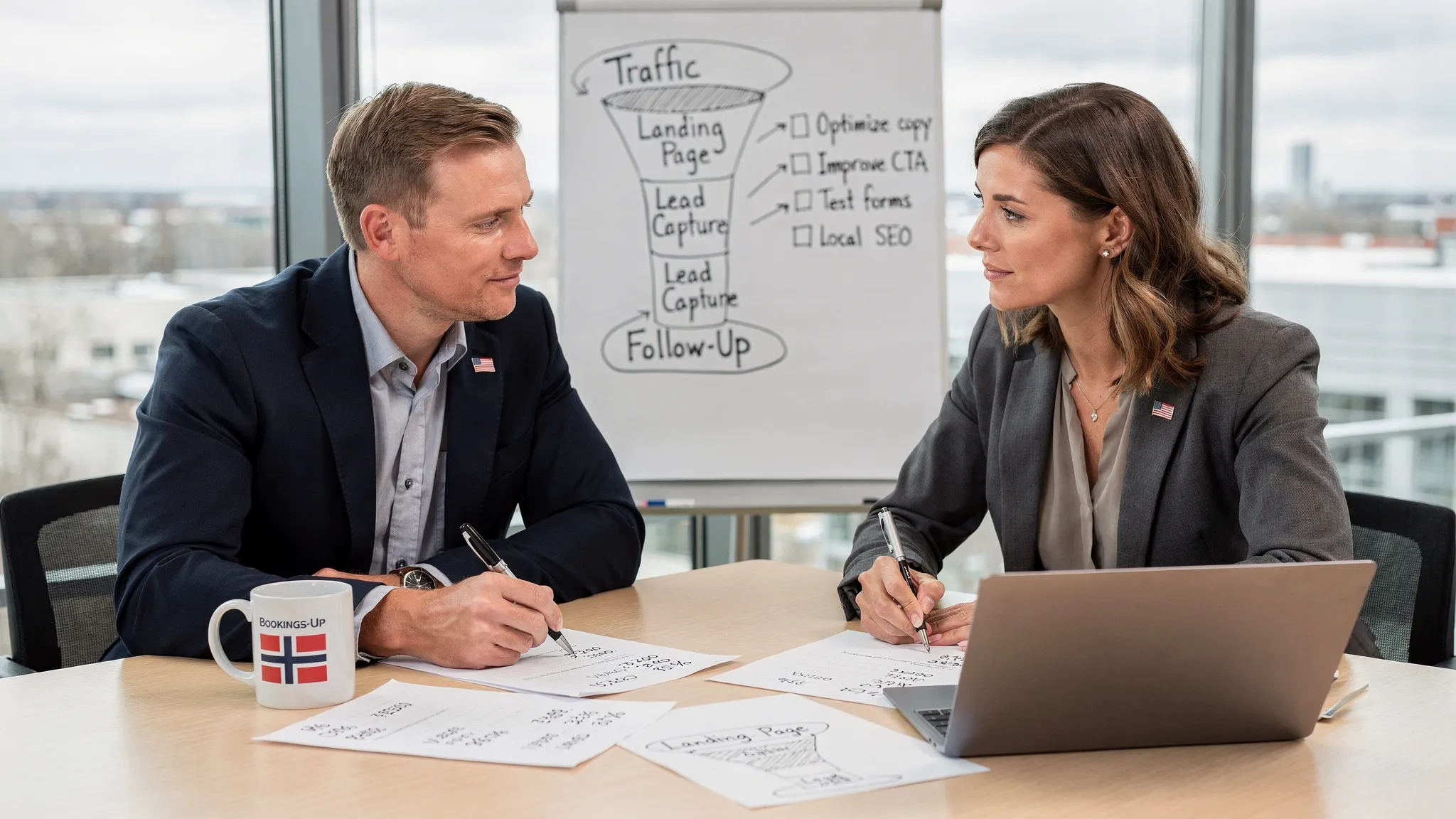
Most funnels don’t “fail” because you need a new ad platform. They fail because a few small leaks compound: unclear messaging, slow pages, weak calls to action, missing follow-up, and no measurement.
This 30-day sprint is designed for local businesses in Norway and the US (service providers, clinics, trades, local retailers, and B2B companies) who want better marketing and conversion outcomes without rebuilding everything from scratch.
What “fix your funnel” means in 2026
A functional funnel is simply a predictable path from:
- The right people finding you
- To understanding your offer fast
- To taking one clear next step (call, form, booking, quote)
- To being followed up until they become customers
If any part is unclear or untracked, you end up guessing which channel “works,” and conversion stays flat.
The 4 conversion metrics that tell you where the leak is
Before you change creative or budgets, anchor your sprint to a few metrics:
- Traffic quality: Are the right people landing on the right page (channel, keyword, intent)?
- Landing page conversion rate: What percent takes your primary action (form, call, booking)?
- Lead-to-customer rate: Of all leads, how many close?
- Speed to lead: How fast does your business respond?
If you can’t answer these, your first “funnel fix” is measurement.
The 30-day funnel plan (overview)
Think of this as four weekly cycles: measure, clarify, remove friction, then optimize.
| Week | Primary goal | Deliverable you can point to | What improves first |
|---|---|---|---|
| 1 | Make performance measurable | Clean tracking + baseline | Decision clarity |
| 2 | Make the offer instantly understandable | One primary landing page per offer | Landing page conversion |
| 3 | Turn leads into booked jobs | Follow-up system + scripts + proof | Lead-to-customer rate |
| 4 | Scale what’s working | Tests + budget reallocation | Cost per lead + volume |
If you do nothing else, complete Weeks 1 to 3. Week 4 helps you scale.
Week 1 (Days 1 to 7): Measurement and funnel diagnosis
Your goal this week is not more traffic. It’s knowing what is happening.
Day 1 to 2: Define one conversion goal per offer
Pick one primary action per offer. Examples:
- “Request a quote” (form)
- “Book a consultation” (calendar)
- “Call now” (phone)
Avoid splitting attention across five buttons. Secondary actions (newsletter, “learn more”) should not compete with the primary.
Day 3 to 4: Verify analytics and conversion tracking
At minimum, you want:
- A modern analytics setup (commonly GA4) to see traffic sources and on-site behavior
- Conversion events for your primary action
- Call tracking if phone calls matter (many local businesses convert primarily by phone)
Helpful references:
- Google Analytics for setup and event tracking
- Google Tag Manager for managing tags without constant code changes
If you run Google Ads, correct conversion tracking is non-negotiable. Otherwise, “smart” bidding optimizes on incomplete signals.
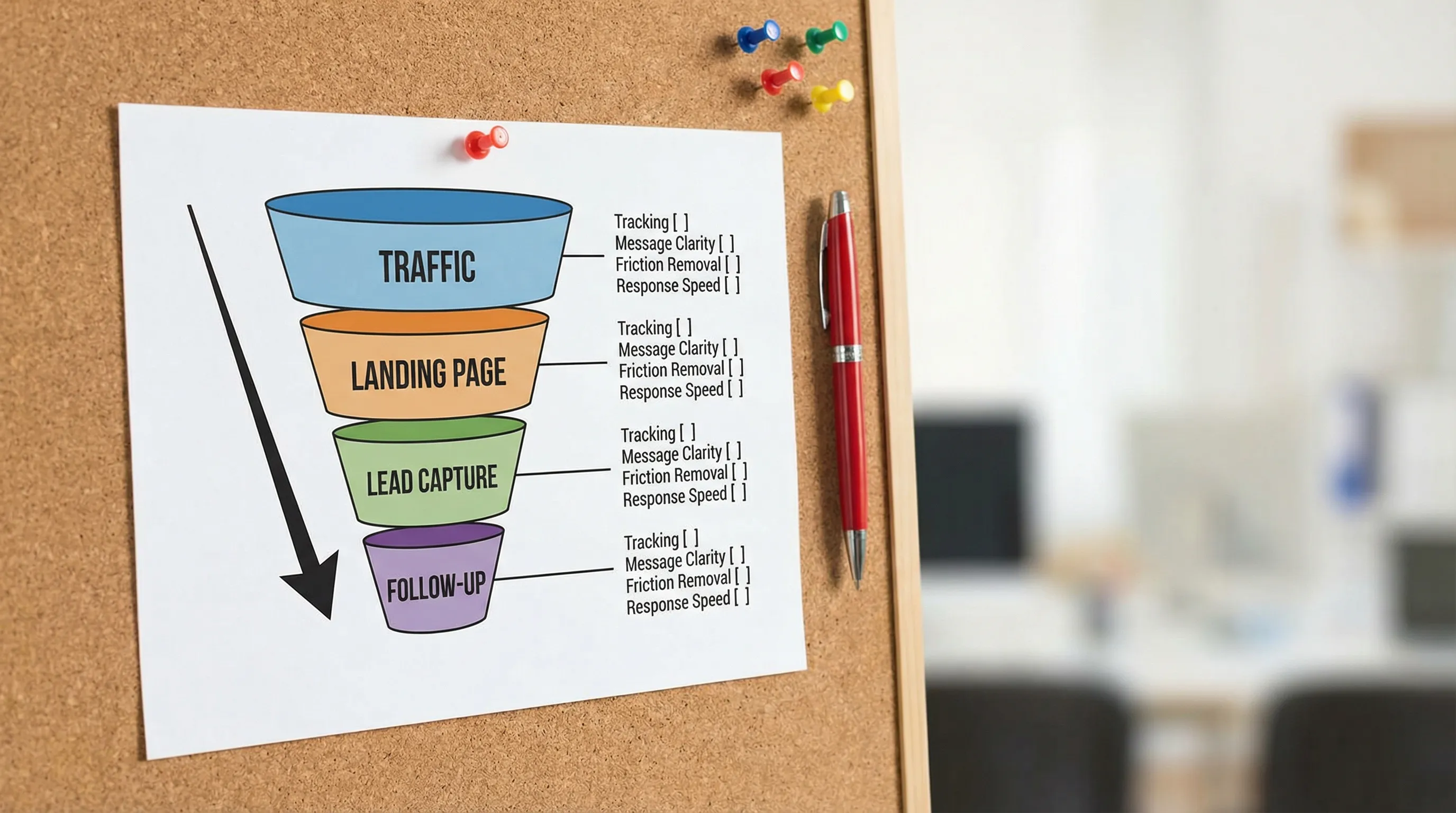
Day 5 to 7: Map your funnel and find the biggest leak
Create a simple funnel map and write real numbers next to each step.
| Funnel stage | What you measure | Common leak | Typical fix |
|---|---|---|---|
| Traffic | Sessions by channel, top landing pages | Wrong intent traffic | Tighten targeting and keywords, align ad-to-page |
| Landing page | Conversion rate, scroll, clicks | Message mismatch, slow load | Rewrite above-the-fold, improve speed |
| Lead capture | Form starts vs submits, calls | Too many fields, low trust | Shorten form, add proof, clarify next step |
| Follow-up | Response time, contact rate | Leads go cold | Same-day follow-up workflow |
This week’s outcome is a baseline: you know where to focus next.
Week 2 (Days 8 to 14): Fix the page that sells the next step
Most conversion gains come from improving the one page most prospects see.
Step 1: Build one “primary” landing page per offer
A landing page that converts for local businesses typically includes:
- A headline that states the outcome (not the company history)
- 3 to 5 bullets explaining who it’s for and what’s included
- Proof (reviews, before/after, logos, certifications)
- A single primary CTA (call, booking, quote)
- A section that answers the top objections
If you have multiple services, resist the temptation to send all traffic to a generic homepage. Route each channel to the most relevant page.
Step 2: Rewrite above the fold for clarity
Above the fold should answer three questions in five seconds:
- What do you do?
- Who is it for?
- What should I do next?
If you want a practical benchmark, look at well-structured storefront experiences that remove uncertainty, for example how Jascotee’s online store clearly separates browsing, product discovery, and the next step to purchase. The industry is different, but the principle is the same: reduce confusion, increase momentum.
Step 3: Reduce friction (forms, speed, mobile)
For local lead gen, conversion friction is usually one of these:
- Forms that feel like homework: Ask only what you need to start the conversation.
- Mobile usability: Buttons too small, tap targets too close, click-to-call missing.
- Slow pages: Users bounce before reading your value.
Use PageSpeed Insights as a diagnostic, then prioritize obvious fixes (large images, heavy scripts, unnecessary plugins).
Step 4: Add “trust blocks” where people hesitate
Add proof near your CTA, not only at the bottom:
- Short testimonials tied to the service
- A simple process explanation (what happens after you submit)
- Clear location/service area details (important in both Norway and the US)
This week’s outcome is a page that makes the next step feel easy.
Week 3 (Days 15 to 21): Follow-up that turns leads into revenue
Many businesses improve conversion without changing ads at all, simply by improving what happens after the lead arrives.
Day 15 to 16: Define your lead response standard
Set a concrete rule:
- Respond within X minutes during business hours
- Respond within X hours outside business hours
The exact number depends on your capacity, but the point is consistency. Leads decay quickly, especially for urgent services.
Day 17 to 18: Create a simple follow-up workflow
Keep it simple and repeatable:
- Confirmation message immediately after submission (what happens next)
- A same-day personal reply (call or email)
- A second touch if no response (next business day)
If you use a CRM, implement this there. If not, a shared inbox plus calendar reminders can still outperform “we’ll get back to you soon.”
Day 19 to 21: Upgrade your sales conversion assets
Add two assets that reduce friction and increase close rate:
- A one-page “what to expect”: timeline, steps, and what you need from the customer
- An objection-handling script: pricing concerns, timing, comparisons, and “I’ll think about it”
This week’s outcome is that more leads become booked calls, visits, or signed deals.
Week 4 (Days 22 to 30): Optimize acquisition and scale what works
Only after measurement, landing page clarity, and follow-up are in place should you push harder on traffic.
Step 1: Tighten targeting to match intent
For local businesses, “more clicks” is often the wrong goal. You want fewer, higher-intent visits.
Examples of higher intent:
- Service + location (or service area)
- “Near me” and urgent modifiers
- Clear B2B intent terms (for B2B teams)
If you run Google Ads, structure campaigns so each ad group maps to one offer page. Align the ad promise with the landing page headline.
Step 2: Run 2 controlled tests, not 12 random changes
Pick two tests that directly impact conversion:
- Test A: Headline and subheadline (clarity and positioning)
- Test B: CTA wording and form length
Run tests long enough to avoid reacting to noise, especially on lower-traffic local sites.
Step 3: Reallocate budget based on measured conversion
Once conversion actions are tracked, you can make clean decisions:
- Increase spend where conversion rate and lead quality are strongest
- Reduce spend where you get leads that do not answer or never close
This week’s outcome is scalable acquisition that supports profitable growth.
Common funnel problems (and fast fixes)
“We get traffic but no leads”
Usually a message mismatch or weak CTA. Fix the top section of the page first: outcome, audience, proof, next step.
“We get leads but they don’t close”
This is typically follow-up speed, lead qualification, or unclear expectations. Add a tighter process, confirmation messaging, and a second touch.
“We rely on referrals and want predictable growth”
Build one primary conversion path (one offer, one page, one CTA) and then support it with SEO or search ads. Predictable growth comes from repeatable systems.
Frequently Asked Questions
Can I really improve marketing and conversion in 30 days? Yes, if you focus on fundamentals: tracking, one clear offer page, reduced friction, and faster follow-up. Those changes often produce visible improvements within weeks.
What should I fix first, ads or website? Fix measurement and the landing page experience first. Better ads cannot compensate for unclear messaging, slow pages, or missing conversion tracking.
What is a good conversion rate for a local business website? It depends on the offer, traffic quality, and the action (call vs form vs booking). Use your current baseline, then aim for steady improvement by removing friction and improving follow-up.
Do I need SEO or Google Ads to fix my funnel? Not immediately. You can often increase revenue from existing traffic first. Once your funnel converts reliably, SEO and Google Ads help you scale.
Want a high-converting website without committing upfront?
If your funnel is leaking because your site is outdated, unclear, or built without SEO fundamentals, Kvitberg Marketing can help. We build pre-built, professional, SEO-optimized websites for local businesses completely free, then you review the finished site in a short walkthrough meeting and only decide to buy if you like the result.
If you want, we can also support growth after launch with optional services like SEO campaigns and Google Search Ads management.
Get started here: Kvitberg Marketing