Marketing Email Automation: Sequences That Book Meetings
If your calendar is not filling up, it is rarely because “email doesn’t work.” It is usually because the emails are not part of a system. Marketing email automation becomes a meeting-booking engine when it is built around the right audience, a clear offer, and a sequence that reduces friction step by step (instead of blasting a generic pitch).
This guide breaks down the exact sequence structures that reliably book meetings for local businesses and B2B teams, plus the automation rules that keep it consistent without spamming.
What “sequences that book meetings” actually do
A meeting-booking sequence is not a newsletter and not a one-off cold email. It is a short, intentional series where each message has a single job:
- Create relevance fast (why you, why now)
- Earn a reply (micro-commitment)
- Offer a low-friction next step (a 10 to 15 minute call, a quick audit, a quote review)
- Follow up like a professional (polite persistence)
For local businesses (clinics, contractors, legal services, B2B services), the winning pattern is simple: targeted outreach + fast follow-up + clear qualification + easy scheduling.
Before you automate: the 5 foundations that prevent spamminess
Automation amplifies what you already have. If the inputs are weak, the sequence feels like spam even if the copy is “good.”
1) A tight ICP (ideal customer profile)
Define who you can help, and who you cannot. For local businesses, this often means narrowing by:
- Location and service radius
- Service type (one flagship offer beats ten “we do everything” services)
- Budget signals (team size, pricing tier, category)
2) One meeting-worthy offer
Your email should not sell everything. It should sell the next conversation.
Examples of meeting offers that convert well:
- “2-minute teardown + 3 fixes” (landing page, Google Ads account, booking funnel)
- “Quick quote review” (for high-ticket services)
- “I found 3 leads you are currently missing” (for B2B)
3) Clean lead sourcing and segmentation
If your list is mixed (homeowners + businesses, Norway + US, different industries), your copy will be generic. Segment early.
4) A conversion-focused landing page (optional, but powerful)
Not everyone will reply. Some will click. A simple page that matches the email promise can lift booked calls significantly, especially for skeptical prospects.
5) Qualification and routing
A sequence that books unqualified meetings wastes time. Use light qualification:
- A one-question reply prompt
- A short form
- Calendar routing rules (service type, location, budget)
Deliverability and compliance: the unsexy part that decides results
You can have perfect copy and still land in spam. For meeting sequences, deliverability is a feature, not an afterthought.
Set up authentication correctly
At minimum, configure:
- SPF
- DKIM
- DMARC
Google and Yahoo have also tightened expectations for bulk senders in recent years, which makes list hygiene and authentication even more important.
Respect consent and opt-out rules
If you market to Norway (EEA) and the EU, you must consider GDPR and local marketing rules, especially around lawful basis and data handling. If you market in the US, you must comply with CAN-SPAM requirements (clear identification, opt-out, valid address, and no deceptive headers).
Helpful official references:
Keep volume human
For cold outreach, avoid “newsletter-scale” sends from a new domain. Warm up gradually, keep targeting tight, and prioritize replies over raw volume.
The anatomy of a meeting-booking email (that does not feel automated)
High-performing sequences share a structure. You can use this as a checklist for every email you write.
| Element | What it means | Simple example |
|---|---|---|
| Specific relevance | You chose them for a reason | “Noticed you serve Trondheim + run Google Ads for ‘akutt rørlegger’ terms” |
| One clear outcome | One email, one goal | “Worth a quick look?” |
| Proof without bragging | Credibility in one line | “We build outbound + conversion workflows for agencies and local businesses” |
| Low-friction CTA | Easy to say yes | “Open to a 12-minute call Tuesday or Wednesday?” |
| Polite persistence | Follow-ups add context | “If timing is off, when should I circle back?” |
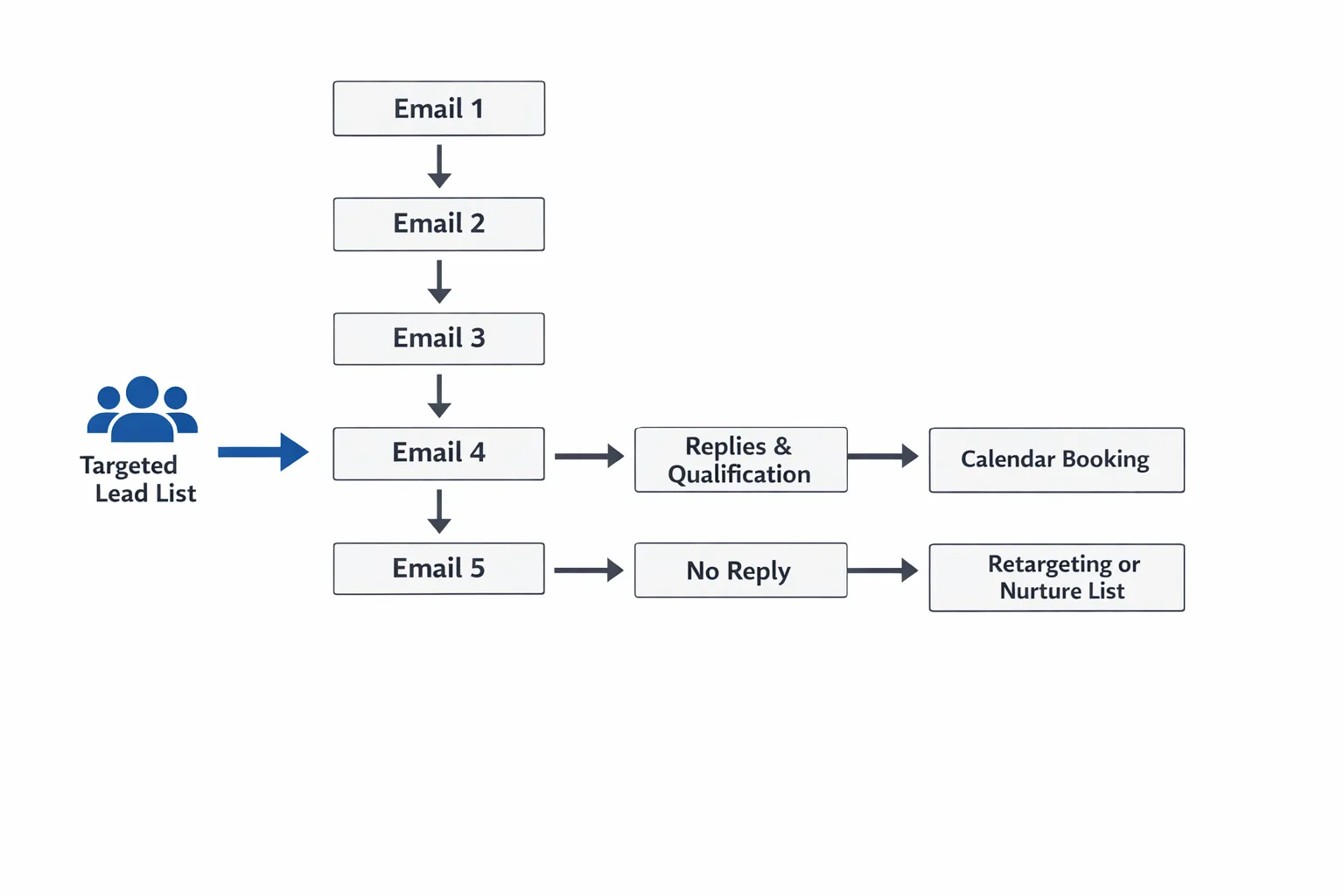
Sequence 1: Cold outbound sequence that books meetings (5 emails)
This is your baseline for reaching new prospects. The goal is a reply, not an immediate sale.
Timing rules (simple and effective)
Send one email per day for the first 2 follow-ups, then space out.
- Email 1: Day 1
- Email 2: Day 3
- Email 3: Day 5
- Email 4: Day 9
- Email 5: Day 14
The 5-email blueprint (with subjects and intent)
| Goal | Subject line style | CTA | |
|---|---|---|---|
| Email 1 | Permission-based opener | Short and plain | “Worth a quick chat?” |
| Email 2 | Add specific observation | “Quick question” style | “Who handles this?” or “Open to 10 min?” |
| Email 3 | Offer value (mini-audit) | “I noticed X” | “Want me to send the 3 fixes?” |
| Email 4 | Handle objection (timing) | “Should I close your file?” | “If not now, when?” |
| Email 5 | Breakup + alternate path | “Last try” | “Should I stop reaching out?” |
Copy templates you can adapt
Keep templates as a starting point, then personalize 1 to 2 lines based on the business.
Email 1 (permission-based)
Subject: Quick question
Hi {{FirstName}}, I am reaching out because you serve {{City/Area}} and it looks like you are actively growing {{Service}}.
We help local businesses set up predictable meeting flow using outbound + follow-up automation (no spray-and-pray lists).
Open to a quick 12-minute call this week to see if it fits, or should I send a 3-bullet summary first?
Email 2 (add context)
Subject: Re: quick question
Hi {{FirstName}}, quick one: are you the right person to talk to about new customer acquisition for {{BusinessName}}?
If yes, I can share what we typically change first to increase booked calls from traffic you already have (ads, website, follow-ups).
Would Tuesday or Wednesday work for a short call?
Email 3 (mini-audit offer)
Subject: Noticed something on your site
Hi {{FirstName}}, I noticed {{SpecificObservation}}.
If you want, I can send 3 practical fixes that usually increase conversions for {{Industry}} without increasing ad spend.
Should I send them here, or would you rather hop on a quick call?
Email 4 (timing objection)
Subject: Timing
Hi {{FirstName}}, totally fine if now is not the right time.
If improving booked calls is a priority in the next 30 to 60 days, I can show you a simple sequence + routing setup that keeps follow-up consistent.
If not, when should I circle back?
Email 5 (breakup)
Subject: Close the loop?
Hi {{FirstName}}, I do not want to keep bugging you.
Should I close the loop, or is there someone else I should speak with about generating more qualified meetings for {{BusinessName}}?
Sequence 2: Inbound lead automation (fast follow-up that wins the deal)
Inbound leads often convert or disappear based on speed and clarity. When someone fills a form or requests a quote, your automation should do two things immediately:
- Confirm the request and set expectations
- Make the next step stupidly easy (calendar + qualification)
A simple inbound sequence (3 emails)
You can run this when someone:
- Submits a form
- Requests a quote
- Downloads a guide
- Replies to an ad
| When | Purpose | Key line | |
|---|---|---|---|
| Email A | Immediately | Confirm + route | “To help you fast, what best describes what you need?” |
| Email B | +4 hours | Reduce no-shows | “Here’s what we’ll cover in 10 minutes.” |
| Email C | Next day | Recover stalled leads | “Still want help with this, or should I close it?” |
Tip for local businesses: If you take calls in both Norway and the US, mention time zone clearly in the calendar and email confirmations.
Sequence 3: No-show and post-meeting follow-up (where revenue is often won)
Many teams obsess over booking meetings and forget the follow-up that turns a conversation into a signed agreement.
No-show sequence (2 touches)
If someone no-shows, assume life happened, not bad intent.
- Touch 1 (15 minutes after): “No worries, want to reschedule?” + link
- Touch 2 (next day): “Should I close this out?” + alternate time slots
Post-call summary email (same day)
This one email can lift close rates because it reduces confusion and keeps stakeholders aligned.
Include:
- The problem you understood
- The agreed next step
- The timeline
- The owner of each action
Personalization at scale: how to use AI without sounding fake
The goal is not to “sound human.” The goal is to sound relevant.
High-signal personalization inputs:
- The service they are known for (from the website)
- A recent review theme (what customers praise)
- A visible gap (missing booking flow, unclear offer, slow follow-up)
- Location-specific language (Norway: city, region, service area)
If you want to go further with automated prospecting and qualification, tools like Orsay position themselves as AI-driven systems that can find, qualify, and engage leads while booking meetings into your calendar. Regardless of the tool you choose, the sequence frameworks in this guide remain the core.
What to measure (and what to fix) in marketing email automation
Email automation should improve over time. That only happens if you track a few practical metrics and tie them to actions.
| Metric | What it usually means | What to try next |
|---|---|---|
| Low open rate | Deliverability or weak subject | Verify SPF/DKIM/DMARC, simplify subjects, tighten targeting |
| Low reply rate | Message-market mismatch | Narrow ICP, rewrite opener with a specific observation |
| Replies but no bookings | CTA friction | Offer two time options, reduce meeting length, add routing question |
| Bookings but low show rate | Weak confirmation | Add reminders, set clear agenda, ask a one-question confirmation |
| Meetings but low close rate | Poor qualification or unclear offer | Add pre-qual questions, improve post-call summary, tighten offer |

Frequently Asked Questions
What is marketing email automation, in plain English? Marketing email automation is sending the right emails automatically based on triggers (like a new lead, a reply, a booked meeting, or no response) so follow-up is consistent and prospects always know the next step.
How many emails should a cold sequence have to book meetings? For most local B2B offers, 4 to 6 emails is a strong range. Fewer often leaves money on the table, and more can hurt deliverability if your targeting is broad.
Do automated sequences work for local businesses, or only for SaaS? They work very well for local businesses when the offer is clear (quote, audit, consultation) and the targeting is tight (service type + geography + buying signals).
How do I avoid sounding spammy with automation? Use smaller, cleaner lists, personalize one relevant detail, keep the CTA low-friction, and make opt-out easy. Most “spam” complaints come from weak targeting, not from follow-ups.
Should I send people directly to my calendar link? Sometimes. A good default is to ask a simple question first (to earn a reply), then send the calendar link to qualified prospects. For inbound leads, calendar-first is often fine.
Want a sequence built for your market (and your calendar)?
Kvitberg Marketing engineers outbound and conversion systems that help agencies and local businesses book qualified meetings and generate predictable revenue without spamming prospects. If you want help with ICP and messaging, deliverability setup, automated meeting booking, qualification and calendar routing, and ongoing optimization, explore our approach at Kvitberg Marketing.