Marketing Strategy Agency Checklist: What to Ask First

Hiring a marketing agency should feel like buying a clear outcome, not buying “marketing.” Yet most bad agency relationships start the same way: a smooth pitch, vague strategy, and unclear accountability once the contract is signed.
This checklist is designed for local businesses (in Norway or the US) that want a marketing strategy agency to drive leads, bookings, calls, or revenue. Use it to quickly filter out poor fits and surface the agencies that can actually plan, execute, and measure growth.
Before you talk to any agency: get these 5 basics straight
You will get better answers when your inputs are clear. You do not need a 40-page strategy doc, just a few decisions.
1) Define the business outcome (not the channel)
Examples of outcomes that are specific enough:
- 40 qualified calls per month for a plumbing service
- 25 demo requests per month for a B2B SaaS
- 15 bookings per week for a dental clinic
If your “goal” is “rank on Google” or “run ads,” the agency will optimize for activity, not impact.
2) Know your best customer (and your worst customer)
A strong strategy needs boundaries. Write down:
- Best-fit customer profile (location, budget, timeline, needs)
- Deal breakers (price shoppers, out-of-area requests, low-quality leads)
This protects your ad spend, your sales team, and your calendar.
3) Decide your budget range and risk tolerance
A good agency can propose options, but you should set the range. Also decide what you prefer:
- Stable lead volume with conservative testing
- Aggressive growth with faster experimentation
4) Identify your true constraint
Most local growth problems are one of these:
- Not enough demand capture (people search, you are not visible)
- Weak offer or messaging (clicks come in, leads do not)
- Broken tracking (you cannot tell what works)
- Poor lead handling (leads come in, sales does not follow up)
5) Confirm you can measure the outcome
At minimum, you should be able to track:
- Form submissions
- Phone calls (including call quality, not just volume)
- Bookings or purchases
If tracking is unclear, strategy becomes guesswork.
Marketing strategy agency checklist: what to ask first (and why)
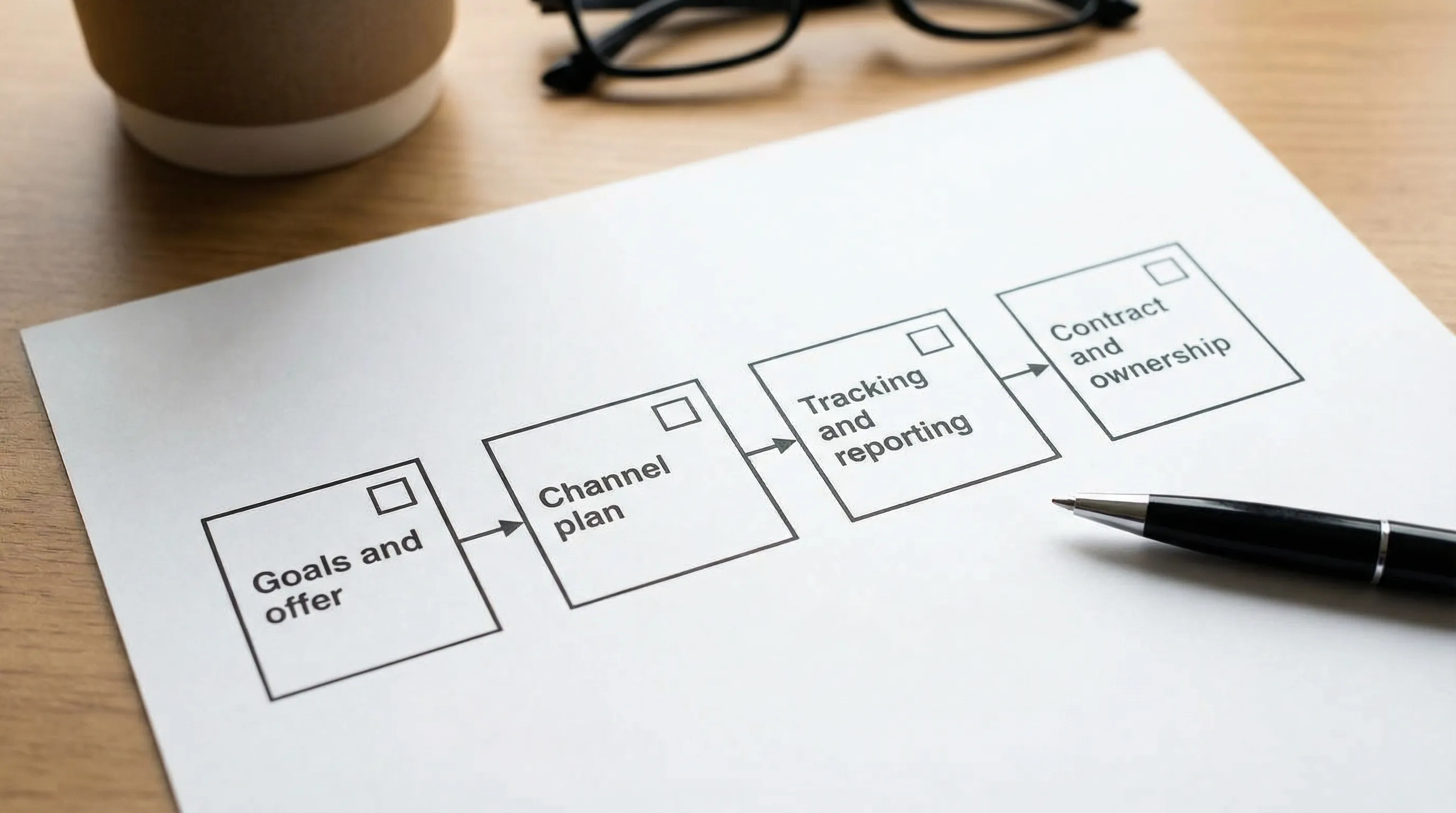
Think of this as an order of operations. The early questions reveal whether an agency is strategic, process-driven, and accountable.
A. Strategy and positioning (the “why us” layer)
Question: “How will you learn what actually sells our service in our market?”
What good answers include:
- A plan to review your current data (calls, CRM notes, search terms, past campaigns)
- Competitive analysis (who dominates local intent and why)
- Customer language research (the words people use before they buy)
Red flag: They jump straight to channels and tactics without clarifying what you sell, who you sell to, and what differentiates you.
Question: “What is your process for turning our offer into messaging and landing pages that convert?”
Look for:
- Clear message hierarchy (headline, proof, objections, CTA)
- Conversion rate optimization approach (testing plan, not just opinions)
- Willingness to recommend offer improvements (packages, guarantees, pricing presentation)
B. Channel plan and sequencing (the “what happens first” layer)
Question: “What would you prioritize in the first 30 days, and what would you delay?”
Strong agencies sequence work. For many local businesses, this is common:
- Fix tracking and lead routing first
- Launch or restructure high-intent campaigns (search, local pages)
- Build a repeatable landing page framework
- Expand into broader targeting only after the funnel works
Red flag: “We do everything at once” with no tradeoffs.
Question: “How do you decide between SEO, Google Ads, Meta Ads, and local listings for our case?”
Look for:
- A decision framework based on intent, sales cycle, and local competition
- Examples of when a channel is a bad fit
- Discussion of blended strategy (ads for speed, SEO for compounding returns)
C. Measurement and attribution (the “prove it” layer)
Question: “What are the core KPIs you will report weekly and monthly?”
For local lead gen, strong answers often include:
- Qualified leads (not just raw leads)
- Cost per qualified lead
- Conversion rate (landing page and lead to sale)
- Call outcomes or pipeline impact when available
Question: “How will we know if lead quality is improving?”
Good answers mention:
- Call tracking and call outcome tagging
- CRM integration or at least a simple lead-quality feedback loop
- Lead source visibility (which campaign, keyword, ad, landing page)
Red flag: Reporting that focuses on impressions, clicks, and CTR only.
D. Execution details (the “who does what” layer)
Question: “Who exactly will do the work, and what parts are outsourced?”
You want clarity on:
- Who owns strategy, who owns implementation, who owns creative
- Seniority of the person touching your account
- What is handled in-house vs contractors
Question: “What does your creative testing process look like?”
Even local marketing needs iteration. Strong answers include:
- A structured testing cadence
- Hypotheses (what they are testing and why)
- How winners are rolled out and losers are retired
E. SEO, content, and AI readiness (especially important in 2026)
If SEO is part of the engagement, the agency should be able to explain how they will win in both classic search and AI-influenced discovery.
Question: “How do you evaluate our site’s technical SEO, content gaps, and local SEO fundamentals?”
Look for:
- A real audit process (technical, on-page, local listings, competitors)
- Prioritization by impact, not a giant to-do list
- Clear content standards (helpful, original, aligned to search intent)
If you want an SEO-specific screening set, this guide of questions to ask an SEO company is a helpful companion, especially for comparing vendors side by side.
Red flag: Guarantees like “#1 on Google in 30 days,” or vague talk about “backlinks” without quality control.
F. Access, ownership, contracts, and exit terms (the “protect yourself” layer)
Question: “Will we fully own and retain access to our ad accounts, analytics, and creative?”
Best practice:
- You own the Google Ads and Meta ad accounts
- You own GA4 and tracking configurations
- You keep the landing pages and creative you paid for (or the contract clearly states otherwise)
Question: “What happens if we want to pause or leave?”
Look for:
- Clear cancellation terms
- A clean handover plan
- No hostage scenarios (locked accounts, inaccessible data)
A practical scorecard to compare agencies
Use a simple scoring method so you do not choose based on charisma. After each call, score from 1 to 5.
| Category | What “5 out of 5” looks like | Score (1-5) |
|---|---|---|
| Goals and strategy | They translate your business goal into a measurable plan and clear positioning | |
| Channel plan | They explain sequencing and tradeoffs, not a one-size-fits-all package | |
| Tracking and measurement | They can clearly explain how attribution and lead quality will be measured | |
| Execution team | You know who does what, how often they ship, and how they test improvements | |
| Reporting and communication | You get a reporting cadence tied to decisions, not vanity metrics | |
| Ownership and exit | You retain access and can leave without losing data or assets |
If an agency averages under 4, keep looking. If they score high but you still feel unsure, run a short pilot.
Red flags that often predict failure
Most agency disasters are visible early. Watch for these patterns:
- They sell you a channel before diagnosing your funnel
- They avoid specifics about tracking, reporting, or who does the work
- They cannot explain how they handle lead quality feedback
- They overpromise timelines or rankings
- They require the agency to own your ad account (you should own it)
What a good “first 30 days” plan typically includes
You are not looking for a 12-month prophecy. You want a coherent first month.
A solid first 30 days often looks like this:
- Tracking plan (calls, forms, bookings) and verification
- Landing page or website improvements tied to conversion goals
- A small set of high-intent campaigns with tight targeting
- A reporting baseline and agreed KPI definitions (including what “qualified” means)
If an agency cannot outline this clearly, execution will likely be reactive.
Special considerations for local businesses in Norway and the US
Local marketing is not generic marketing. Ask questions that reflect your reality.
For Norway
- Language and localization: Do they create content and ads that match how Norwegians search (and in which language)?
- Privacy and consent: Can they implement tracking in a way that respects GDPR and your consent setup?
- Local intent: Do they understand “near me” behavior and map-driven discovery (Google Business Profile, local pages)?
For the US
- Competition and CPC volatility: Are they prepared to manage budgets efficiently in competitive metros?
- Lead fraud and spam: Do they have a plan to reduce junk leads (filters, exclusions, offline conversion signals)?
Frequently Asked Questions
How long should I give a marketing strategy agency before judging results? Most paid campaigns show early signals in 2 to 4 weeks, but reliable performance trends often take 8 to 12 weeks, especially if tracking or landing pages need fixes.
Should a marketing agency guarantee results? Be cautious with guarantees. Ethical agencies can commit to process, transparency, and leading indicators, but they cannot control every market variable.
What should we provide before onboarding an agency? Your goals, service areas, past campaign history (if any), access to your website and analytics, and clarity on what counts as a qualified lead.
Is it better to start with SEO or ads? It depends on urgency and demand. Ads can produce faster data and leads, while SEO compounds over time. Many local businesses use both, with ads funding learning that informs SEO.
Do we need a new website before marketing? Not always, but you do need pages that load fast, clearly explain the offer, and make it easy to contact you. If your site cannot convert, scaling traffic just scales waste.
Want a low-risk way to validate a partner?
If your main blocker is your website, Kvitberg Marketing offers an unusually low-risk starting point: a pre-built, professional, SEO-optimized website created for free with no upfront commitment. You review the finished site in a short walkthrough meeting, and only choose to buy if you like the result. After that, you can add growth services like SEO campaigns or Google Search Ads management when you are ready.
Explore the offer at Kvitberg Marketing.