Outbound Marketing in 2026: Playbook for B2B Teams

Outbound marketing in 2026 looks nothing like the “spray-and-pray” era. B2B buyers have stronger spam filters, higher privacy expectations, and less patience for generic pitches. At the same time, AI has made it easier to produce messages at scale, which means the bar for relevance (and trust) has risen fast.
This playbook is for B2B teams and local-service businesses selling higher-value work (agencies, B2B services, professional firms, niche operators) that want predictable meetings without spamming. It focuses on what’s working now: targeted lists, clean deliverability, intent-led messaging, and automated workflows that still feel human.
What changed for outbound in 2026 (and why most teams struggle)
1) Trust and deliverability became the real gatekeepers
Even a great offer fails if your emails land in spam or your domain reputation tanks. After major inbox providers tightened bulk-sender requirements in 2024 (authentication and complaint-rate expectations), the “technical layer” of outbound stopped being optional.
Practical implications in 2026:
- You need solid authentication (SPF, DKIM, DMARC) and consistent sending patterns.
- You need a list strategy that minimizes bounces and complaints, not just maximizes volume.
- You need a follow-up system that does not feel like a robot is chasing people.
(Reference: Google’s guidance for bulk senders is a good baseline for expectations around authentication and spam complaints.)
2) AI raised volume, so buyers reward specificity
Prospects can tell when a message was assembled from a template with a few tokens swapped in. AI helps, but only if it’s anchored to real signals (industry, role, trigger events, tech stack, hiring, reviews, local expansion, recent ad activity).
3) Compliance risk increased, especially across regions
If you sell into Norway (EEA) and the US, you are operating across different regimes. At minimum, teams should align outreach with:
- GDPR principles (lawful basis, data minimization, transparency) for EEA markets, including Norway.
- CAN-SPAM requirements for email in the US.
- TCPA and state-level rules when using SMS or certain calling practices.
This is not legal advice, but in 2026 the safest outbound programs are the ones designed to be respectful by default: clear identity, clear relevance, easy opt-out, and minimal data collection.
The 2026 outbound engine (simple model)
Outbound works best when you treat it like an engineered system, not a collection of random tactics.
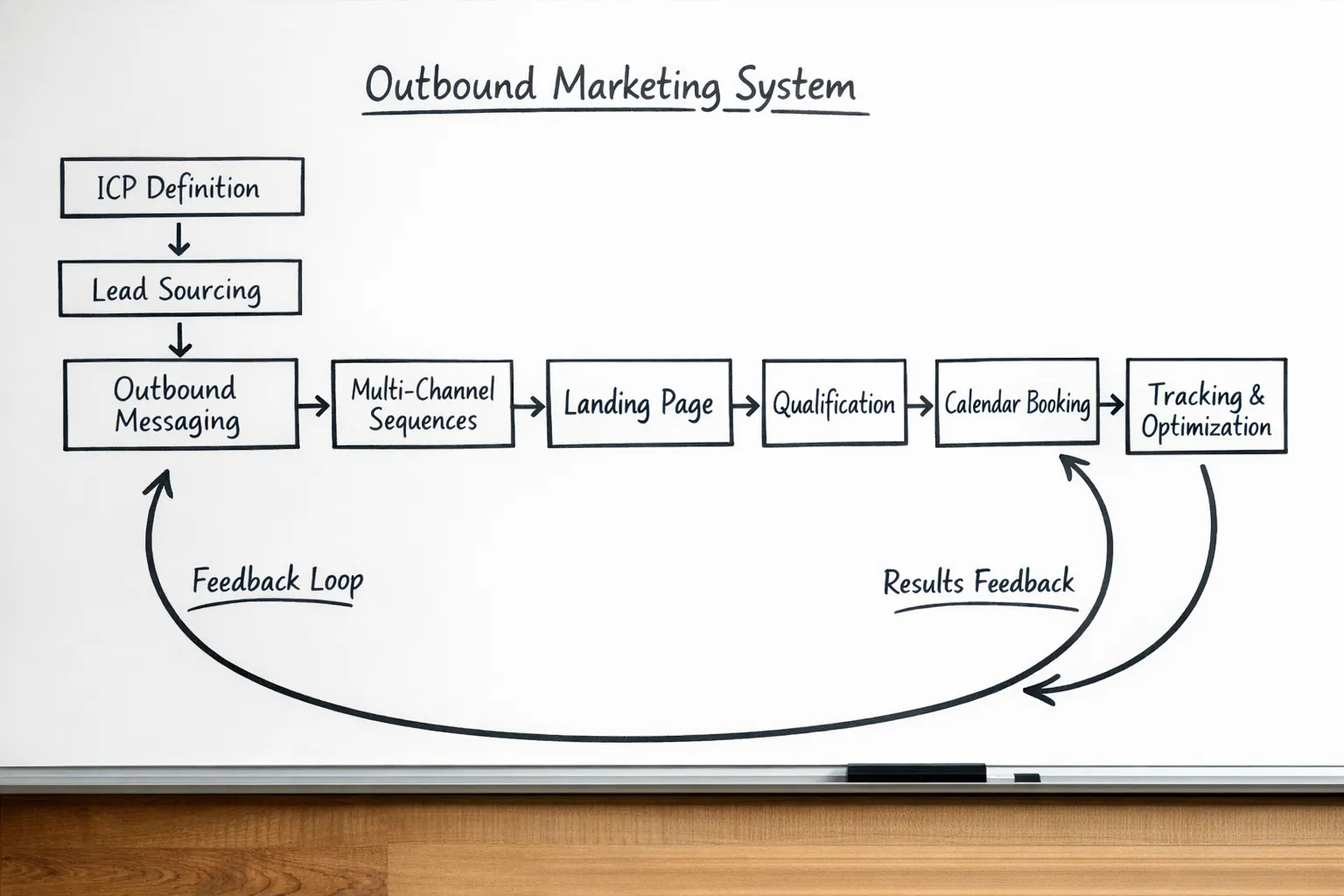
The engine has three layers:
- Targeting layer: who you contact and why now
- Messaging layer: what you say and what you ask for
- Conversion layer: what happens after they reply or click
Most teams over-invest in messaging and under-invest in targeting and conversion.
Step 1: Define an ICP you can actually target
An ICP in 2026 is not “B2B companies with 10 to 200 employees.” It is a set of constraints you can find in data.
A practical ICP definition includes:
- Industry and sub-niche (tight enough that pain is shared)
- Buyer role (the person who owns the outcome)
- A measurable trigger (hiring, expansion, new location, new funding, new ad spend, declining reviews, competitor movement)
- A clear “why you” wedge (speed, specialization, compliance, location, proof)
For local businesses, an ICP can be geographic plus category, for example “multi-location dental groups in [region]” or “commercial HVAC companies with 5+ trucks.”
Step 2: Build a list strategy that protects reputation
In 2026, list quality is a moat. Better data means better conversion and fewer deliverability problems.
Prioritize:
- Role accuracy (wrong role increases complaints)
- Company fit (avoid outreach to businesses that cannot buy)
- Email validity (reduce hard bounces)
- Segmentation fields you will actually use (trigger, service line, location, tech)
If you sell locally, do not overlook “boring” data sources that create relevance: city permits, new locations on Google Business Profile, job postings, local press, trade associations, and review trends.
Step 3: Nail deliverability before you scale
Think of deliverability like credit. You build it slowly and you can lose it fast.
A strong baseline includes:
- Domain and mailbox setup aligned with best practices (authentication, consistent sending)
- Warming and ramping schedules that avoid spikes
- Bounce and complaint monitoring
- A suppression list and clear opt-out handling
If you do nothing else, do this: do not scale sequences until your technical setup and early metrics are stable.
Step 4: Write messaging that earns attention (not “clever” copy)
In 2026, the most effective outbound messages are:
- Short
- Specific
- Evidence-based
- Low-friction
A reliable structure:
- Relevance: why them (role + trigger)
- Problem: what tends to break (cost, time, missed revenue)
- Proof: a single credible line (outcome, mechanism, or case reference)
- Ask: a small next step (permission-based)
Avoid:
- Over-personalization that feels invasive
- Fake familiarity
- Big claims without proof
A note on AI personalization
Use AI to generate hypotheses and variants, but keep humans responsible for:
- The offer and positioning
- The “reason to believe” proof
- Final QA (tone, accuracy, compliance)
Step 5: Build a multi-channel sequence that behaves like a professional
Most B2B buyers do not respond to the first touch. But they also do not want 12 touches in 10 days.
In 2026, sequences work best when they combine:
- Email (asynchronous, easy to forward)
- LinkedIn (light social proof, name recognition)
- Phone (when relevant and compliant, especially for local services)
- Retargeting (optional, if your audience size supports it)
Here is a practical channel-by-goal view:
| Channel | Best use in 2026 | Common failure mode | What to do instead |
|---|---|---|---|
| Permission-based intro and follow-up | Too long, too generic | 60 to 120 words, one clear ask | |
| Credibility and light touches | Pitching in the first message | Connect with context, then reference a specific trigger | |
| Calls | Fast qualification for high-fit leads | Random dialing without context | Call only after a clear trigger and a relevant message |
| Landing page | Proof and conversion | “Brochure” pages | One offer, one audience, clear proof, simple booking |
Step 6: Treat “post-reply” like a product (your conversion layer)
Many outbound programs fail after they succeed. The prospect replies, clicks, or books, and then the experience becomes messy: slow response, unclear next steps, wrong calendar routing, no qualification, no reminders.
A useful mindset is to design the post-action journey like top consumer brands do. The same principle shows up in other industries too, for example travel brands optimizing the steps after purchase to reduce friction and improve outcomes. This guide on building a seamless post-booking visa journey with tools and templates is a great example of how to map a time-based workflow (T+0 to T+10), write clear customer comms, and measure the journey end-to-end.
For B2B outbound, your “post-reply journey” should include:
- Fast first response (minutes, not days)
- Qualification that respects time (short form, or conversational)
- Correct routing (right rep, right calendar)
- Reminders and pre-frame (agenda, outcomes, who should attend)
- Follow-up that summarizes next steps and drives a decision
Step 7: Add qualification and calendar routing to protect your team’s time
If you are booking meetings for an agency or local B2B team, you want fewer meetings, but better meetings.
Practical qualification signals:
- Budget range (even a rough bracket)
- Timeline (now, this quarter, later)
- Current approach (in-house, vendor, nothing)
- Complexity (locations, service lines, stakeholders)
Route meetings based on rules that match your business model (industry specialist, geography, deal size). This is where automation creates real leverage.
Step 8: Track the few metrics that actually diagnose the system
Outbound is measurable, but too many teams track vanity metrics.
Use a small scorecard that maps to the three layers (targeting, messaging, conversion):
| Layer | Metric | What it tells you | Common fix |
|---|---|---|---|
| Targeting | Reply rate by segment | Are you contacting the right people? | Tighten ICP, add triggers, improve list accuracy |
| Messaging | Positive reply rate | Is your offer compelling and clear? | Change angle, add proof, reduce ask |
| Deliverability | Bounce and spam complaint rate | Are you damaging reputation? | Clean lists, slow down, verify setup |
| Conversion | Show rate and qualified meeting rate | Is the post-reply journey working? | Better reminders, pre-frame, routing, qualification |
| Revenue | Pipeline per 100 leads | Is this profitable at your volume? | Rebalance segments and channels |
A 30/60/90 rollout plan (realistic for 2026)
Days 1 to 30: Foundation
Focus on ICP, list strategy, deliverability setup, and one clear offer. Build a landing page that matches the offer and install basic tracking.
Days 31 to 60: Controlled scaling
Launch one primary sequence, test 2 to 4 message angles, and validate which segments produce qualified conversations. Add lightweight LinkedIn touches.
Days 61 to 90: Automation and optimization
Introduce qualification and routing automation, improve follow-ups, and begin A/B testing at the system level (segment, offer, channel mix), not just subject lines.
Common outbound mistakes to avoid in 2026
- Scaling volume before deliverability is stable
- Targeting too broadly, then blaming copy
- Asking for a 30-minute call before establishing relevance
- Treating follow-up as “more touches” instead of “more value”
- Letting meetings book without qualification and routing
Frequently Asked Questions
Is outbound marketing still effective in 2026? Yes, but only when it is targeted, compliant, and supported by a strong conversion workflow. Generic high-volume outreach is less effective and carries higher deliverability and brand risk.
What is the best outbound channel for B2B in 2026? Email remains the most scalable starting point, but top programs use a multi-channel approach (email plus LinkedIn, and phone when appropriate) and rely on landing pages and follow-up workflows to convert interest into qualified meetings.
How many touches should a B2B outbound sequence have? There is no universal number, but in 2026 quality beats quantity. Use enough touches to be consistent, and ensure each touch adds clarity, proof, or a better next step. If you see rising complaints or declining positive replies, reduce volume and improve segmentation.
How do local businesses use outbound without damaging their reputation? By targeting narrowly (specific roles and triggers), keeping outreach respectful and short, using clear opt-outs, and ensuring the post-reply experience is fast and professional.
What should we automate first in outbound? Start with lead sourcing hygiene, deliverability monitoring, follow-up workflows, qualification, and calendar routing. Automate the process, not the relationship.
Want a predictable outbound system (without spam)?
Kvitberg Marketing builds outbound client acquisition systems designed to book qualified meetings through strong targeting, deliverability-safe outreach, and conversion workflows (qualification, routing, follow-up) that help B2B teams create predictable revenue.
If you want help engineering your outbound engine, explore Kvitberg Marketing at kvitbergmarketing.com.