Performance Marketing Company: What to Expect and What to Avoid

Most local businesses don’t need “more marketing.” They need predictable demand, measurable return, and a partner who can connect ad spend to real outcomes like calls, booked appointments, quote requests, and revenue. That’s what a performance marketing company is supposed to deliver.
But the term is often misused. Some agencies call everything “performance,” then report only impressions and clicks. Others hide behind black-box dashboards, lock you into long contracts, or promise results they can’t control.
This guide breaks down what you should realistically expect when hiring a performance marketing company, and what to avoid so you don’t waste months (and budget) learning the hard way.
What “performance marketing” should mean in 2026
A performance marketing company is accountable to measurable business outcomes. The exact KPI depends on your business model, but it should be tied to value, not vanity.
For a local service business, that might be:
- Cost per qualified lead (calls, forms, bookings)
- Lead-to-customer conversion rate
- Cost per booked job
- Return on ad spend (when revenue tracking is reliable)
For B2B, it might be:
- Cost per marketing-qualified lead (MQL)
- Cost per sales-qualified lead (SQL)
- Pipeline influenced
- CAC payback (for longer sales cycles)
The important part is alignment: the company should help you define “performance” in your context, then build systems to track it.
What to expect from a good performance marketing company
1) A clear measurement plan before they scale spend
Before budgets increase, you should see a plan for:
- What constitutes a qualified lead (and what does not)
- What conversion actions are tracked (calls, forms, bookings, purchases)
- How conversions are attributed across channels (at least a practical approach)
- How lead quality will be audited (not just counted)
In 2026, measurement also includes consent and privacy realities. For Norway and the EU, GDPR and cookie consent can affect tracking reliability. A competent partner will acknowledge this, and set expectations accordingly.
2) Proper tracking setup (or a plan to fix it)
You should expect help with the fundamentals, such as:
- Correct conversion tracking (Google Ads, Meta Ads, GA4 as relevant)
- Call tracking if phone leads matter
- Landing page events (form submits, booking confirmations)
- Filtering obvious spam and junk leads
A performance marketing company doesn’t need to own every technical task, but they should be able to identify what’s broken, prioritize fixes, and coordinate implementation.
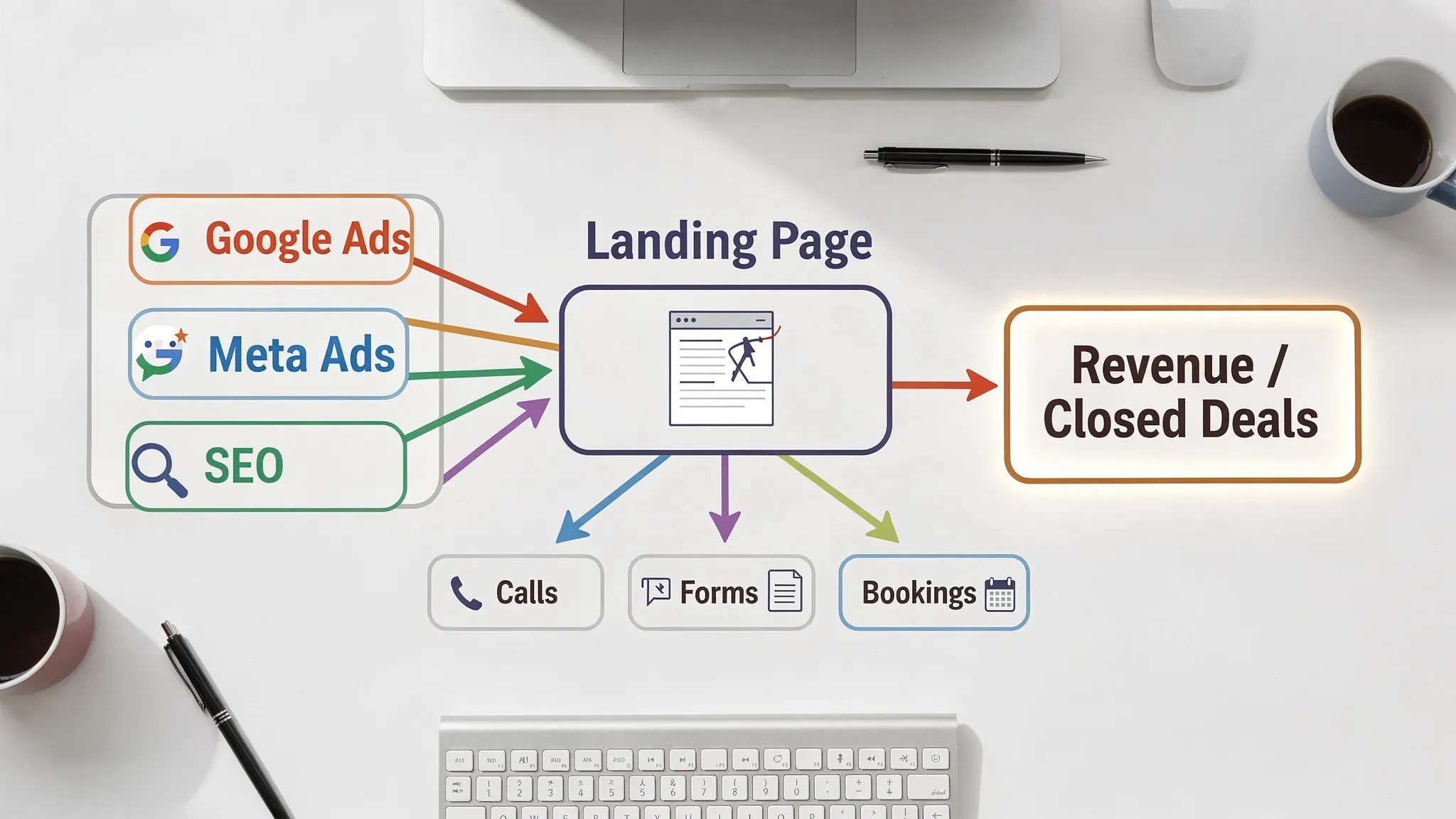
3) Channel strategy based on intent, not trends
A solid partner explains why a channel makes sense for your goals.
Examples:
- Google Search Ads can capture high-intent demand (“electrician near me,” “roof repair estimate,” “accounting firm for construction”).
- Meta Ads can generate demand for certain services, retarget site visitors, and support local awareness, but requires strong creative and lead quality controls.
- SEO is slower, but can reduce dependency on paid media and improve lead economics long-term.
If you serve multiple areas (for example both Norway and the US), you should also expect localized structure: targeting, language/phrasing differences, and region-specific landing pages where appropriate.
4) Landing pages and conversion rate thinking (not just “running ads”)
Performance marketing fails most often on the page, not in the platform.
A good company will care about:
- Message match (ad promise equals page headline and offer)
- Speed and mobile usability
- Clear call-to-action (call, book, request quote)
- Proof elements (reviews, case studies, certifications)
- Friction reduction (short forms, clear next steps)
Even small improvements can materially change results because they reduce the cost per lead without increasing spend.
5) Testing cadence: creative, offers, and targeting
You should expect a structured approach to experimentation:
- Testing 2 to 4 creative angles at a time (not 20 random variations)
- Iterating on offers (free estimate, same-day booking, fixed-price intro package)
- Adjusting targeting based on lead quality feedback
- Using negative keywords and search term reviews (for Google Ads)
“Set it and forget it” is not performance marketing.
6) Reporting that answers business questions
A good performance marketing report should tell you:
- What happened (leads, CPA, spend)
- Why it likely happened (seasonality, auction pressure, creative fatigue, tracking changes)
- What they changed (and what they plan to test next)
- What you should do on your side (sales follow-up speed, booking availability, offer clarity)
You do not need a 40-slide deck every week. You need decisions, clarity, and accountability.
7) Transparent commercial terms and ownership
Expect clarity on:
- Who owns the ad accounts (you typically should)
- What happens if you leave (data access, account access, creatives)
- Fees (management fee, setup fee, performance fee, or a hybrid)
- Minimum contract length (and why)
A performance relationship should reduce risk, not increase it.
What to avoid: common red flags that cost local businesses money
Some problems are obvious, others are subtle. Here are the biggest ones to watch for.
Guaranteed results (especially with a short timeline)
Be careful with promises like “#1 on Google in 30 days” or “500 leads next week.” Platforms are auction-based, your market changes, and lead quality is influenced by your offer and your follow-up.
A serious company can forecast scenarios and ranges, but it won’t guarantee outcomes it can’t control.
Reporting vanity metrics instead of pipeline metrics
Impressions, clicks, and CTR are diagnostic. They are not the goal.
If the reporting rarely mentions:
- Qualified leads
- Cost per qualified lead
- Close rate (or at least lead quality review)
- Revenue or pipeline impact (when trackable)
…then “performance” is likely just branding.
Opaque tracking or “trust our dashboard”
If you cannot understand what is being tracked, where the numbers come from, or what counts as a conversion, you can’t manage performance.
A good partner can explain tracking in plain language, and will help you verify lead sources.
Lock-in tactics and account hostage situations
Avoid situations where:
- The agency owns the ad account and won’t transfer it
- You cannot access billing or campaign history
- Creatives and landing pages disappear if you cancel
You want portability and continuity.
One-size-fits-all packages
Local businesses vary wildly. A dentist, a roofing company, and a B2B IT consultant do not share the same funnel.
If the proposal looks identical to what your neighbor received (same keywords, same spend, same landing page template, same promises), expect mediocre results.
Ignoring operational reality (sales process, capacity, response time)
Marketing can generate leads, but it cannot fix:
- Calls going to voicemail
- Slow follow-up
- No-shows with weak qualification
- No capacity to take new work
A performance marketing company should ask about these constraints early, and help you adapt campaigns so you are not paying for leads you cannot handle.
A practical expectations vs red flags table
Use this as a quick sanity check during calls and proposals.
| Area | What you should expect | What to avoid |
|---|---|---|
| KPIs | Clear definition of qualified lead and success metric | “More traffic” as the main goal |
| Tracking | Conversion tracking plan and validation steps | No explanation of what’s tracked |
| Strategy | Channel choice tied to intent and economics | Pushing whatever is “hot” this month |
| Optimization | Ongoing testing and documented changes | Set-and-forget campaigns |
| Reporting | Insights + next actions, tied to business outcomes | Vanity metrics only |
| Contracts | Transparent fees and reasonable exit terms | Lock-in, hidden fees, account ownership issues |
| Communication | Regular cadence and fast issue handling | Long gaps, vague answers |
Questions to ask before you hire a performance marketing company
You don’t need to interrogate agencies, but you should ask enough to reveal competence and fit.
Ask about measurement and lead quality
- “What exactly counts as a conversion for my business?”
- “How do you handle spam leads and low-intent inquiries?”
- “How will we review lead quality together?”
Ask about process and optimization
- “What do you typically do in the first 30 days?”
- “What do you test first: keywords, landing page, creative, offer?”
- “How often do you make optimizations?”
Ask about ownership and transparency
- “Will I own the ad account and retain access if we part ways?”
- “Can you show examples of reporting that focuses on outcomes?”
- “How do you handle budgets if results are below target?”
Good partners answer directly, and will tell you what they need from you to succeed.
Industry note: performance marketing also depends on your buying committee
In some industries, the buyer is not a single person, and “lead” does not mean “ready to buy.” If you sell into procurement-driven environments (common in energy, industrial, and enterprise services), you’ll need content, credibility, and longer-cycle attribution.
In those cases, it can help to understand the ecosystem your prospects operate in, including industry bodies and advisory resources. For example, Germany’s commercial energy users often rely on specialized procurement and management expertise through organizations like BVGE (Bundesverband der gewerblichen Energienutzer), which highlights how complex buying decisions can be in energy-related B2B markets.
Where Kvitberg Marketing fits (and how to reduce your risk)
If you’re a local business that wants growth but hesitates to commit upfront, the biggest risk is paying for strategy before you can see execution quality.
Kvitberg Marketing is positioned around reducing that risk by building free, pre-built, SEO-optimized websites for local businesses with no upfront commitment, then reviewing the finished site in a short walkthrough meeting so you can decide whether to buy after seeing the result. From there, you can optionally add growth services like SEO campaigns or Google Search Ads management.
That approach can be especially useful if:
- Your current website is the bottleneck for conversions
- You want a clearer foundation before investing in paid acquisition
- You prefer to evaluate real deliverables, not just promises

The bottom line
A true performance marketing company should bring measurement discipline, channel strategy aligned with intent, ongoing testing, and reporting that ties spend to business outcomes.
If you’re evaluating partners, prioritize transparency, ownership, and process. Avoid guaranteed results, vanity reporting, and lock-in structures.
Done right, performance marketing becomes a compounding system: better tracking improves decisions, better landing pages improve conversion rate, better lead quality improves close rate, and your acquisition costs become more predictable over time.