Performance Marketing Metrics: What Actually Drives Revenue

Most businesses do not have a “marketing problem”, they have a measurement problem. If you are watching clicks, impressions, and follower growth while revenue stays flat, you are optimizing the wrong scoreboard.
Performance marketing is supposed to be simple: spend money to produce profitable demand. The hard part is choosing metrics that actually predict revenue, not just activity.
Below is a practical, revenue-first way to think about performance marketing metrics, especially if you are a local business in Norway or the US running Google Ads, Meta Ads, SEO, or a mix.
Start with a revenue-first metric hierarchy
A clean way to avoid vanity metrics is to organize KPIs from “boardroom outcomes” down to “channel inputs”. Top metrics tell you if marketing is creating value. Lower metrics tell you why.
| Level | What it answers | Metrics that matter most | What to be careful with |
|---|---|---|---|
| Business outcomes | Is marketing growing profitable revenue? | Revenue, gross profit, contribution margin, cash collected, new customers | Revenue without margin can hide unprofitable growth |
| Customer economics | Are we buying customers efficiently? | CAC, LTV, LTV:CAC, payback period, retention | LTV estimates can be fantasy if churn and repeat rates are unknown |
| Funnel + sales | Are leads turning into booked jobs or closed deals? | Lead-to-customer rate, SQL rate, close rate, time-to-close, show rate | “Leads” alone can inflate performance when quality drops |
| Channel performance | Which channels are producing efficient outcomes? | CPA/CPL, ROAS, MER, conversion rate, impression share | ROAS can be misleading without incrementality and margin |
| Creative + execution | What levers can we pull this week? | CTR, CPM, CPC, landing page CVR, form completion rate | These are inputs, not success measures |
If you do nothing else, align stakeholders on one thing: inputs are not outcomes. CTR and CPC are useful, but only if they tie to sales quality and unit economics.
The “true north” metrics that actually drive revenue
Revenue and profit (not just revenue)
Revenue is the obvious endpoint, but revenue alone is not the performance marketing finish line.
For local services (plumbers, clinics, contractors) and B2B, the most honest top-line metrics are:
- Revenue attributed to marketing (with clear attribution rules)
- Gross profit attributed to marketing (revenue minus direct cost of goods/service delivery)
- Contribution margin (gross profit minus variable marketing costs, sometimes minus variable sales costs too)
Why profit-based reporting matters: two campaigns can generate the same revenue while one produces low-margin jobs, high refund rates, or heavy operational load.
Average order value (AOV) or average deal size
AOV (ecommerce) or average deal size (B2B and local services) determines how much CAC you can afford.
If your AOV rises due to packaging, upsells, or better lead quality, performance can improve even if CPC increases.
Conversion to cash (cash collection rate)
Especially for B2B or invoice-based local services, “closed-won” is not the same as “paid”. If you can, track:
- Cash collected from marketing-sourced deals
- Time to invoice and time to payment
This is where many “profitable” campaigns quietly fail.
Customer economics: the metrics investors and owners care about
If you want marketing decisions that scale, you need a few unit economics metrics that are hard to game.
CAC (Customer Acquisition Cost)
CAC answers: “How much do we spend to acquire a paying customer?”
At a minimum:
- Include ad spend
- Include agency/contractor costs tied to acquisition
- Ideally include key tooling costs used primarily for acquisition
For owner-operators, keep it simple and consistent. A “good enough” CAC that you trust beats a perfect CAC nobody believes.
LTV (Customer Lifetime Value)
LTV answers: “How much gross profit does a customer generate over time?”
Local businesses often underestimate LTV by ignoring repeat work, maintenance, referrals, and reactivation. B2B often overestimates it by assuming renewals that do not happen.
If you are early, use a conservative LTV and update it quarterly.
LTV:CAC ratio
The ratio helps you see if growth is healthy.
- If LTV:CAC is too low, you are buying customers at an unsustainable price.
- If it is very high, you might be under-investing and leaving growth on the table.
What “good” looks like depends on your margins, cash flow, and how fast you can fulfill demand.
Payback period
Payback period answers: “How quickly do we earn back CAC from gross profit?”
Payback matters more than ratios for many local businesses because cash flow is the constraint.
Here are the most common unit-econ formulas in one place.
| Metric | Formula (basic) | Best practice note |
|---|---|---|
| CAC | Total acquisition cost ÷ New customers | Decide once what costs you include and keep it consistent |
| LTV (gross profit) | Avg gross profit per order × Orders per customer over lifetime | Use gross profit, not revenue |
| LTV:CAC | LTV ÷ CAC | Recalculate when pricing, margins, or retention changes |
| Payback period | CAC ÷ Avg monthly gross profit per customer | Shorter payback reduces risk and increases reinvestment ability |
Channel metrics that matter (and how to interpret them)
ROAS: useful, but easy to misuse
ROAS (Return on Ad Spend) is simple: revenue divided by ad spend.
It is useful when:
- You have clean purchase tracking (common in ecommerce)
- Margins are stable
- Attribution is relatively consistent
It is risky when:
- You are lead-gen (most local businesses and B2B)
- Sales cycles are longer
- Offline conversions are not imported back to ad platforms
For lead-gen, a “ROAS” number often becomes an illusion because you are not capturing revenue events reliably.
MER (Marketing Efficiency Ratio): a better executive metric
MER is typically total revenue divided by total marketing spend (across channels). It is a reality check that prevents channel-by-channel optimization from missing the big picture.
MER answers: “Are we growing revenue efficiently overall?”
It is not perfect, but it is harder to game than platform ROAS.
CPA / CPL (cost per acquisition or cost per lead)
For local businesses, CPL is common, but it is only meaningful if you pair it with lead quality.
A better pair is:
- Cost per qualified lead (qualified by budget, location, intent, etc.)
- Cost per booked appointment (if you run a calendar flow)
- Cost per closed-won (for B2B with CRM discipline)
Conversion rate (CVR), the most underrated lever
Many teams obsess over CPC, but conversion rate often offers the biggest profit lift.
Improving CVR can come from:
- Faster pages and clearer offers
- Trust signals (reviews, case studies, guarantees)
- Fewer form fields (without killing lead quality)
- Better match between ad promise and landing page content
If you build or rebuild a site, treat CVR as a first-class KPI, not an afterthought.
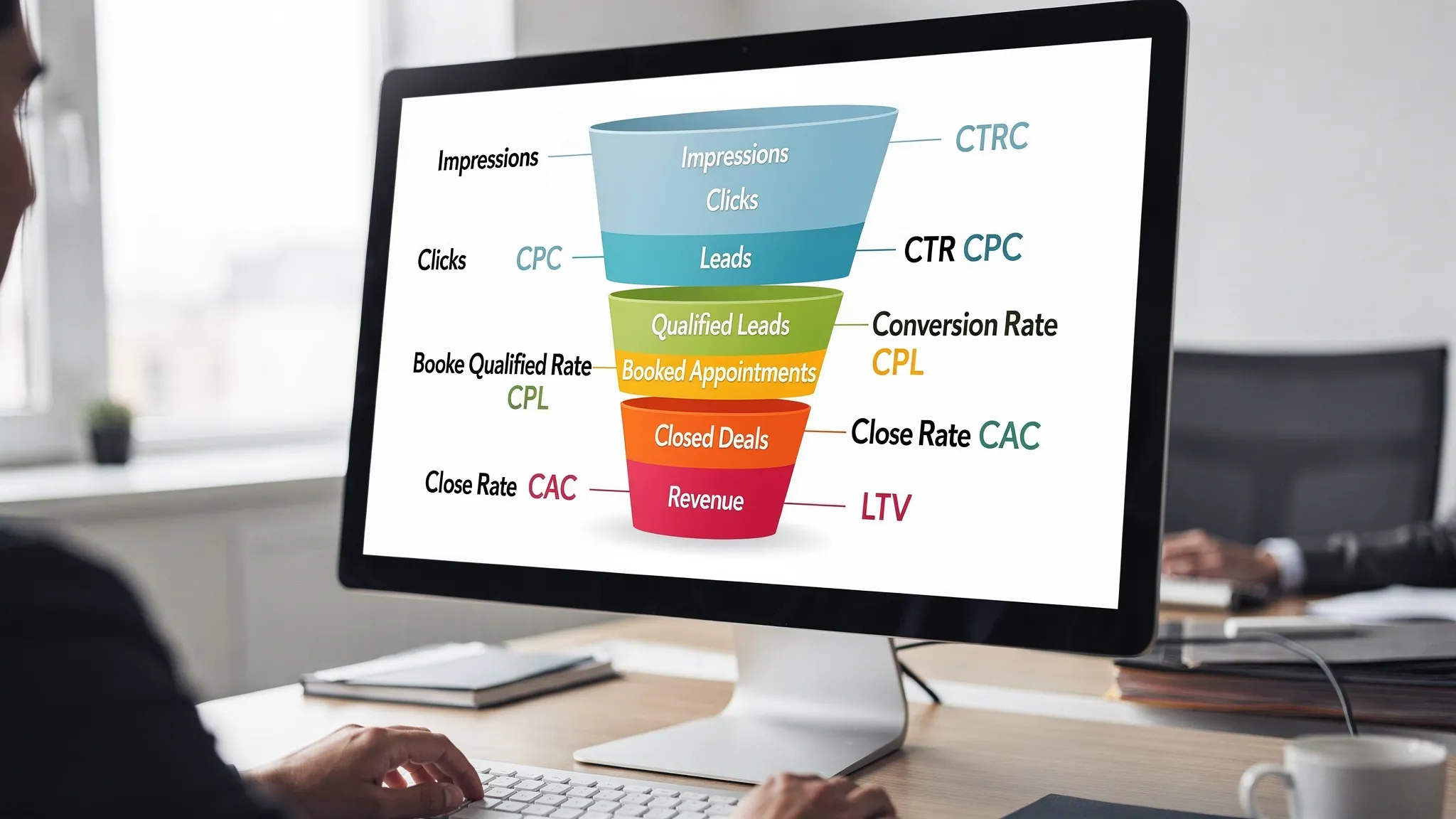
Funnel and sales metrics that predict revenue (especially for lead generation)
If your business depends on calls, forms, consult bookings, or quote requests, revenue is determined as much by follow-up as by ads.
Lead quality rate
Define a “qualified lead” in writing. Examples:
- Service area matches
- Budget minimum
- Clear intent (repair request, consultation, quote)
- Business size criteria (for B2B)
Then track qualified leads ÷ total leads. If CPL drops but qualified rate collapses, you did not improve performance.
Speed to lead
Speed-to-lead is one of the strongest predictors of booking and close rate for many service businesses.
If you cannot respond quickly, you will buy leads for competitors.
Booking rate and show rate
For appointment-based models:
- Booking rate: appointments booked ÷ qualified leads
- Show rate: attended appointments ÷ booked appointments
These two numbers often matter more than CTR, CPM, and CPC combined.
Close rate and time-to-close
For sales-led businesses:
- Close rate: customers ÷ qualified opportunities
- Time-to-close: median days from first touch to closed-won
A campaign that produces slower deals can hurt cash flow even if it looks good in-platform.
Attribution and tracking: your metrics are only as good as your instrumentation
Most “marketing reporting” breaks because conversions are under-tracked or misattributed.
Track the conversions that represent real business value
For local businesses and B2B, that usually means:
- Phone calls (and call quality, if possible)
- Form submissions
- Booked appointments
- Quote requests
- Offline revenue events (closed-won, invoice paid)
If you rely on Google Ads, set up proper conversion tracking and consider features like Enhanced Conversions when appropriate and compliant with your privacy policies.
Import offline conversions (if you have a sales process)
If leads close in a CRM, the most meaningful improvement you can make is importing offline outcomes back into ad platforms. That is how you stop optimizing for cheap leads and start optimizing for closed revenue.
Common approach:
- Capture a click ID (like GCLID) at the moment of lead
- Store it in your CRM
- Upload conversion events for qualified leads or closed-won deals
QA your tracking like it is production software
Broken forms, missing thank-you events, misfiring tags, and spam leads can destroy your metrics.
A simple but high-leverage tactic is to automate testing of form flows and email notifications. For example, developers and ops teams sometimes use programmable temp inboxes to validate that confirmation emails, lead alerts, and verification flows are being delivered correctly, then parse messages as structured data for monitoring.
Incrementality: the difference between “attributed” and “real” growth
Attribution answers “what got credit”, not always “what caused the sale”. That gap widens when you scale spend.
If you want to know what actually drives revenue, use at least one incrementality method as you grow:
- Holdout tests (pause a channel or audience segment briefly, when safe)
- Geo tests (run ads in some areas, not in others)
- Brand vs non-brand separation (avoid letting brand search soak up all the credit)
Even lightweight tests can prevent months of budget going to campaigns that only capture demand created elsewhere.
A practical dashboard for revenue-focused performance marketing
A dashboard should help you make decisions quickly, not just report.
Weekly: are we buying profitable demand?
Review:
- Spend by channel
- Qualified leads, bookings, or closed-won counts
- CAC (or cost per booked job, cost per closed-won)
- MER (or gross profit divided by marketing spend)
If you only have time for one view, make it this one.
Bi-weekly: where is the bottleneck?
Look for the stage with the steepest drop:
- Click to lead (landing page problem)
- Lead to qualified lead (targeting or offer mismatch)
- Qualified lead to booked (follow-up speed, scheduling friction)
- Booked to closed (sales process, trust, pricing)
Monthly: should we scale, fix, or cut?
Use month-level data to decide:
- Scale: stable CAC/payback, consistent lead quality, capacity to fulfill
- Fix: good demand but low conversion downstream (sales ops, landing page, offer)
- Cut: poor quality leads, weak economics, no path to improvement
The most common metric mistakes (and what to do instead)
Mistake: optimizing CTR or CPC as the goal
A low CPC can be a sign of weak intent. A high CTR can come from curiosity clicks.
What to do instead: optimize to qualified outcomes, even if CPC rises.
Mistake: reporting “leads” without quality
Volume hides waste. Especially for local businesses, spam and low-intent inquiries can inflate performance.
What to do instead: define and track qualified lead rate and cost per qualified lead.
Mistake: believing platform ROAS without offline data
If your revenue happens offline, platform ROAS is incomplete.
What to do instead: import offline outcomes and use MER plus unit economics as your truth set.
Mistake: ignoring capacity constraints
If your team cannot answer calls, book jobs, or fulfill work, performance marketing will look worse as you scale.
What to do instead: align spend with staffing, scheduling, and fulfillment capacity.
How this ties into your website and growth system
For many local businesses, the fastest path to better metrics is not a “new campaign”, it is a better conversion system:
- A fast, clear website that matches search intent
- Clean tracking for calls, forms, and bookings
- A follow-up process that turns leads into revenue
Kvitberg Marketing builds pre-built, professional, SEO-optimized websites for local businesses with no commitment upfront, then reviews the finished site in a short walkthrough so you can decide if you want it. If you choose to grow beyond the website, optional services like SEO campaigns and Google Search Ads management can be layered on, with performance measured against the revenue-driven metrics above.
If you want a simple next step, pick one revenue KPI (profit, CAC, payback, or booked jobs) and audit whether your current tracking can actually measure it. That single exercise usually reveals where revenue is leaking.