Proven Marketing Playbook for Local Businesses

Local growth in 2026 comes down to a simple equation: be the business people find first, trust fastest, and book without friction. This playbook turns that idea into a repeatable system you can run every quarter, whether you are a clinic, trades company, law firm, gym, or local agency.
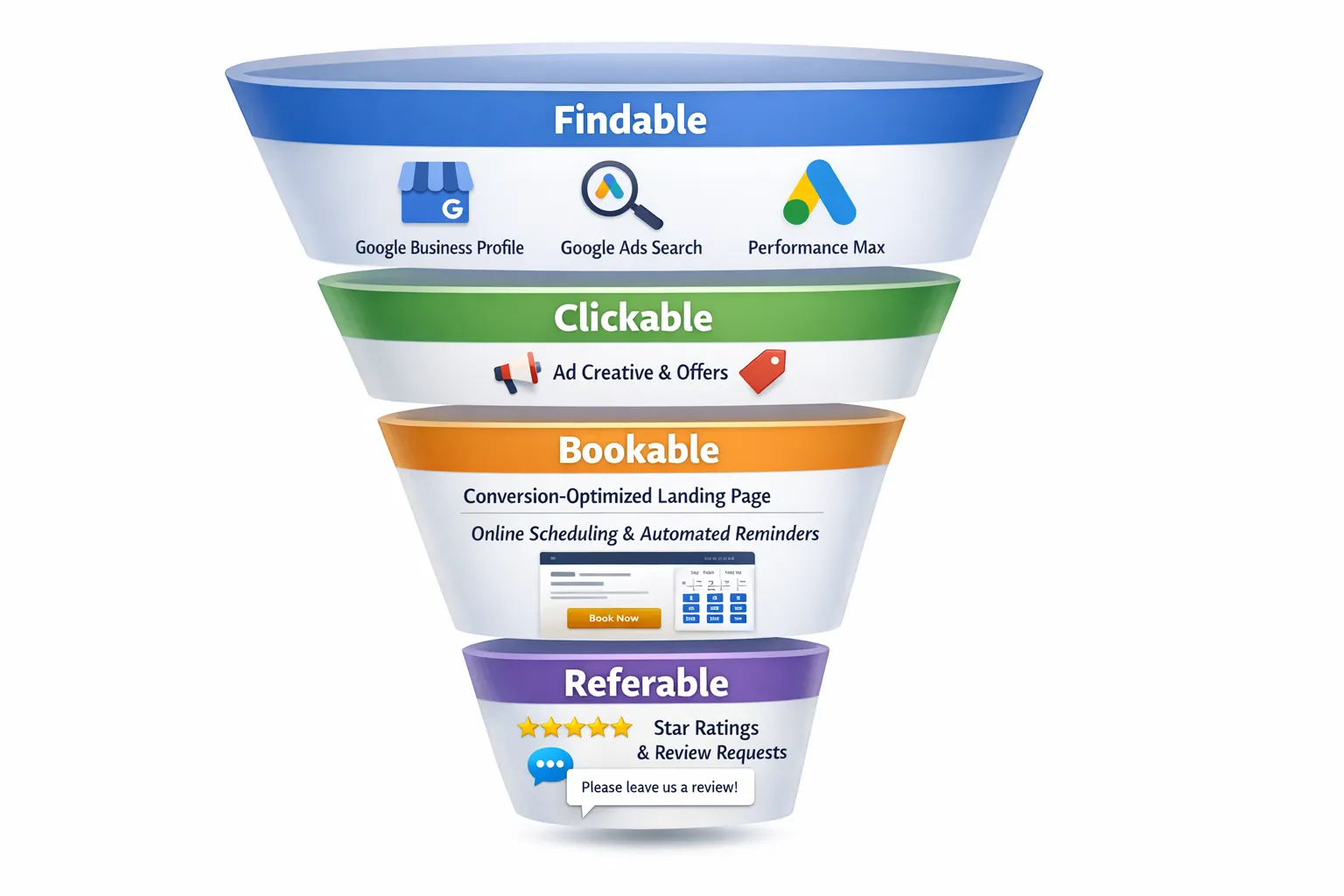
The local growth system: findable, clickable, bookable, referable
Think of local marketing as four connected pillars that feed each other.
Findable means you show up for high-intent local searches and discovery moments across your service area. Clickable means your next step is obvious, with messaging and offers that match what the searcher wants right now. Bookable means you remove friction so someone can call, request a quote, or schedule in seconds, with the right information captured and routed correctly. Referable means you systematically collect reviews, publish social proof, and bring back visitors who did not convert.
When these four pillars run in sync, you stop relying on one-off “campaigns” and start building compounding results that feel predictable.
Step 1: clarify ICP and offer before you buy traffic
Advertising only works when your message matches the moment. Before you spend on Google Ads or Meta, take a short pass at clarifying who you are really trying to win and what “yes” should look like.
Start with your ICP: the location you want to serve, who makes the decision, what pain triggers urgency, what budget expectations are realistic, and what objections show up in almost every sales conversation. This is also the time to map micro-geographies, the zip codes, neighborhoods, or districts where proximity and revenue overlap. In local markets, this matters because you can often improve close rates simply by prioritizing areas where your team can respond faster and show up reliably.
Then write a tight three-line offer you can reuse everywhere. A good local offer usually includes an outcome (what they get), a risk reducer (why it is safe to choose you), and a single call to action. For example, a plumber might go with: “Burst pipe? 60-minute emergency response in Oslo. No weekend surge pricing. Call now or book a slot.”
Once this is documented, it becomes the source of truth for keywords, ad creative, landing page structure, and follow-up messaging.
Foundation in 7 days: your digital storefront and tracking
Before you scale spend, get the basics live so you can both convert demand and measure what is driving revenue.
Google Business Profile
Your Google Business Profile is often your real homepage in local search. A strong profile increases visibility, improves click-through, and sets expectations before the visit.
Choose the most accurate primary category, add relevant secondary categories, and keep your NAP (name, address, phone) consistent everywhere. Build out hours, service area, and services, and upload original photos and short videos that reflect your real work. Posting weekly updates helps too, not because posts are magic, but because they keep your listing fresh and give customers new reasons to engage.
Use the Q&A section proactively by answering common questions in the language customers use. If you can respond quickly, messaging can be a conversion lever, but only turn it on if you can maintain response speed.
For the ranking levers you can influence, follow Google’s own guidance on improving your local ranking.
Website essentials
Your website does not need to be fancy, but it must be fast, mobile-first, and clear. For local services, clarity usually beats creativity.
Aim for one page per core service and per priority city or district, with unique copy and real proof (photos, cases, reviews, certifications). Put click-to-call, online booking, and your address or service area on every page so users do not hunt.
Add structured data where appropriate, especially LocalBusiness schema, to help search engines understand what you do and where you operate.
Compliance, analytics, and call tracking
In Norway, GDPR expectations apply. Your consent banner and tracking setup should be privacy aligned, and Datatilsynet guidance is a practical reference point.
From a measurement perspective, implement GA4 and Google Tag Manager with events for calls, form submissions, chats, and bookings. If possible, use Consent Mode so measurement remains privacy-safe while still useful.
Finally, add at least one tracked phone number so you can attribute calls by source. If you record calls, do it only with explicit consent and clear notice.
Landing pages that convert local demand
Every paid click (and many organic clicks) should land on a page that does four jobs in seconds: prove relevance, reduce risk, clarify the next step, and remove friction.
Relevance is about mirroring what the visitor searched or what the ad promised, including the city or district when it is genuinely part of your service promise. Risk reduction is where reviews, guarantees, badges, and real before/after photos do the heavy lifting. Next step clarity means a single primary CTA, usually “Call,” “Book,” or “Get a quote,” not three competing buttons. Friction removal is about short forms, minimal fields, and instant scheduling where it makes sense.
A practical structure most local businesses can reuse is: outcome-driven headline, short subhead that defines who it is for and where you serve, a strip of social proof, a plain-language problem/solution section, a short benefits section, a brief process timeline, and a final CTA with reassurance. If you add live chat or SMS, only do it if you can respond fast, because slow chat can hurt trust.
Paid acquisition sprint: a 30-day test that pays for itself
Start with intent and only layer discovery once you see early wins. In local marketing, “more reach” is rarely the first problem. “Wrong reach” is.
Google Ads: Search and Performance Max
Search is your baseline for high intent. Keep campaign themes consolidated enough to collect data, and structure ad groups around services rather than dozens of tiny clusters. If you are new and want control, start with phrase match, then expand toward broad match once you have strong negatives and conversion quality signals.
Use extensions aggressively, especially location extensions, callouts, structured snippets, and call extensions during business hours. Geo-targeting should reflect where you truly serve, including radius targeting and exclusions for areas you do not cover.
Performance Max can be helpful for incremental reach when your creative is solid and your conversion signals are clear. If you use it, provide audience signals, sitelinks, and good assets. Google’s help page on Performance Max is worth reading so you understand how automation allocates budget.
Negative keywords are non-negotiable. Maintain an ongoing list to filter out jobs, careers, DIY, “free,” and other non-commercial terms that waste budget.
Meta Ads: discovery and retargeting
Meta is strong for discovery and for retargeting, especially when the buying decision is emotional or visual (fitness, wellness, aesthetic services) or when you can make the first step extremely low friction.
Lead ads with Instant Forms can work well for quick quotes, while sending traffic to a booking page can be better when calendar context matters. Meta’s documentation on Instant Forms can help you choose the right setup and permissions.
Start targeting by location first, then layer interests and refine using lookalikes based on past customers (where available and compliant). Retargeting is often where you reclaim ROI, especially by nudging visitors with a simple offer like “Get an estimate today” or “Book the next available slot.”
Availability varies for some ad products across countries, so always confirm what is currently supported in your market.
Organic compounding: local SEO that stacks results
Paid gives you speed, but organic builds defensibility. Local SEO still comes down to relevance, proximity, and prominence.
Service and city pages work when they are genuinely unique and grounded in local proof, not copy-paste templates. A location page should include real photos, clear service boundaries, and examples of your work in that area.
Internal links help search engines connect your service relationships, for example linking a “Bathroom renovation” page to “Plumbing,” “Tiling,” and the relevant districts you serve.
Citations matter most when they are inconsistent. Audit and fix directory listings so NAP is identical everywhere, and focus on trusted Norwegian directories such as Gule Sider, 1881, and Proff.
Finally, keep a simple content rhythm: monthly posts answering buyer questions you already hear on calls. Those posts can feed your email nurture and become social snippets without extra creative work.
Reputation engine: reviews that drive ranking and clicks
Reviews are not only social proof. In local search, they are also a click-through lever, and they can influence how confident someone feels before they ever visit your site.
Consistency beats bursts. Build a process where you ask every happy customer within 24 hours, ideally via SMS or email with a direct link to your Google profile. Make it easy in person too, with QR codes at checkout and review links on receipts and follow-ups.
Reply to every review. Thank positive reviewers, and respond to negatives with calm problem-solving, because future buyers read your responses more than you think.
Stay compliant: do not gate reviews by asking only happy customers, and do not offer incentives. Google’s user contributed content policy explains what is allowed.
Booking and follow-up automation to increase show rates
You can often increase revenue without buying more clicks by improving speed-to-lead and reducing no-shows.
Routing matters first. If you can automatically send leads to the right person or calendar based on location, service, or value, you prevent delays and reduce handoff failures. Then layer reminders: confirmation, day-before, and one-hour-before messages with reschedule links. This simple operational change can lift show rates dramatically for appointment-driven businesses.
No-shows happen even in well-run systems, so build a lightweight workflow for quick rescheduling and a reconnection message. Aftercare messages can also improve retention and referrals, especially if they include clear instructions, warranty details, and a review request at the right moment.
If possible, connect your CRM, forms, and calendars so every lead is tracked from click to closed revenue.
Outbound for local B2B without spamming prospects
If you sell to other businesses in your city, outbound can add predictability, but only when it is targeted and respectful.
Start with account selection. Build a list of ideal businesses by industry, headcount, and location, then verify contacts and roles so you are not blasting generic emails. Deliverability matters too: warmed domains, correct SPF/DKIM/DMARC, and low volumes protect your sender reputation.
Messaging should be simple. One problem, one offer, and one clear next step tends to outperform long explanations. Add personalization that is actually relevant, such as a local context or a specific observation, not generic compliments.
A small multichannel sequence can work well: a short email, one LinkedIn touch, and a polite call, spaced several days apart. Track what matters, not vanity activity: reply rate, positive reply rate, booked meetings, and pipeline created.
The metrics that matter
Do not optimize for clicks. Optimize for revenue speed and lead quality.
| Stage | Primary KPI | What to watch weekly | Fix if weak |
|---|---|---|---|
| Findable | Qualified impressions in your service area | Search impression share, map views, directory visibility | Expand keywords, add locations, improve GBP content |
| Clickable | Click through rate to relevant pages | Ad copy click through, paid vs organic split | Tighten ad to page match, refresh assets, test offers |
| Bookable | Conversion rate to call or booking | Form submits, calls, booked slots, show rate | Shorten forms, faster response, clearer pricing, better reminders |
| Revenue | Cost per qualified booking and close rate | Pipeline value, win rate by channel | Refine qualification, coach sales, reallocate budget |
Where possible, add offline conversion tracking so ad platforms learn which leads become revenue, not just form fills. Both Google Ads and GA4 support offline conversion import when you pass a click identifier and later upload outcomes.
A practical 90-day plan
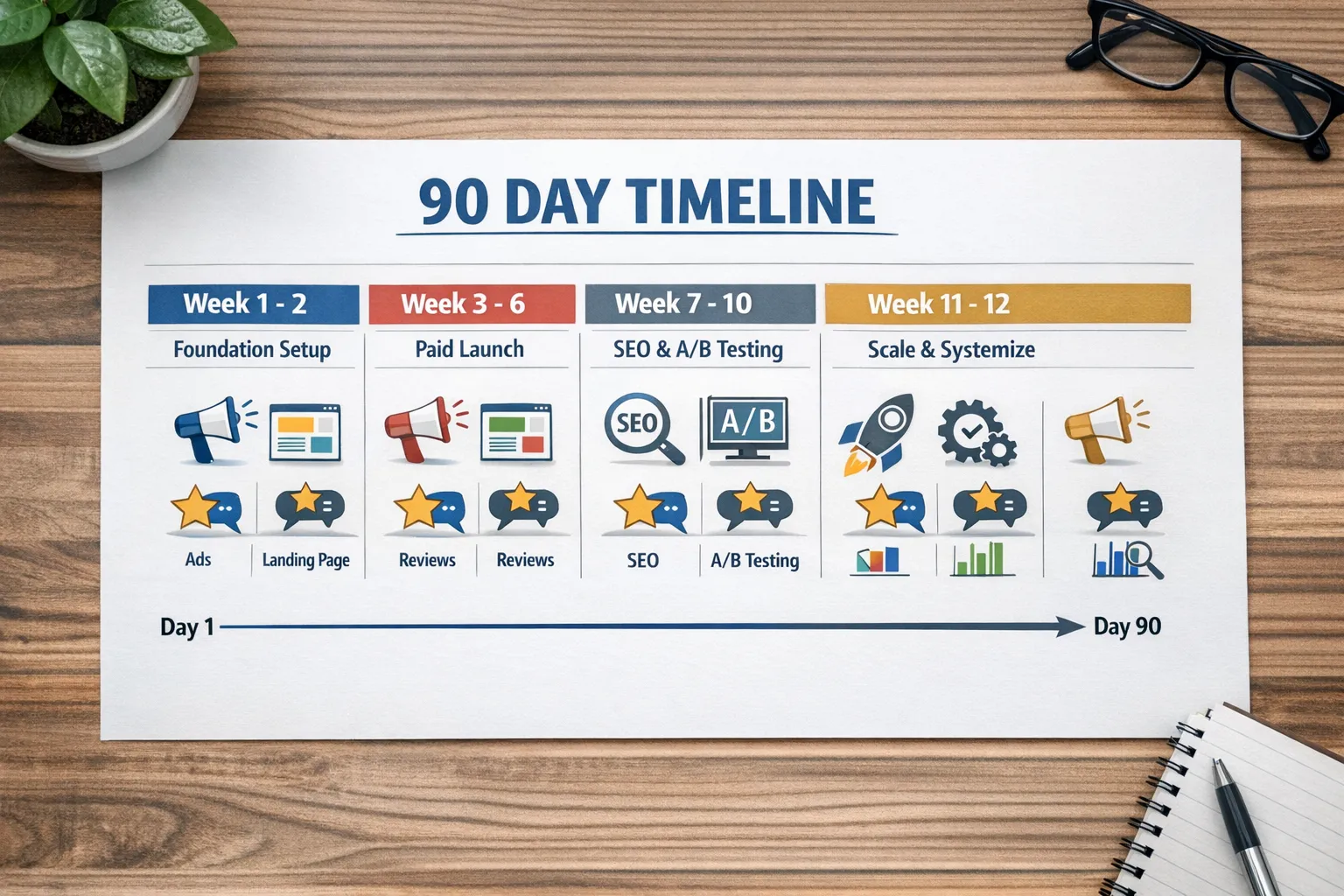
A plan only works if it is runnable. This timeline keeps the focus on what actually changes outcomes.
In weeks 1 to 2, lock the ICP and offer, finish your Google Business Profile, fix the website essentials, implement consent and analytics, confirm conversion tracking, and publish at least one conversion-ready landing page.
In weeks 3 to 6, launch Google Search, add Performance Max only if your creative and conversion signals are ready, launch Meta retargeting, start the review program, and implement basic booking and reminder automations.
In weeks 7 to 10, expand keywords based on real search terms, publish two high-quality service or city pages, test headlines and CTA placement, and add a simple email nurture for unbooked leads.
In weeks 11 to 12, evaluate performance by revenue created, scale what works, pause or fix what does not, and document learnings so the next quarter starts faster.
Common pitfalls to avoid
The fastest way to waste budget is to create friction or track the wrong outcome. Sending paid traffic to your homepage usually underperforms compared to a focused service page. Counting every form fill as a qualified lead distorts bidding and optimization. Over-fragmenting ad groups can also starve the algorithm of data.
Operationally, ignoring reviews until you get a negative one is a common and expensive mistake, as is using complex forms or replying slowly. Finally, do not scale spend before you can track revenue, not just clicks.
Useful references
If you want to go deeper using primary sources, these are the most relevant references from the platforms themselves and from reputable industry research.
- Google Business Profile guidance on improving local ranking
- Google Ads Help overview about Performance Max
- BrightLocal’s annual Local Consumer Review Survey
- Norway GDPR guidance from Datatilsynet
Turn the playbook into a system
If you want this running as a reliable machine instead of a one-off campaign, partner with a team that builds outbound and inbound systems end to end, from ICP and messaging to lead sourcing, booking automation, landing pages, qualification and routing, and continuous testing.
Kvitberg Marketing engineers premium AI automation and performance marketing for agencies and local B2B teams in Norway. If you want qualified meetings and predictable revenue without spamming prospects, you can learn more at Kvitberg Marketing.