Sales B2B Tactics That Book More Meetings

Most B2B teams do not have a “lead problem”, they have a meeting conversion problem. The list is messy, the message is generic, the follow-ups feel spammy, and when someone finally clicks, the next step is unclear.
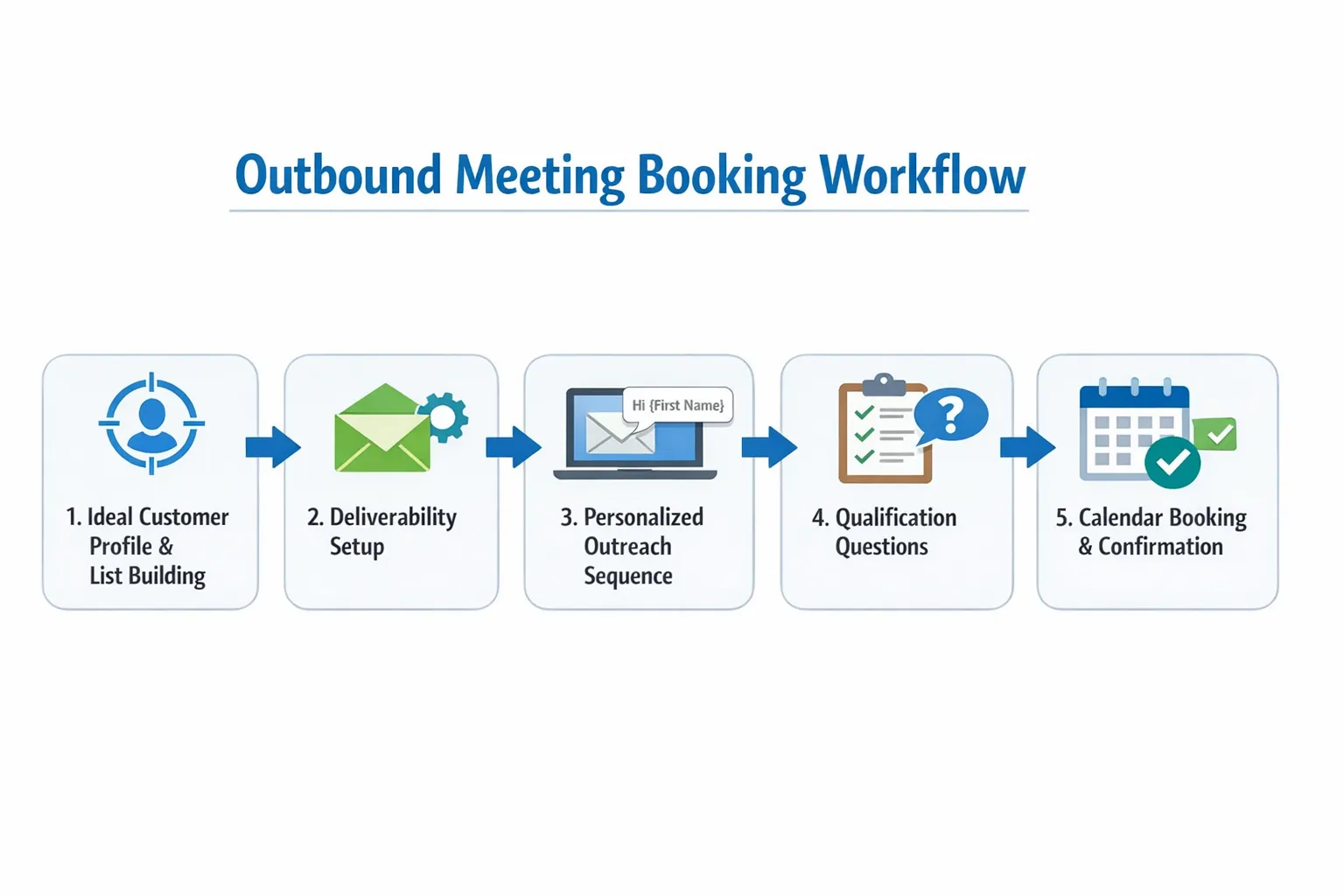
The good news is that booking more qualified meetings is rarely about finding a new “hack”. It is about building a repeatable outbound engine: the right ICP, clean targeting, deliverability, messaging that earns attention, and a conversion path that makes it easy to say yes.
What’s different about B2B meeting booking in 2026
A few trends have made old-school outbound less effective, and modern Sales B2B tactics more system-dependent:
- Inbox and spam filtering is stricter than it was even a couple years ago, and poor sending practices can quietly kill your reach.
- Prospects are over-sequenced. They have seen the same templates, the same fake personalization, and the same “15 minutes?” ask.
- Buying committees are larger, which means your message must land with multiple stakeholders or at least help your champion sell internally.
- Trust signals matter earlier. Prospects often check your site and LinkedIn before replying.
So the teams winning meetings are doing two things well: they (1) target narrowly and (2) make the reply decision easy.
Tactic 1: Define an ICP that is narrow enough to message clearly
“Anyone who could use our service” is not an ICP. It is a guarantee of bland messaging.
A practical ICP definition includes:
- Firmographics: industry, company size, geography, revenue range
- Trigger events: hiring, funding, tech changes, expansion, leadership changes
- Pain indicators: symptoms the buyer already feels (missed pipeline targets, low lead quality, long sales cycles)
- Internal roles: who owns the metric, who influences, who blocks
If you sell to multiple ICPs, do not force one sequence to fit all. Split by segment so your message can be specific.
Quick self-check
If you cannot finish this sentence in one breath, your ICP is too broad:
“We help [role] at [type of company] who are experiencing [pain] achieve [outcome] without [common objection].”
Tactic 2: Build lists that are small, accurate, and intentionally sourced
Most outbound underperforms because teams chase volume. A smaller list with the right targeting routinely outperforms a massive list with generic messaging.
Prioritize data quality over quantity:
- Use multiple sources to verify job title and current company
- Confirm the company actually matches your ICP (not just the SIC code)
- Capture a reason they are a fit (a trigger event, a relevant product line, a hiring signal)
If you sell in or to Europe (including Norway), remember that outreach may also involve GDPR considerations depending on your process and targeting. If you operate in the US, make sure your approach aligns with rules like the FTC’s CAN-SPAM guidance for commercial email.
Tactic 3: Fix deliverability before you “optimize copy”
If your emails do not land in the inbox, your copy does not matter.
While deliverability has many variables, the operational basics are consistent:
- Send from a domain and identity that makes sense (and matches your website trust signals)
- Keep your sending behavior steady and professional (avoid sudden volume spikes)
- Avoid obvious spam signals (overly aggressive language, misleading subject lines)
- Make it easy to opt out and keep your list clean
If your team is not sure whether deliverability is the problem, look for patterns:
- Low opens across all segments
- Few replies even when the offer is strong
- Prospects saying they “just saw this” after several touches
Tactic 4: Use a message structure that earns replies (not pitches)
Great outbound messaging is not about sounding clever. It is about reducing the mental load for the reader.
A reliable structure for booking meetings:
1) Context (why them, why now)
Tie your outreach to a real reason.
Examples of acceptable “why you” signals:
- They are hiring for a role your offer impacts
- They launched a new product line
- They expanded to a new market
- Their positioning suggests a pain you solve
Avoid fake personalization like “Loved your website”.
2) One painful problem (symptom-first)
Do not describe your solution yet. Describe the symptom they likely recognize.
Examples:
- “Strong traffic, but sales conversations are inconsistent month to month.”
- “Leads are coming in, but the team spends too much time disqualifying.”
3) A credible outcome (specific, not exaggerated)
Instead of huge promises, position a measurable improvement.
- “More qualified meetings booked from the same traffic.”
- “A cleaner handoff between lead capture, qualification, and scheduling.”
4) A low-friction question
Asking for “15 minutes” immediately can work, but it often performs better to ask a decision question first.
- “Open to seeing the workflow we use to turn replies into booked meetings?”
- “Worth a quick look if we can map this to your current funnel?”
Tactic 5: Write follow-ups that add value (and stop before you become noise)
Most sequences fail because follow-ups are just “bumping this” messages.
Each follow-up should introduce a new angle:
- A common root cause you see in their segment
- A simple diagnostic question
- A short teardown observation (one point only)
- A relevant case pattern (avoid naming clients if you cannot disclose)
A healthy rule: if you cannot add something new, do not send the follow-up.
Tactic 6: Add a conversion layer (landing page + qualification + calendar routing)
Even when a prospect is interested, deals die in the gap between “sounds interesting” and “book a time”.
Your goal is to make the next step obvious and safe.
What a meeting-booking landing page should do
A conversion-focused page for outbound traffic is not your homepage. It should:
- Restate the problem in the prospect’s words
- Explain the outcome and who it is for
- Show your process at a high level (simple, not a wall of text)
- Provide proof signals (logos, snippets, frameworks, or clear experience claims you can back up)
- Make the CTA crystal clear
Qualification and calendar routing
If you sell a higher-ticket B2B service, you usually want a light qualification step before the calendar.
Good qualification feels like:
- “Help me route you to the right person”
- “Make sure this is relevant before we take a meeting”
Not:
- A 20-field form that kills momentum
Kvitberg Marketing’s outbound systems, for example, are positioned around automating client acquisition, meeting booking, and conversion workflows without spamming prospects, which is exactly the type of end-to-end thinking that prevents leakage between reply, qualification, and booked meeting.
Tactic 7: Use multichannel touches, but keep it coordinated
Email alone can work, but coordinated touches often lift reply rates because prospects recognize you across surfaces.
A practical multichannel approach:
- Email for the main narrative
- LinkedIn for light reinforcement (profile credibility, short connection note if appropriate)
- Retargeting ads only if you have the volume and proper setup (and you are not violating privacy rules)
The key is coordination. If your LinkedIn message is a different pitch than your email, it feels automated and disconnected.
Tactic 8: Offer a meeting that has a clear outcome
Many Sales B2B teams invite prospects to a vague “intro call”. That creates uncertainty.
Instead, name the meeting by outcome:
- “Pipeline audit and meeting bottleneck review”
- “Outbound system teardown and quick wins”
- “Lead-to-meeting workflow review”
And set expectations:
- What you will review
- What they should bring (optional)
- What they will leave with
This is not fluff. It increases attendance and reduces no-shows because the meeting feels useful even if they do not buy.
Tactic 9: Track the metrics that reflect meeting quality (not vanity)
If you only track “meetings booked”, you will optimize for the wrong thing.
Track the full chain: targeting quality, reply quality, show rate, and pipeline impact.
Here is a practical scorecard you can use.
| Funnel stage | What to measure | Why it matters | What “good” looks like (directionally) |
|---|---|---|---|
| Targeting | % of accounts matching ICP | Bad ICP fit creates fake volume | Higher is better |
| Deliverability | Reply rate relative to sends | Helps detect inboxing issues | Stable or improving |
| Messaging | Positive reply rate | Measures message-market fit | Higher is better |
| Booking | Booked meetings per positive reply | Shows booking friction | Higher is better |
| Attendance | Show rate | Indicates meeting value and reminders | Higher is better |
| Qualification | % qualified meetings | Protects sales time | Higher is better |
| Revenue | Pipeline created per meeting | Keeps outbound tied to business impact | Higher is better |
If one metric is weak, fix that stage rather than rewriting everything.
Tactic 10: A/B test one variable at a time (and keep a learning log)
Outbound improves fastest when you treat it like performance marketing: small tests, controlled variables, and consistent documentation.
Good things to test:
- ICP segment (industry A vs industry B)
- One opening line style (trigger-based vs pain-based)
- CTA type (question-first vs direct booking)
- Landing page CTA (book directly vs qualify then book)
Avoid testing too many things at once. You will not know what caused the lift.
Common mistakes that silently kill meeting volume
Mistake 1: Asking for a meeting before earning relevance
If your first message is 80 percent about you, the prospect will ignore it.
Mistake 2: Over-automation without control
Automation is valuable, but sequences still need human quality control: list accuracy, personalization integrity, and reply handling.
Mistake 3: No reply handling process
Booking meetings is not only about sending. It is also about what happens after a reply.
If responses sit for hours, or the reply tone is mismatched, you lose momentum.
Mistake 4: Sending prospects to a generic homepage
If the prospect has to figure out the next step, they often will not.
Frequently Asked Questions
What are the most effective Sales B2B tactics to book more meetings quickly? The fastest wins usually come from tightening ICP targeting, fixing deliverability basics, and using a message that leads with a relevant context plus a low-friction question. If interested replies do not convert into booked calls, improve your conversion path with a clear landing page and simple qualification plus calendar routing.
Should I ask for a meeting in the first message? Sometimes, but it often works better to ask a smaller commitment question first (for example, if they are open to seeing a workflow or teardown). This reduces pressure and increases replies, then you can move naturally to scheduling.
How many follow-ups should I send in a B2B outbound sequence? There is no universal number, but you should stop when you can no longer add a new, helpful angle. Repeating the same message creates spam signals and damages brand trust.
Why do we get replies but not booked meetings? The usual causes are unclear next steps, too much friction (long forms), slow reply handling, or a calendar experience that does not match the promise of the message. Tighten the handoff between reply, qualification, and booking.
Do I need a landing page for outbound? If you sell a considered B2B service, a dedicated page often helps prospects validate you quickly. It should match the outreach message and make the CTA obvious.
Build a predictable meeting engine (without spamming)
If you want more qualified meetings, the biggest lever is not another template. It is a system: clean targeting, deliverability, messaging, follow-up workflows, and a conversion path that turns interest into booked time.
Kvitberg Marketing engineers outbound client acquisition and automated meeting booking systems for agencies and B2B teams (with deliverability setup, ICP and messaging development, landing pages, qualification, and ongoing optimization). If you want a predictable approach to booking meetings that protects your brand, explore working with Kvitberg Marketing.