Strategy for Advertising: Build a 2026 Plan That Scales

If your advertising feels harder to scale in 2026, you are not imagining it. Costs rise faster than patience, tracking is less straightforward than it was a few years ago, and customers bounce between Google, social, email, and AI-assisted search summaries before they ever call you. The upside is that businesses that build a real strategy for advertising (not just a set of campaigns) can create a predictable system that compounds.
This guide shows you how to build a 2026 advertising plan that scales, whether you run a local service business in Norway, the US, or both.
What “strategy for advertising” means in 2026
In 2026, an advertising strategy is not “we run Google Ads and post on Facebook.” It is a documented plan that connects:
- Business outcomes (revenue, profit, pipeline quality)
- Target buyers (who you want, who you can serve best)
- A clear offer (why someone should choose you now)
- Channels (where you will reach people, and why)
- Measurement and feedback loops (what you will track, how you will improve)
The difference between “campaigns” and “strategy” is simple:
- Campaigns spend money to get clicks.
- Strategy builds a system that turns attention into leads, and leads into customers, repeatedly.
Step 1: Set goals that force clarity (and stop vanity metrics)
Before you pick channels or budgets, define success in business terms. Most local businesses can get 80 percent of the benefits with three numbers:
- Monthly qualified leads (calls, form submissions, booked appointments)
- Close rate (how many leads become customers)
- Average gross margin per job (or contribution margin)
From there, you can back into a realistic cost per lead target.
Example (simple math, not a promise): if you need 20 new jobs/month, close 25 percent of qualified leads, you need 80 qualified leads/month. If your margin per job supports $200 per lead profitably, you have a benchmark to guide channel selection and landing page investment.
Step 2: Decide what you are truly selling (offer architecture)
Scaling is easier when your offer is easy to understand and easy to say yes to. In 2026, “we do everything” often underperforms “we solve this one painful problem fast.”
A scalable local-business offer usually has:
- A clear primary service (the main profit engine)
- A fast-start entry point (inspection, consultation, starter package, first-time offer)
- A proof mechanism (case studies, reviews, before/after, guarantees you can actually honor)
If your advertising is underperforming, it is often not because your targeting is wrong. It is because your offer is not specific enough to convert.
Step 3: Build a measurement plan that matches 2026 reality
Attribution is tougher than it used to be, and it varies by channel. That does not mean you should fly blind. It means your measurement plan needs structure.
At minimum, you want:
- Clean lead tracking (calls, forms, booking events)
- A source of truth (usually GA4 plus CRM or lead logs)
- Offline conversion feedback (which leads became sales, and the value)
If you work with an agency or you are evaluating one, use a deliverables checklist that is built for 2026. This guide on what a digital marketing agency should deliver in 2026 is a strong reference because it emphasizes privacy-ready tracking, integrated channel planning, CRO, and governance rather than vanity metrics.
Practical measurement guidance for local businesses
You do not need perfection to scale, but you do need consistency.
- Track every lead with a timestamp, source, and outcome (won/lost).
- Use call tracking if calls matter to your business.
- Treat “qualified lead” as a defined category, not a feeling.
Here is a simple scorecard you can use across Norway and the US:
| Metric | What it answers | How often to review | Why it matters for scaling |
|---|---|---|---|
| Qualified leads | Are we generating demand? | Weekly | Scaling only works with volume |
| Lead-to-sale rate | Are leads the right fit? | Monthly | Poor fit increases costs fast |
| Cost per qualified lead | Are we buying efficiently? | Weekly | Keeps budgets grounded |
| Cost per acquisition (CPA) | Are we profitable? | Monthly | Prevents “growth at any cost” |
| Time-to-first-response | Are we wasting leads? | Weekly | Speed is a conversion lever |
Step 4: Choose channels based on intent, not trends
A scalable advertising plan usually includes more than one channel, but not necessarily many. The best channel mix depends on how people buy.
A useful way to choose is to map channels to intent:
| Channel | Best for | Typical strength in 2026 | Watch-outs |
|---|---|---|---|
| Google Search Ads | High-intent demand capture | Fast lead generation | Limited by search volume, requires strong landing pages |
| Local SEO | Durable visibility for “near me” and service terms | Compounds over time | Requires consistent content, reviews, and technical basics |
| Meta Ads (Facebook/Instagram) | Demand creation and retargeting | Great creative testing | Lead quality varies by offer and follow-up |
| Remarketing | Converting warm traffic | High ROI when set up well | Needs enough traffic to work |
For many local businesses, the scaling path is:
- Capture existing demand (Search + local landing pages)
- Convert better (website, proof, follow-up)
- Expand reach (Meta, YouTube, partnerships)
- Increase lifetime value (email/SMS, referrals, repeat services)
Step 5: Make your website the “conversion engine” (not a brochure)
In 2026, your ads are only as good as the page they send people to. If your site is slow, unclear, or generic, your cost per lead rises no matter how well you optimize campaigns.
A scalable local-business landing experience typically includes:
- One primary goal per page (call, form, booking)
- Service-area clarity (cities, regions, neighborhoods)
- Proof close to the call-to-action (reviews, certifications, before/after)
- Friction removal (pricing ranges when appropriate, FAQs, what happens next)
- Fast load times and mobile-first layout
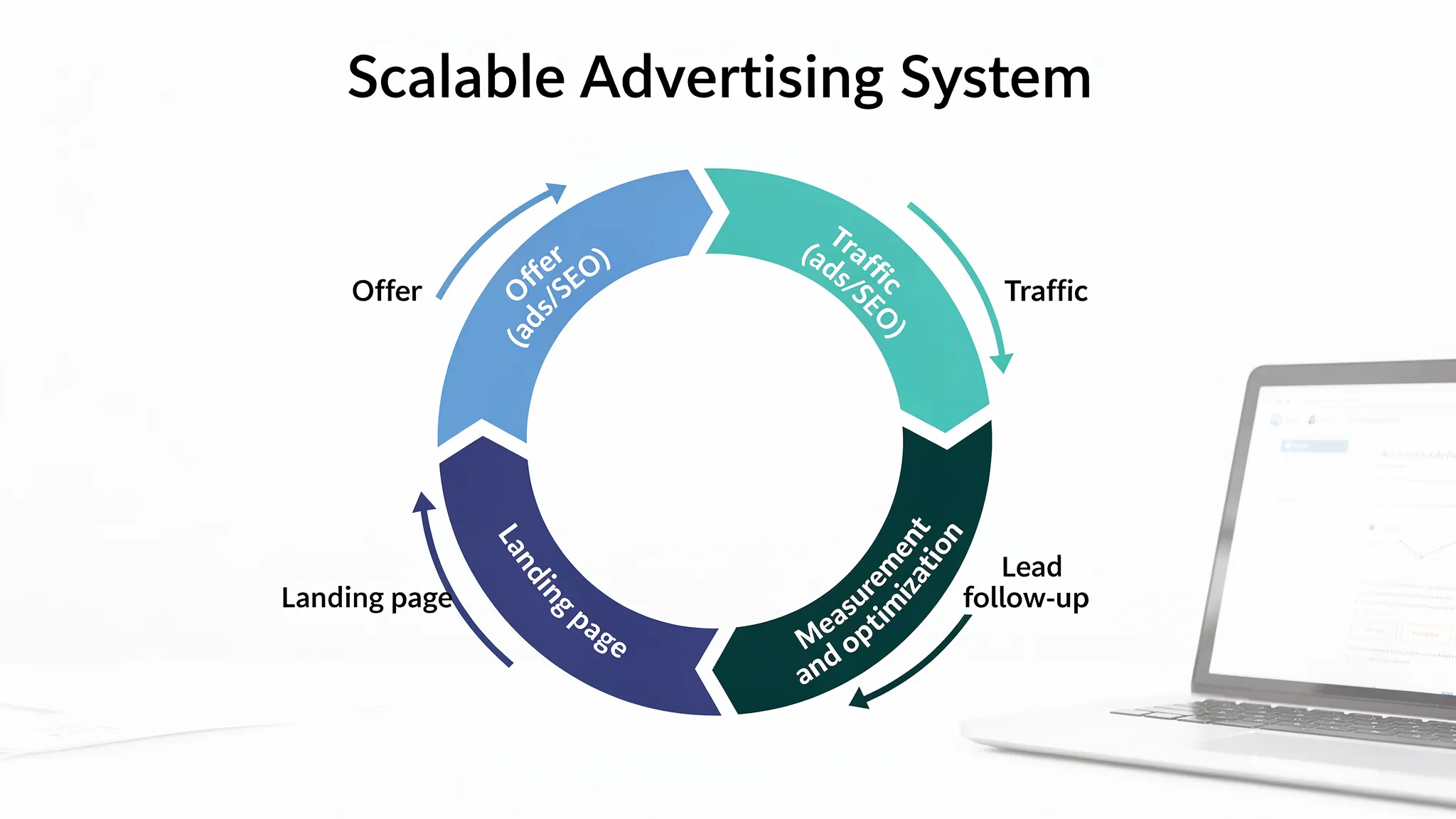
A practical option if your website is the bottleneck
Many local businesses know the site is holding them back, but they delay fixing it because rebuilding feels expensive and risky.
Kvitberg Marketing offers a different approach: a free, finished website build for local businesses (SEO-optimized and professionally designed), with no upfront commitment. You review the completed site in a short walkthrough meeting and only decide to buy if you like the result. If your 2026 advertising plan depends on stronger conversion rates, this kind of low-risk upgrade can remove a major constraint.
Step 6: Build a creative system you can produce every month
In 2026, creative is not a one-time project. It is a system.
Even for “boring” local services, creative is what explains:
- What you do
- Who it is for
- Why you are different
- What the next step is
To scale, you need a repeatable way to generate variations. A simple structure that works across Google and Meta is:
- Problem-first: “If your [symptom], here is the fastest fix.”
- Process: “How our [service] works in 3 steps.”
- Proof: reviews, photos, mini case studies
- Offer: clear, time-bound when appropriate, but honest
Avoid the trap of making everything about you (“we are passionate”). Make it about outcomes and risk reduction.
Step 7: Design the follow-up process before you increase spend
Most scaling failures are not ad failures. They are follow-up failures.
If you double spend without tightening your response system, you often get:
- More leads that never get contacted
- More unqualified leads you do not filter
- Lower close rates, which makes ads “look worse”
In both Norway and the US, speed matters. Build a basic lead handling playbook:
- Respond quickly during business hours
- Use a consistent script (qualify, confirm need, propose next step)
- Track outcomes in a spreadsheet or CRM
- Identify the top 3 disqualifiers (budget, location, timeline) and ask early
If you are using automation, keep it human-friendly. Automations should reduce delay and prevent lost leads, not spam people.
Step 8: Plan budget like an investor, not a gambler
Scaling is not “increase budget and hope.” It is staged.
A practical 2026 budget framework:
- 70 percent on what is already working (proven campaigns, highest-intent keywords, best audiences)
- 20 percent on iterative improvements (new creatives, landing page tests, new service pages)
- 10 percent on experiments (new channel, new offer angle, new market)
This keeps performance stable while still creating upside.
How long should you test before judging results?
As a rule of thumb for local lead gen:
- Give new campaigns enough time to collect meaningful lead data.
- Judge based on qualified leads and booked jobs, not clicks.
The exact window depends on your market size and lead volume. A rural area in Norway will need longer than a major US metro. The key is to set the evaluation window upfront, so you do not “optimize” emotionally.
Step 9: Build a 90-day plan you can actually execute
A scalable advertising strategy should fit inside a 90-day operating rhythm. Here is a practical blueprint.
| Timeline | Primary objective | What you build | What you measure |
|---|---|---|---|
| Days 1 to 30 | Fix the foundation | Offer clarity, conversion pages, tracking plan, follow-up process | Qualified leads, response time, baseline CPL |
| Days 31 to 60 | Improve efficiency | Keyword/audience refinement, creative iterations, landing page improvements | CPL trend, lead quality, close rate |
| Days 61 to 90 | Start scaling | Budget increases on winners, add retargeting, expand geo/services cautiously | CPA, profit per job, capacity utilization |
If you cannot describe what will be different by day 90, you do not have a strategy yet.
Step 10: Scaling rules (so growth does not break your business)
Scaling advertising is also scaling operations. Local businesses hit limits fast: staffing, scheduling, inventory, travel time, customer service.
Use these scaling rules:
- Do not scale spend faster than your ability to serve. A campaign that works can still hurt you if fulfillment collapses.
- Expand one dimension at a time. New city, new service, or new channel, not all three at once.
- Protect your best segment. If one service type has higher margins and fewer headaches, design ads and landing pages to attract more of that segment.
- Treat conversion rate like a growth lever. Improving conversion rate often scales more safely than increasing budget.
A simple example: one scalable strategy for advertising (local services)
Imagine a local business that serves a 30 to 60 minute radius, common in both Norway and many US regions.
A scalable plan could look like:
- Google Search Ads to capture immediate demand for core services
- A dedicated landing page per core service (with proof and clear service area)
- Local SEO to reduce reliance on paid traffic over time
- Meta retargeting to convert site visitors who are comparing options
- A structured follow-up process to improve close rates
This works because it balances quick wins (Search) with compounding growth (SEO), and it uses remarketing to reduce wasted clicks.

Common mistakes that stop advertising from scaling in 2026
Measuring the wrong thing
If your reports focus on impressions and clicks, you will scale activity, not results. Bring everything back to qualified leads, CPA, and profit.
Sending all traffic to the homepage
Homepages rarely answer a specific intent. Service pages and focused landing pages usually scale better.
Trying too many channels at once
More channels means more complexity. Win on one, stabilize, then expand.
Treating creative as decoration
Creative is your sales argument. In competitive markets, it is often the difference between expensive and profitable.
Ignoring operations
If you cannot answer the phone, follow up quickly, or handle the volume, scaling ads will expose the weakness.
Frequently Asked Questions
What is the best strategy for advertising for a local business in 2026? The most reliable approach is to combine demand capture (often Google Search Ads) with strong conversion pages and a follow-up process, then build compounding visibility with local SEO. Once you have consistent lead quality, add remarketing and test new creative angles to scale.
How much should a small business spend on advertising to scale? There is no universal number, but you can reverse-engineer it from your goals: required jobs, close rate, and acceptable cost per acquisition. Start with a controlled test budget, prove lead quality, then increase spend in steps while monitoring CPA and capacity.
Should I focus on SEO or paid ads in 2026? If you need leads quickly, paid search is often the fastest. If you want long-term cost reduction and durable visibility, SEO is essential. Many businesses scale best with both, paid for speed and SEO for compounding returns.
Why do my ads get clicks but not leads? Usually the landing page and offer are not aligned with the visitor’s intent, or the page lacks proof and clarity. It can also be a follow-up issue, where leads come in but are contacted too late.
How do I know if my advertising tracking is good enough? If you can consistently answer “which channel produced this lead,” “was it qualified,” and “did it turn into revenue,” you are in a strong position. You do not need perfect attribution, but you need dependable lead-to-outcome tracking.
Want a 2026-ready advertising plan with a website that converts?
If your current site feels like the bottleneck, or you are not confident it is built to convert paid traffic, Kvitberg Marketing can help. We build high-quality, SEO-optimized websites for local businesses for free, with no upfront commitment. You review the finished site first, then decide whether you want to buy it, plus optional growth services like SEO campaigns and Google Search Ads management.
Explore Kvitberg Marketing and submit an inquiry at kvitbergmarketing.com.